A guide to building an IT strategy roadmap with examples for CIOs and business leaders.
Guide
Jul 21, 2026
Technology can either drive growth or hold it back. The difference comes down to planning so you can equip your business and your people with the best tools available, purpose-built to conquer your roadblocks and achieve big goals.
This guide breaks down what an IT strategy roadmap is, why it matters, and how businesses across industries can build one that turns technology into a genuine competitive advantage.
What Is an IT Strategy Roadmap?
Let’s start high level: what is an IT strategy roadmap?
An IT strategy roadmap is a strategic planning document that maps out how technology initiatives will support and advance a business' broader goals over a defined period of time. It translates high-level objectives (like scaling operations, improving security, or entering new markets) into a sequenced, actionable plan for technology investment and execution.
Types of IT Strategy Roadmaps
Not all roadmaps look the same. The right type depends on what a business is trying to solve:
Project roadmaps track the rollout of a specific initiative, like an ERP implementation, from kickoff to completion
Architecture roadmaps outline how core systems and technologies will evolve to support long-term scalability
Application roadmaps plan the lifecycle of business software—new deployments, integrations, upgrades, and sunsets
Infrastructure roadmaps chart the evolution of hardware, networks, and cloud environments that keep everything running
Together, these roadmap types give leadership a clear, coordinated view of where technology is headed.
IT Strategy vs. IT Roadmaps
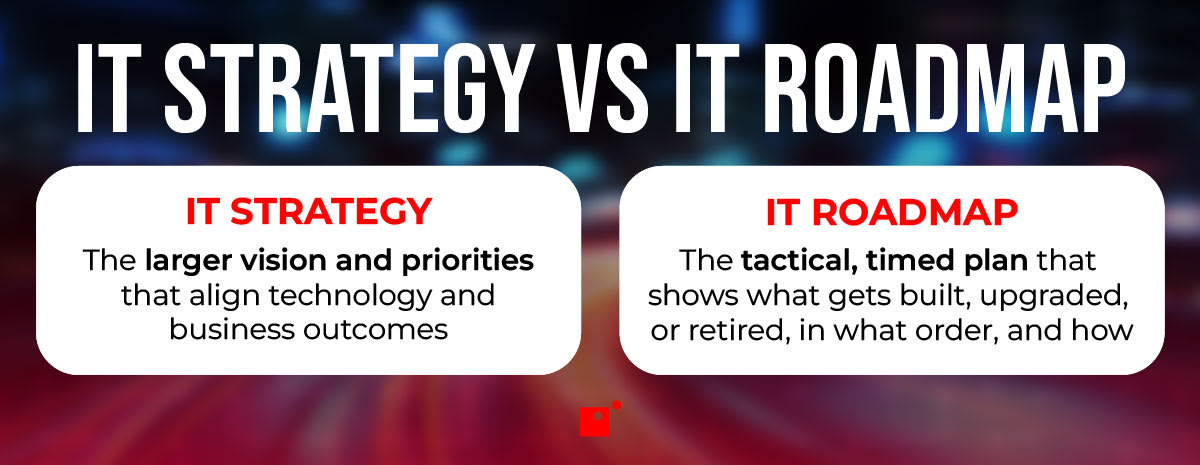
It's worth distinguishing IT strategy from IT roadmap.
IT strategy is the "why": the overarching vision and priorities that align technology with business outcomes
IT roadmaps are the "how" and "when": a tactical, time-bound plan that shows what gets built, upgraded, or retired and in what order
The Cost of Operating Without an IT Strategy
Without a roadmap, IT decisions tend to happen in isolation. One department adopts a new tool, another patches a problem with a quick fix, and nothing connects to a larger plan.
Over time, this disjointed decision-making creates a patchwork of systems that don't talk to each other and slow the business down.
That fragmentation also hits the bottom line. Teams end up purchasing overlapping tools, paying for underused licenses, or rebuilding what already exists elsewhere—leading to budget waste and costly redundancies.
One of the most devastating effects of having no IT roadmap or strategy is that it makes your business reactive in nature.
In IT, it looks like a break/fix model where you only fix issues as they come up, introducing more downtime into your operations. Plus, your tech is typically outdated and unsupported because nobody has been assigned to think about the future.
This reactivity becomes a cybersecurity problem, too. Without a roadmap to guide proactive investment, IT teams are left reacting to threats as they emerge instead of building defenses ahead of time, leaving the business exposed which is expensive and risky.
Perhaps most costly of all, businesses without a roadmap miss chances to use technology as a growth driver—falling behind competitors that plan ahead.
Why Every Organization Should be Building an IT Strategy Roadmap
A well-built IT strategy roadmap turns technology from a cost center into a growth engine by helping businesses cover key gaps in their operations, stay secure, and make it easier than ever for people to do their best work.
Here’s how an IT strategy helps businesses achieve growth goals and avoid stagnation:
Align technology with business goals—Every tech investment is tied directly to broader objectives, ensuring IT effort supports where the business is actually headed rather than operating in a silo
Enable smarter budget allocation—With a clear plan in place, leaders can prioritize spending on what matters most, avoid redundant tools, and forecast costs with far greater accuracy
Allow for better, smarter work—An IT strategy keeps updated, high-quality technology in the hands of your doers, allowing them to work more efficiently without roadblocks or bottlenecks
Strengthen cybersecurity posture—A roadmap builds security into the plan from the start, allowing organizations to get ahead of threats rather than scrambling to respond after the fact
IT Strategy Frameworks and Operating Models Used by Businesses
Building a roadmap is easier with the right frameworks to guide the process. Three models are especially noted as being useful to businesses across industries and sizes:
IT maturity models help businesses assess where they currently stand from ad hoc, reactive IT practices to fully optimized, strategically-driven operations. Understanding this baseline shows leaders exactly where gaps exist and what to prioritize firs
IT operating models define how technology gets delivered across the organization: who owns which decisions, how IT collaborates with other departments, and whether functions are centralized, decentralized, or hybrid. Choosing the right model ensures the roadmap can actually be executed, not just planned
IT governance frameworks (like COBIT or ITIL) provide structure for decision-making, risk management, and accountability. They set the rules of the road for how technology investments are approved, measured, and adjusted over time
Together, these frameworks give businesses a common language and structure for building a roadmap that's realistic, well-governed, and built to evolve alongside the organization.
Step-By-Step: How to Start Building an IT Strategy Roadmap
Creating an effective IT roadmap doesn't happen overnight, it's a deliberate process built in stages.
Assess the current state: Start with an honest audit of existing systems, infrastructure, applications, and security posture. Identify what's working, what's outdated, and where gaps exist between current capabilities and business goals.
Build the strategy and include everyone: A roadmap shouldn't be built in an IT vacuum. Bring in leadership, department heads, and end users to understand real pain points and priorities. The most effective roadmaps are thorough, accounting for budget, timelines, risk, and dependencies across the entire organization, not just the tech team's wish list.
Execute with clear, recorded guidelines: A strategy is only as good as its execution. Translate the roadmap into clear, documented processes with clearly labeled responsibilities so the plan gets followed day to day, not just referenced once and shelved.
Check in regularly: Business needs and technology both shift constantly. Schedule consistent reviews (quarterly is a common cadence) to track progress against milestones and catch issues early.
Optimize as you go: Whether you meet up yearly or quarterly, you should continue to optimize your roadmap as your business, goals, and needs change. Use what's learned from each check-in to refine priorities, adjust timelines, and reallocate resources. A roadmap is a living document, not a one-time deliverable. The businesses that get the most value from their IT roadmaps treat it as something to continuously improve.
How Businesses Measure Success in their IT Strategy Roadmaps
A roadmap is only valuable if its impact can be measured and its ROI proven. Tracking the right metrics turns IT from a black box into a function leadership can evaluate and trust.
Start with KPIs that tie directly to business outcomes. Think system uptime, help desk response times, security incident frequency, employee productivity gains, or time-to-deployment for new tools.
The right KPIs will vary by organization, but they should always map back to the goals set in the original strategy.
Remember that measuring IT ROI goes beyond cost savings. Look at both hard returns (reduced downtime, lower licensing costs, fewer redundant tools) and soft returns (improved employee experience, faster decision-making, better customer service).
Comparing costs before and after roadmap implementation helps quantify whether investments are paying off and helps with the next step: budget planning.
Budget planning should be built into the measurement process from the start. Set aside funds for ongoing evaluation and implementation and revisit allocations regularly based on what the data shows.
Businesses that build flexibility into their budgets can shift resources toward what's working and away from what isn't, keeping the roadmap financially sustainable as needs evolve.
IT Strategy Roadmap Examples
Although the process of building an IT strategy roadmap can be consistent across most businesses, the details that make up your strategy roadmap must be unique to your business. It’s important to understand that no two should look alike. The right plan depends on an organization's specific operations, risks, and growth goals.
To help visualize this, here are some examples of how a roadmap might take shape across three very different industries.
It Strategy Roadmap Example for Manufacturing
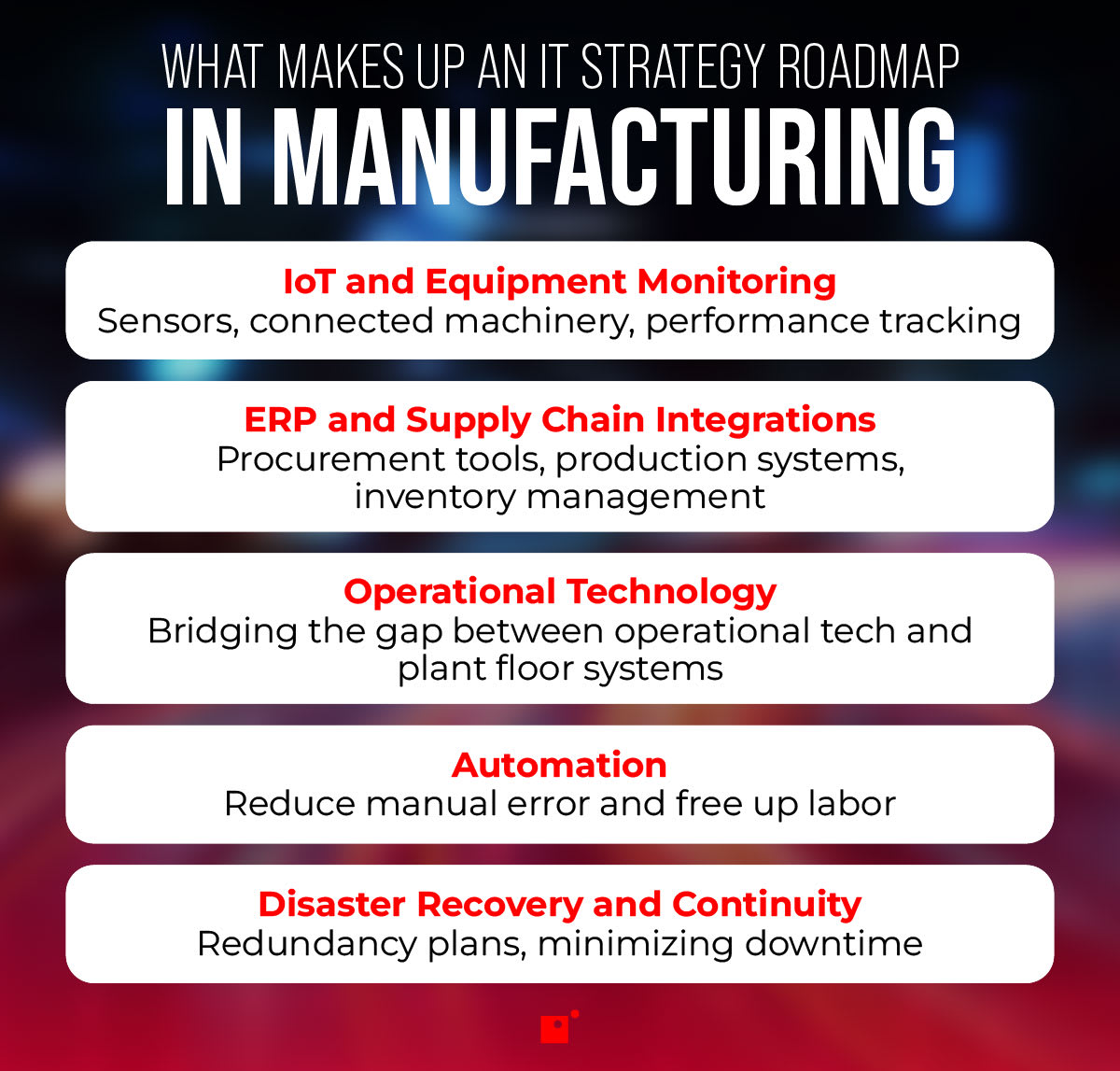
Manufacturers rely heavily on connected equipment across a factory floor, tight supply chains, and production uptime, so their roadmap priorities often include:
IoT and equipment monitoring—Integrating sensors and connected machinery to track performance and flag maintenance needs before breakdowns halt production
ERP and supply chain integration—Connecting inventory, procurement, and production systems, so disruptions upstream are caught early
OT/IT convergence security—Bridging the gap between operational technology on the plant floor and traditional IT systems, which are often managed separately but increasingly targeted by attackers
Automation for repetitive processes—Rolling out automation on the plant floor and in back-office functions to reduce manual error and free labor
Disaster recovery for production continuity—Building redundancy plans specifically around minimizing costly downtime on the manufacturing line
It Strategy Roadmap Example for Finance
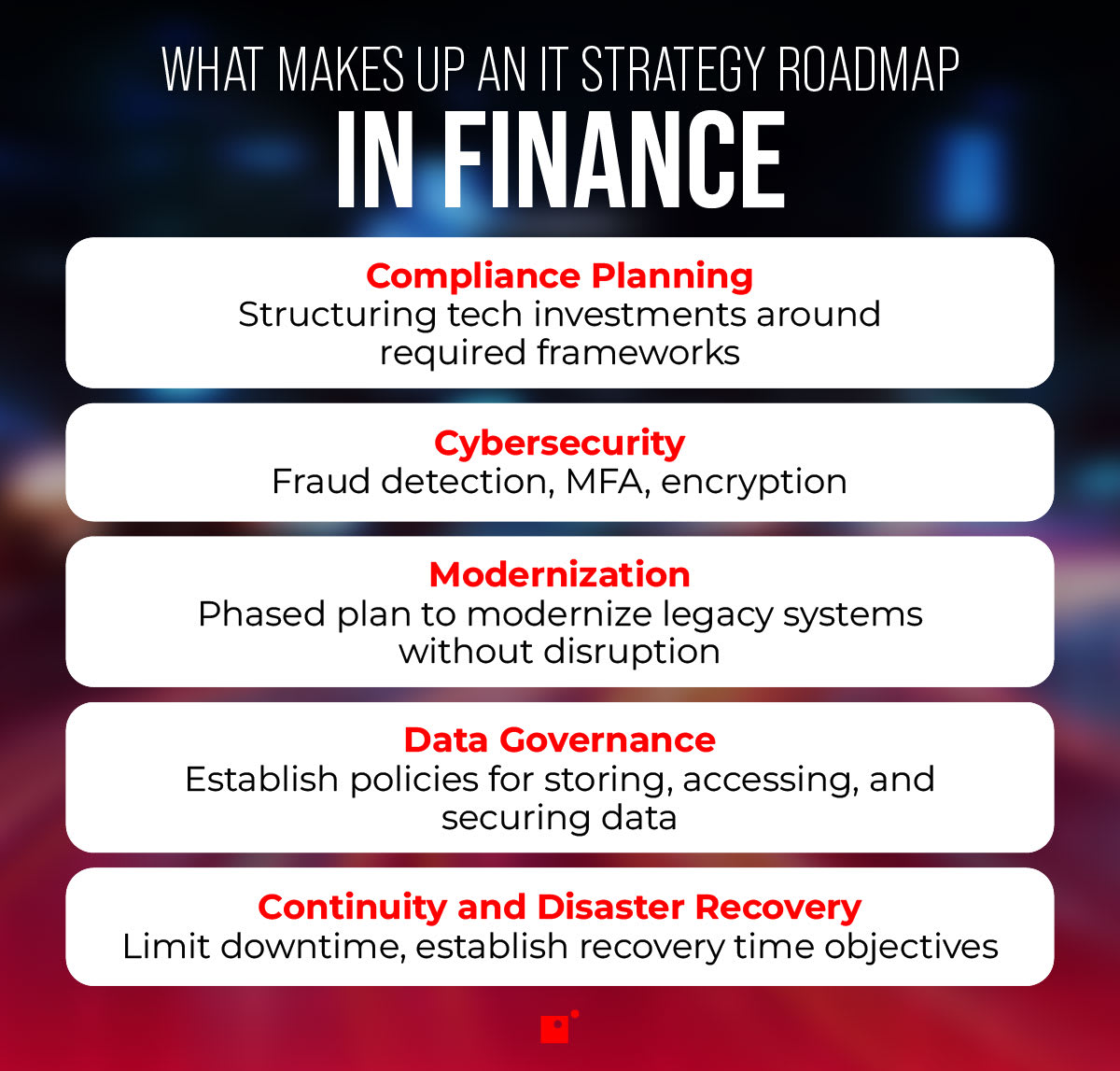
Financial services organizations operate under strict oversight and handle highly sensitive data, so their roadmap tends to center on:
Regulatory compliance planning—Structuring technology investments around finance-specific frameworks with built-in processes for audits and reporting
Advanced cybersecurity and fraud detection—Prioritizing tools like multi-factor authentication, encryption, and fraud monitoring given the high value of financial data to attackers
Legacy system modernization—Many financial institutions run on aging core systems; a roadmap often includes a phased plan to modernize without disrupting daily transactions
Data governance and privacy controls—Establishing clear policies for how customer financial data is stored, accessed, and shared across systems
Business continuity and disaster recovery—Given the stakes of downtime in financial transactions, recovery time objectives tend to be far more aggressive than in other industries
It Strategy Roadmap Example for Construction
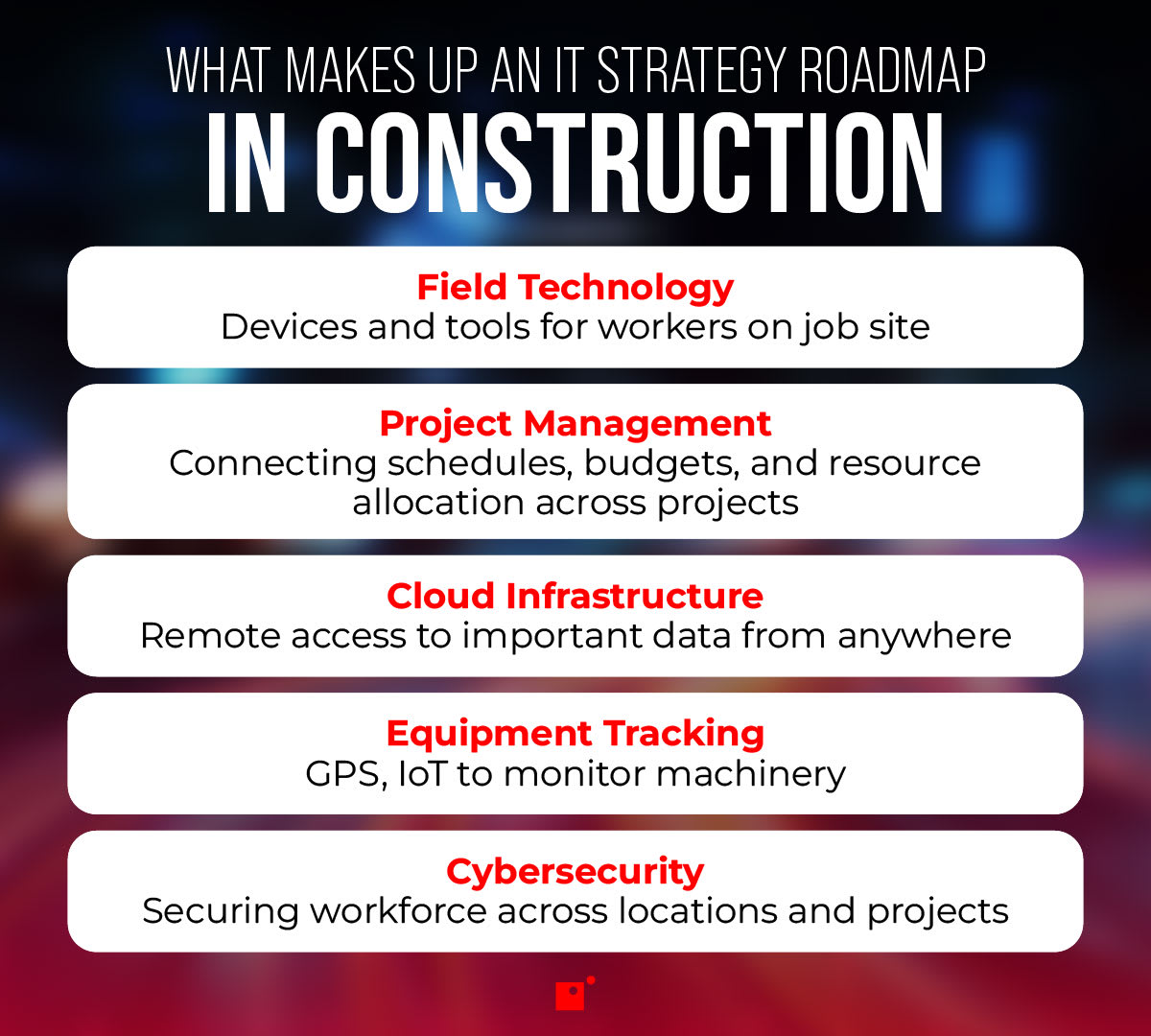
Construction companies manage distributed job sites, mobile teams, and project-based work, so their roadmap often looks like:
Mobile and field technology—Equipping crews with mobile devices and apps for real-time updates, blueprints, and reporting from job sites
Project management software integration—Connecting scheduling, budgeting, and resource allocation tools across multiple concurrent projects
Cloud infrastructure for remote access—Ensuring teams in the field and the office can access shared files and systems without relying on a central physical office
Equipment and asset tracking—Using GPS and IoT tools to monitor expensive machinery and materials across job sites
Cybersecurity for distributed networks—Securing a workforce that connects from constantly changing locations and networks, often on public Wi-Fi
These examples make one thing clear: a real IT strategy roadmap can't be copied from a template. It has to be built around the specific risks, workflows, and growth goals of the business it serves.
How AI Fits into a Modern IT Strategy Roadmap
AI has moved from an emerging trend to a core component of any forward-looking IT roadmap. The question for most businesses is no longer if they'll adopt AI, but how to do it strategically and effectively while empowering workers rather than alienating them.
A modern roadmap should treat AI as an integration layer across existing systems, not a bolt-on project. That starts with identifying high-value use cases: automating repetitive tasks, improving customer service through chatbots, or using predictive analytics to inform decision-making.
Data readiness is foundational. AI tools are only as good as the data feeding them, so roadmaps need a phase dedicated to cleaning, centralizing, and governing data before AI initiatives scale.
Security and governance deserve their own line item too. AI introduces new risks around data privacy, model bias, and compliance that traditional IT security plans weren't built to address.
Finally, a roadmap should account for change management and training, since AI adoption succeeds or fails based on whether employees trust and know how to use the tools they're given.
Done thoughtfully, AI becomes less of a standalone initiative and more a thread woven through every part of the roadmap, including infrastructure, security, applications, and operations alike.
The Most Common Challenges That Cause IT Strategies and Roadmaps to Fail
Even well-intentioned roadmaps can fall short if a few common pitfalls aren't avoided along the way. These are the most common challenges that businesses run into when trying to iron out their IT infrastructure.
Leaving stakeholders out: When IT builds a roadmap in isolation without input from leadership, department heads, or end users, the plan often misses real business needs and faces pushback during rollout. The best roadmaps are built collaboratively, not handed down
Overloading the roadmap: Trying to tackle every initiative at once spreads resources too thin and delays meaningful progress on any one priority. A strong roadmap sequences work realistically, rather than cramming in every possible upgrade
Treating cybersecurity as an afterthought: Bolting security onto a roadmap after the fact, rather than building it in from the start, leaves organizations exposed and often requires costly rework down the line. Cybersecurity and IT are two different things, but they are intertwined. Treating them the same might be a mistake, but the biggest mistake is not building each with the other in mind the entire time
Failing to measure success: Without clear KPIs and a plan for tracking them, businesses have no way to know whether their roadmap investments are actually paying off, making it hard to justify future spending
Not making updates: A roadmap that's created once and never revisited quickly becomes outdated as business needs, technology, and threats evolve. Treating it as a static document undermines its long-term value
Avoiding these pitfalls doesn't guarantee success, but it does ensure the roadmap stays realistic, secure, and aligned with what the business actually needs.
CIOs and CTOs: Leading IT Strategies and Roadmaps
Building an IT roadmap requires strong leadership to keep the plan aligned, realistic, and accountable, and that responsibility sometimes falls to one key role: the chief information officer (CIO), within an organization, or a chief technology officer (CTO).
A CIO/CTO is typically the driving force behind translating business goals into a technology plan and ensuring execution stays on track. For larger organizations, an internal CIO/CTO offers deep institutional knowledge and daily oversight, but, obviously, comes with a significant salary investment.
For businesses that can't justify a full-time hire, a virtual or fractional CIO (vCIO) through a managed service provider offers a strategic alternative, providing the same high-level planning and accountability without the overhead of salary, training, and certifications, while giving businesses access to expert IT consulting when needs evolve.
Frequently Asked Questions About IT Strategy Roadmaps
Still have questions about building an IT strategy roadmap? Here are answers to some of the most common ones business leaders ask.
1. What is an IT strategy roadmap? It's a strategic plan that maps out how technology initiatives will support a business' broader goals.
2. What's the difference between an IT strategy and an IT roadmap? IT strategy defines the "why,” meaning the vision and priorities. The roadmap defines the "how" and "when,” aka the sequenced, actionable plan for execution.
3. How long should an IT roadmap cover? Most roadmaps span 1-3 years, though some organizations build shorter-term project roadmaps or longer architecture roadmaps depending on the initiative.
4. Who should be involved in building an IT roadmap? Leadership, department heads, end users, and IT leaders, like a CIO, should all have input to ensure the plan reflects real business needs.
5. How often should a business update its IT roadmap? Quarterly check-ins are common, with more thorough reviews annually or whenever major business or technology shifts occur.
6. What's the biggest mistake businesses make with IT roadmaps? Building one without stakeholder input, overloading it with too many priorities, or failing to revisit it once it's created.
7. Do small businesses need an IT roadmap too? Of course! Roadmaps help businesses of any size make intentional, cost-effective technology decisions rather than reactive ones.
8. How does cybersecurity fit into an IT roadmap? Security should be built into the roadmap from the start, not added afterward, covering everything from governance to incident response planning.
9. What role does AI play in an IT roadmap today? AI should be integrated across existing systems and use cases rather than treated as a standalone project, with attention to data readiness and governance.
10. Do I need an internal CIO to build a roadmap? Not necessarily, many businesses use a fractional or virtual CIO through a managed service provider to get strategic leadership without a full-time hire.
Start Building an IT Strategy Roadmap Today
Technology isn't slowing down, and neither are the businesses using it well.
Every quarter spent without a clear IT strategy roadmap is a quarter spent making reactive decisions, wasting budget, and falling further behind competitors who are planning ahead.
Building a roadmap today doesn't just solve current pain points, it positions a business to move faster, adapt to new technology (like AI) with confidence, and grow without being held back by disjointed systems or unplanned costs. The businesses that start now won't just keep pace with change; they'll be the ones setting it.
Learn more about managed IT services and the process of building an effective IT strategy.
Dylan Grissom
Senior Copywriter
Dylan Grissom is a Senior Copywriter for Impact's in-house marketing team, where he mentors writers, conceptualizes projects through detailed, imaginative creative direction, crafted a new set of brand voice guidelines, and wrote the overall brand messaging guide.