Learn how to generate more high-quality leads with this comprehensive guide covering strategy, channels, measurement, and the role of AI.
Guide
May 12, 2026
Generating consistent, high-quality leads is one of the biggest challenges facing growing businesses today.
Whether you're an SMB owner wearing every hat or a marketing director under pressure to fill the pipeline, the fundamentals matter more than the trends. This guide breaks down what lead generation really is, how it works, which channels deliver results, how to measure success, and where automation and AI can give your team a meaningful edge.
What Is Lead Generation?
Lead generation is the process of attracting and identifying potential customers (leads) for a business's products or services. It involves capturing the interest of people who have shown some level of curiosity or need, then guiding them toward becoming paying customers.
Common lead generation tactics online include:
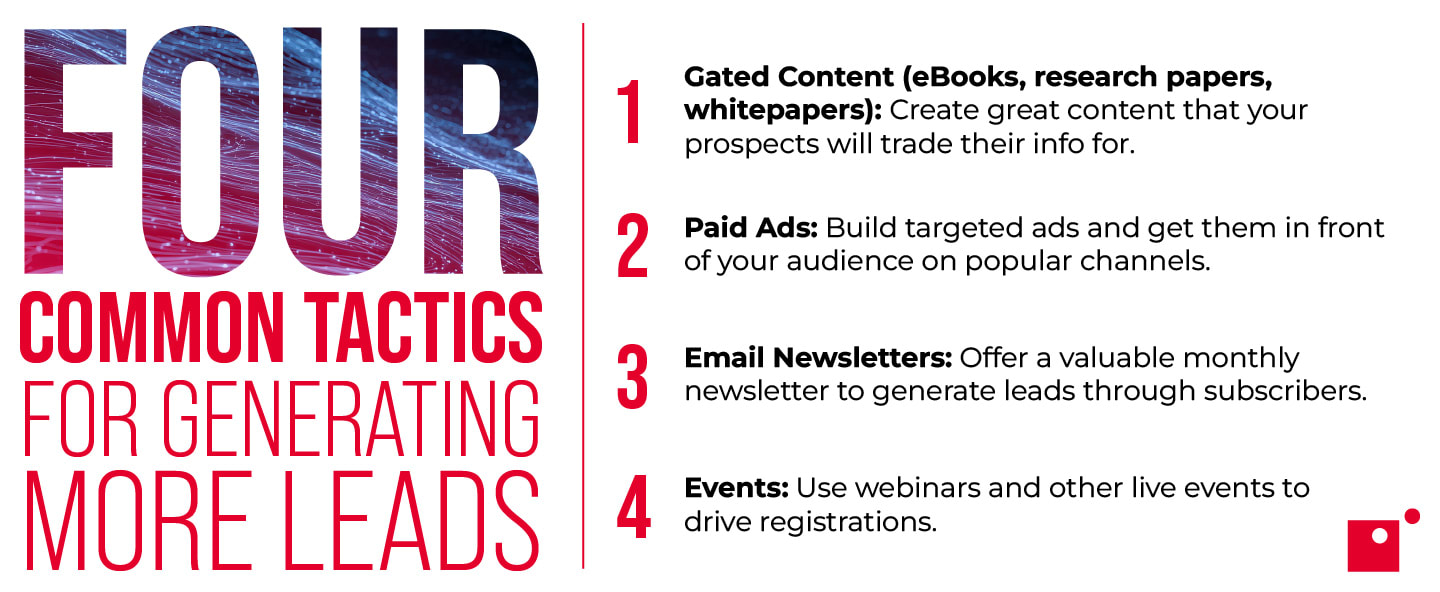
Gated Content: (ebooks, whitepapers) By creating content your target audience wants, you can entice them to give up their information for access
Paid Advertising: By placing relevant ads right in front of your target audience, you can (hopefully) get them to click onto your landing page where they convert for a piece of content, a chance to chat, or maybe a subscription
Email Newsletters: If you’re able to offer a monthly newsletter, you can generate leads through subscribers
Webinars and Events: Throwing live events like webinars, LinkedIn Lives, or other live streams allows you to gather contact info in exchange for access to the live event
The goal of these tactics isn’t just to generate leads, but to create content and ads that are able to specifically target one audience: the type of people who buy your product or service. Generating leads is cool, but generating the wrong leads is useless, because those people, most likely, won’t become customers. That’s where lead quality comes into play, along with the typical process of categorizing those leads.
Leads are typically categorized by their readiness to buy.
Marketing qualified leads (MQLs) have shown interest but aren't ready to purchase, while sales qualified leads (SQLs) are further along in the buying journey.
The goal is to nurture leads through the sales funnel using personalized communication, helpful content, and timely follow-ups, ultimately converting them into customers and building long-term business relationships.
What Makes for a “Quality Lead”?
A quality lead is more than just a name in your CRM—it's a prospect with a genuine need for your solution, the budget to afford it, the authority to make decisions, and a realistic timeline to buy.
Beyond these basics, quality leads align with your ideal customer profile (ICP) in terms of industry, company size, and pain points.
They've engaged meaningfully with your brand, whether by downloading content, attending a webinar, or requesting a demo, and, crucially, they're reachable and responsive, making them worth your sales team's time and effort.
A quality lead is the goal. It’s someone who needs what you’re selling, is actively in the buying process, and is engaging with your nurturing tactics.
Building a Lead Gen Strategy
Lead generation works best when treated as a connected system rather than a checklist.
The sections below walk through the essentials to building a system that generates more leads, step by step: defining your audience, building offers that convert, choosing the right channels, optimizing your website, creating content that attracts prospects, aligning sales and marketing, and qualifying leads effectively.
How to Choose Your Target Audience
Effective lead generation starts with knowing exactly who you're trying to reach.
For B2B, identify the roles and seniority levels of decision-makers and influencers within target accounts. The narrower your focus, the more relevant your messaging becomes, and relevance is what drives response rates. The more specific you can get, the better, because you can tailor your content and ads to better resonate with those people.
Create an Offer People Actually Want
Your offer is the value exchange that convinces someone to raise their hand and convert as a lead.
A generic "contact us" forms rarely cuts it (though it is still important to have).
Instead, develop offers tied to real problems your audience faces: a diagnostic tool, an industry benchmark report, a free audit, a template, a research report, or a calculator. Test your offer against a simple question: would someone willingly trade their email address and phone number for this? If not, it needs more substance or specificity.
Pick the Best Lead Generation Channels
Not every channel works for every business.
B2B companies often see strong returns from LinkedIn, search ads, industry events, and content marketing.
B2C brands may lean harder into social media, influencer partnerships, and SEO.
Start by asking where your audience already spends time and how they research solutions. Then prioritize two or three channels you can execute well rather than spreading thin across a dozen.
Each channel serves a different purpose in a lead generation strategy. Understanding where each one shines helps you allocate budget and effort more effectively.
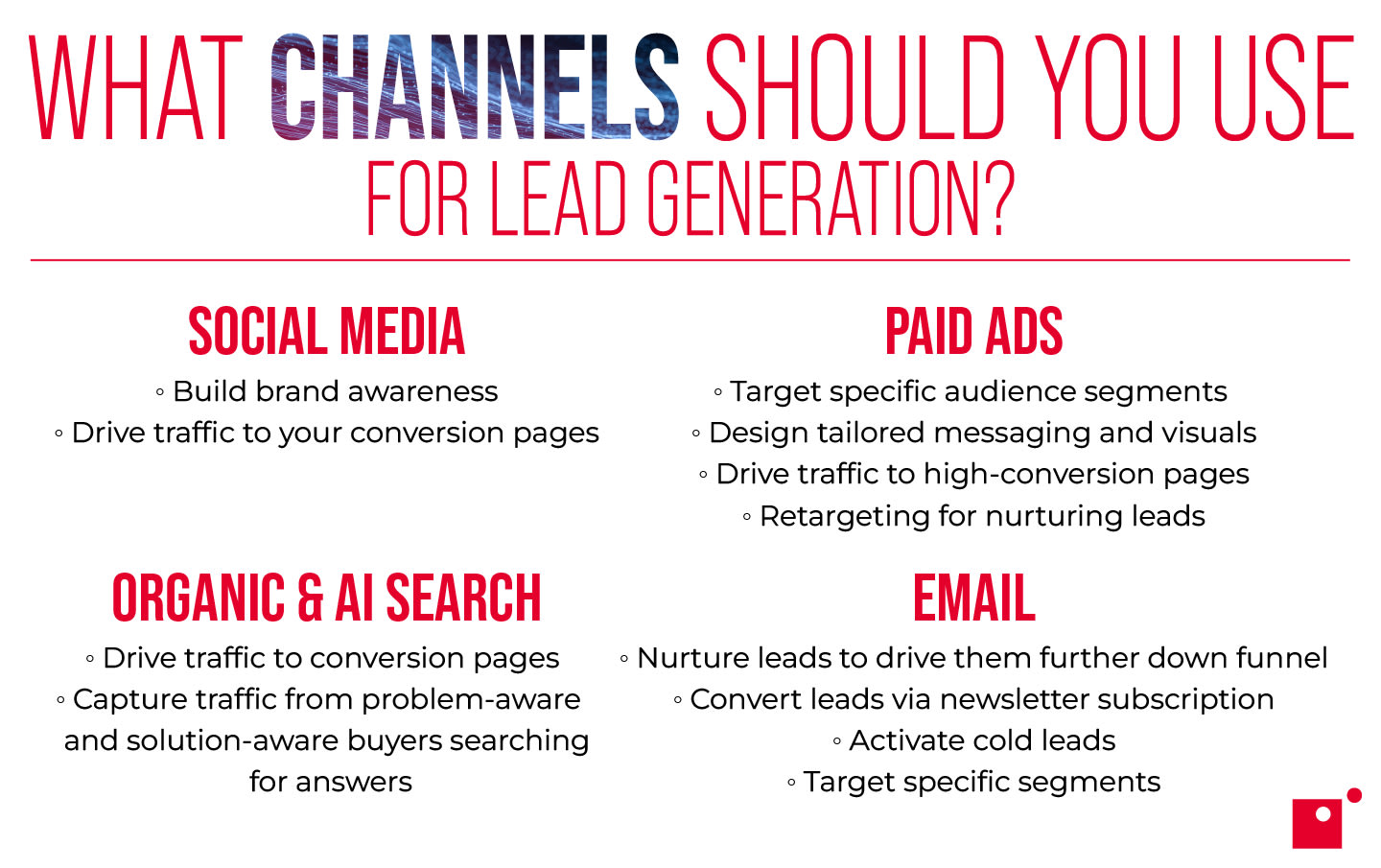
LinkedIn dominates B2B lead generation, particularly for reaching decision-makers, sharing thought leadership, and running targeted ad campaigns by job title or industry
Instagram, TikTok, and Facebook work better for B2C brands focused on lifestyle products, ecommerce, or visual storytelling
Useful for community building, customer engagement, and amplifying content—but expect longer conversion paths since social leads often need additional nurturing
Paid Ads
A paid media strategy is ideal when you need a predictable, scalable lead flow and have a clear cost-per-lead target in mind
Search ads (Google, Bing) capture high-intent buyers actively looking for solutions, making them especially strong for B2B and considered B2C purchases
Paid social ads excel at audience targeting based on demographics, interests, and behaviors, which works well for cold outreach and retargeting warm visitors
Retargeting campaigns recapture visitors who didn't convert the first time and are often among the most cost-effective spend
Best paired with strong landing pages and clear offers, since traffic quality depends heavily on what visitors see after the click
Can require a creative touch to help you stand out. Craft your unique message paired with a striking visual for best effect
Organic Search
Delivers compounding returns over time, making it one of the most cost-effective long-term channels for lead generation
Works particularly well for capturing problem-aware and solution-aware buyers searching for answers, comparisons, or specific products
Requires a sustained content investment and technical SEO foundation, but the leads tend to be high-intent and lower-cost than paid alternatives
Strong for both B2B (how-to guides, industry insights, comparison content) and B2C (product reviews, buying guides, local search)
Does not directly translate to leads but does increase traffic to your pages that contain forms or contact us buttons
AI Search
An emerging channel as buyers increasingly use tools like ChatGPT, Perplexity, and Google's AI Overviews to research solutions before visiting traditional websites
Optimize by creating clear, well-structured content that answers specific questions and includes credible data, citations, and direct answers
Brand mentions, third-party reviews, and authoritative content increase the likelihood of being surfaced in AI-generated responses
Worth investing in early, since visibility in AI search is becoming a meaningful driver of consideration and direct traffic
Again, not directly tied to lead generation, but it’s an important tool in nurturing your audience and spreading awareness, plus it can direct people to your site and conversion pages
Email
If someone is receiving your emails, they’re most likely already a lead because you have their info. This makes email the workhorse channel for nurturing leads, re-engaging cold contacts, and converting interest into pipeline
Segmented campaigns based on behavior, lifecycle stage, or persona consistently outperform generic blasts
Pairs naturally with every other channel, turning one-time visitors into ongoing relationships
Website Changes that Turn Visitors into Leads
Most websites quietly leak potential leads. Small adjustments can dramatically improve conversion rates by creating a smoother, more intuitive customer experience for people who visit your site: clear value propositions above the fold, prominent calls-to-action, simplified forms (asking only for what you truly need), live chat or chatbots for instant engagement, and dedicated landing pages tailored to specific campaigns.
You can also tailor the content shown to visitors (like headlines, related content, etc.) to people’s job titles, industries, or locations.
Page speed matters too. Every additional second of load time chips away at conversions. Test ruthlessly and let data guide your decisions.
In addition, make sure your website is easy to use on mobile, because a good mobile site is a major key for growing your business through your site. 62% of all internet browsing is done via a mobile browser on a phone or tablet. If your site is bad, people will leave.
Content that Generates Leads
Content earns trust before a sales conversation ever begins. The strongest lead-generating content solves problems your prospects are actively searching for: how-to guides, case studies, comparison articles, and original research.
Gate your highest-value pieces behind forms, but keep enough freely accessible to attract organic traffic that keeps coming back for more.
Repurpose long-form content into shorter formats—social posts, email sequences, short videos—to extend reach without constantly creating from scratch.
Sales and Marketing Alignment
Lead generation breaks down when sales and marketing operate in silos. Both teams need shared definitions of what counts as a qualified lead, agreed-upon handoff processes, and consistent feedback loops.
Marketing should know which leads convert to revenue; sales should communicate what's working and what's not.
Regular pipeline reviews and shared dashboards help keep both teams accountable to the same goals.
Not every lead deserves the same treatment. Use lead scoring to rank prospects based on fit (do they match your ICP?) and engagement (how actively are they interacting with your brand?).
High-scoring leads should route directly to sales for immediate follow-up, while earlier-stage leads enter nurture sequences until they're ready. Clear routing rules prevent hot leads from going cold and keep sales focused on prospects most likely to close.
Start with the fundamentals: total leads generated, cost per lead (CPL), and conversion rate from visitor to lead. These give you a baseline view of volume and efficiency across channels. From there, layer in quality metrics like MQL-to-SQL conversion rate, SQL-to-opportunity rate, and ultimately lead-to-customer conversion rate. A channel producing cheap leads that never close isn't actually cheap.
Track customer acquisition cost (CAC) alongside customer lifetime value to understand whether your lead generation efforts are profitable. Pay attention to sales cycle length too, since faster-closing leads often signal better fit and stronger qualification upstream.
Attribution matters as well. Use multi-touch attribution where possible to credit the channels and content that influence deals, not just the last click. Pair this with regular pipeline reviews and feedback from your sales team to catch nuances the data alone might miss.
How Automation and AI Help with Lead Generation Strategies
Automation and AI have transformed how efficiently teams can generate and manage leads.
On the automation side, tools handle repetitive tasks like sending follow-up emails, scoring leads based on behavior, routing inquiries to the right sales rep, and triggering nurture sequences when prospects take specific actions.
This frees teams to focus on strategy and high-value conversations.
AI takes things further by analyzing patterns at scale.
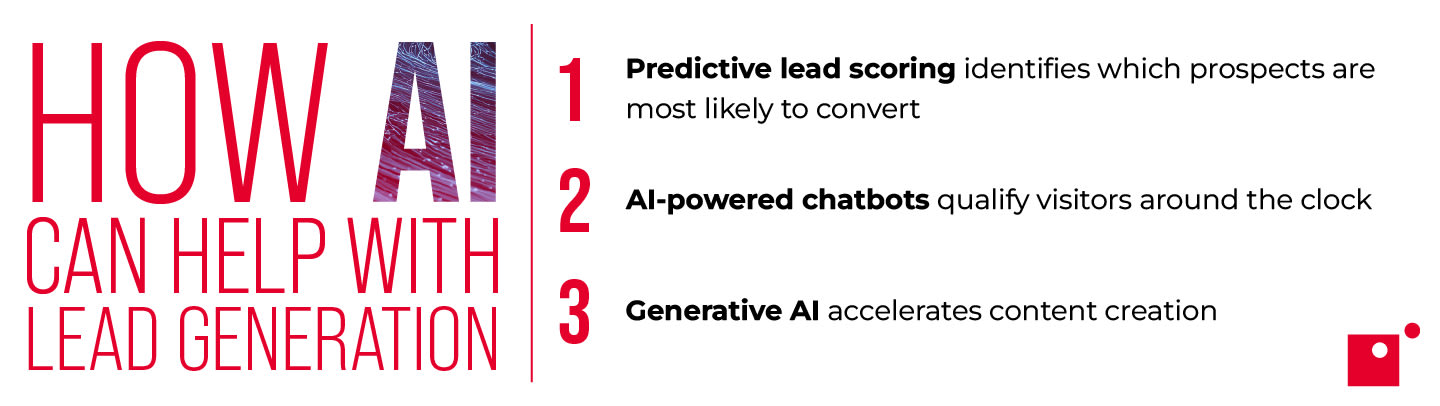
Predictive lead scoring identifies which prospects are most likely to convert based on historical data, often surfacing opportunities humans would miss.
AI-powered chatbots qualify visitors around the clock, answering questions and booking meetings without human involvement.
Generative AI accelerates content creation, personalizes outreach at scale, and helps refine ad copy through rapid testing.
AI also strengthens targeting by analyzing intent signals, firmographic data, and engagement history to identify accounts showing buying behavior—letting teams reach prospects earlier and with more relevant messaging.
Start Generating More Leads Today
Strong, consistent lead generation is about building a system that attracts the right prospects and moves them toward becoming customers. Focus on knowing your audience, offering real value, choosing channels that fit your business, and measuring what actually drives revenue.
Layer in automation and AI to scale your efforts without losing the personal touch, but don't forget to start with the fundamentals, refine as you learn, and the results will compound over time.
Ready to start generating more leads for your business? Contact a marketing expert today for a chat about how Impact can help you find more customers.
Frequently Asked Questions About Generating More Leads
Below are answers to some of the most common questions SMB owners and marketing leaders ask when refining their approach.
How do I generate leads online?
Generating leads online comes down to three things: visibility, value, and conversion. Show up where buyers are looking through SEO, paid ads, social, and AI search, then offer something worth their contact information and make it easy to convert with clear CTAs and short forms.
What's the best way to get leads?
There's no single best way—it depends on your audience, offer, and sales cycle. The highest-performing programs typically combine inbound channels like content and SEO with outbound efforts like paid ads and targeted outreach, then double down on whatever produces the best results.
How do I get leads fast?
Paid channels deliver the quickest results. Search ads put your offer in front of high-intent buyers within hours, while retargeting and personalized cold outreach can generate conversations within days. Just be ready to nurture these leads, since they often need more follow-up than inbound ones.
What are lead generation techniques that work?
Consistently effective techniques include SEO-driven content, gated assets, targeted paid ads, webinars, account-based marketing, referral programs, and personalized email. Strong landing pages, lead scoring, and AI-powered tools like predictive scoring and chatbots amplify results across all of them.
Dylan Grissom
Senior Copywriter
Dylan Grissom is a Senior Copywriter for Impact's in-house marketing team, where he mentors writers, conceptualizes projects through detailed, imaginative creative direction, crafted a new set of brand voice guidelines, and wrote the overall brand messaging guide.