Government Contractor Compliance: Everything You Need to Know
Government contractor compliance is increasingly important for organizations that work with federal agencies, support prime contractors, handle sensitive government information, or provide cloud-based services to the public sector.
Guide
15 minutes
May 22, 2026
Government contractor compliance can feel overwhelming fast. Between FAR, DFARS, NIST 800-171, CMMC, FedRAMP, and changing executive orders, it can be hard to know what actually applies to your business and where to start.
But compliance is becoming a major factor in whether organizations can win, keep, or even compete for federal contracts.
If your business works with the federal government, supports a prime contractor, handles sensitive government information, or sells cloud-based services to federal agencies, you may be responsible for meeting specific federal contractor compliance requirements.
This guide breaks down the key frameworks, what they mean, who they apply to, and how to start building a stronger compliance program.
What Is Government Contractor Compliance?
Government contractor compliance is the process of meeting the legal, cybersecurity, operational, and contractual requirements tied to federal government work.
These requirements may come from:
Federal regulations
Contract clauses
Cybersecurity frameworks
Agency-specific rules
Prime contractor flow-down requirements
Executive orders
In practice, government contractor compliance can affect several areas of your business, including IT, cybersecurity, HR, legal, operations, procurement, vendor management, reporting, and documentation.
For some organizations, compliance starts with basic safeguarding requirements. For others, it may involve more advanced cybersecurity frameworks, formal assessments, or cloud security authorization.
Why Government Contractor Compliance Matters
Federal agencies rely on contractors for critical services, products, systems, software, infrastructure, manufacturing, logistics, and support.
That means contractors may have access to sensitive government information or play a role in important federal operations. Because of that, the government expects contractors to prove they can protect data, follow contract rules, and reduce risk.
Strong federal contractor compliance can help your business qualify for more federal opportunities, work with prime contractors, support US Department of War (formerly the Department of Defense) contracts, protect federal contract information and Controlled Unclassified Information, meet cybersecurity requirements, reduce contract delays and compliance risk, and build trust with agencies and partners.
Compliance is not just about avoiding penalties. It can also become a competitive advantage.
Common Government Contractor Requirements
The exact requirements your organization must meet depend on your contract, agency, data access, and role as either a prime contractor or subcontractor.
However, most federal contractors should understand a few core requirement areas.
Cybersecurity Requirements
Cybersecurity is one of the biggest parts of government contractor compliance.
Depending on the contract, contractors may need to:
Protect federal information
Restrict access to systems
Monitor security activity
Report cyber incidents
Maintain security documentation
Implement specific security controls
Provide evidence of compliance
For many contractors, cybersecurity compliance starts with FAR 52.204-21. Defense contractors may also need to meet DFARS, NIST 800-171, and CMMC requirements.
Data Protection Requirements
The type of information your business handles plays a major role in determining which federal contractor compliance requirements apply.
Two important data categories are:
Federal contract information, or FCI: Information provided by or created for the government under a contract that is not intended for public release.
Controlled Unclassified Information, or CUI: Sensitive information that is not classified but still requires safeguarding or handling controls.
CUI usually comes with stricter cybersecurity requirements than FCI. If your business handles CUI, NIST 800-171 and CMMC may become especially important.
Contracting Requirements
Federal contractors must follow the rules included in their contracts.
These requirements may cover pricing, billing, ethics, recordkeeping, reporting, subcontracting, cybersecurity, incident notification, and performance obligations.
This is why contract review is one of the first steps in government contractor compliance. The clauses in your contract help define what your business is responsible for.
Subcontractor Requirements
You do not have to contract directly with the federal government to be affected by federal contractor compliance requirements.
If you support a prime contractor, certain requirements may be passed down to you through flow-down clauses. This is especially common in defense contracting, where cybersecurity obligations often extend across the supply chain.
Government Contractor Compliance Frameworks at a Glance
Framework
Who It Applies To
Main Purpose
Why It Matters
FAR / DFARS
Federal and defense contractors
Sets federal contracting rules, safeguarding requirements, and defense-specific obligations
These clauses often define what contractors are contractually required to do
NIST 800-171
Contractors that handle CUI
Protects CUI in nonfederal systems
It is a major cybersecurity standard for federal and defense contractors
CMMC
Defense contractors and subcontractors
Verifies cybersecurity readiness for US Department of War contracts
It can affect eligibility for certain US Department of War work
FedRAMP
Cloud service providers working with federal agencies
Standardizes cloud security authorization
It is often required for cloud products used by the federal government
Key Federal Contractor Compliance Frameworks: FAR and DFARS
FAR and DFARS are foundational to government contractor compliance because they are tied directly to federal contracts and are contractual requirements.
If a clause appears in your contract, your business is expected to follow it. That makes reviewing your contracts one of the most important first steps in federal contractor compliance.
What Is FAR?
The Federal Acquisition Regulation, or FAR, is the main set of rules federal agencies use when buying goods and services.
For contractors, FAR matters because FAR clauses may be included in federal contracts. These clauses can create requirements around security, pricing, reporting, ethics, subcontracting, performance, and more.
Not every FAR clause applies to every contractor. Your obligations depend on the specific clauses included in your contract.
FAR 52.204-21: Basic Safeguarding
One of the most important FAR clauses for cybersecurity is FAR 52.204-21, which covers basic safeguarding of covered contractor information systems.
This clause applies when federal contract information is stored in or passes through a contractor’s information system.
It requires basic security practices such as limiting system access to authorized users, controlling what authorized users can do, protecting information from unauthorized access, and managing and monitoring access to systems.
For many organizations, this is the baseline cybersecurity requirement for federal contractor compliance.
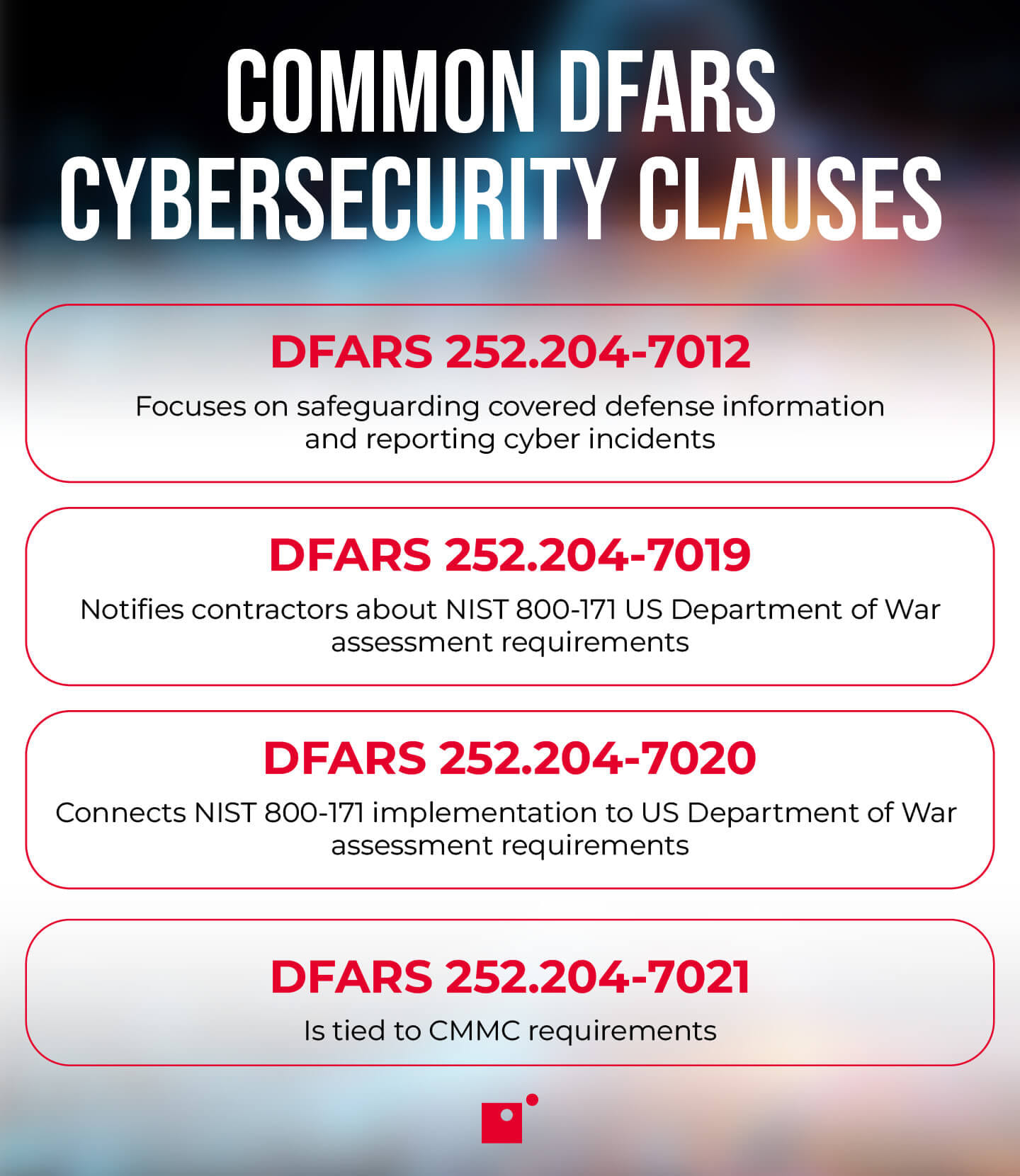
DFARS applies to many US Department of War contractors and subcontractors. If your business works with the US Department of War, supports a defense prime, or handles defense-related information, DFARS may apply.
What Is NIST 800-171?
NIST 800-171, a six-element cybersecurity framework for protecting Controlled Unclassified Information (CUI) in nonfederal systems, is one of the most important cybersecurity frameworks for government contractors that handle sensitive federal information.
Your business may need to follow NIST 800-171 if you:
Handle CUI
Work with the US Department of War
Support a defense prime contractor
Store or transmit sensitive federal information
Have a contract that references NIST 800-171
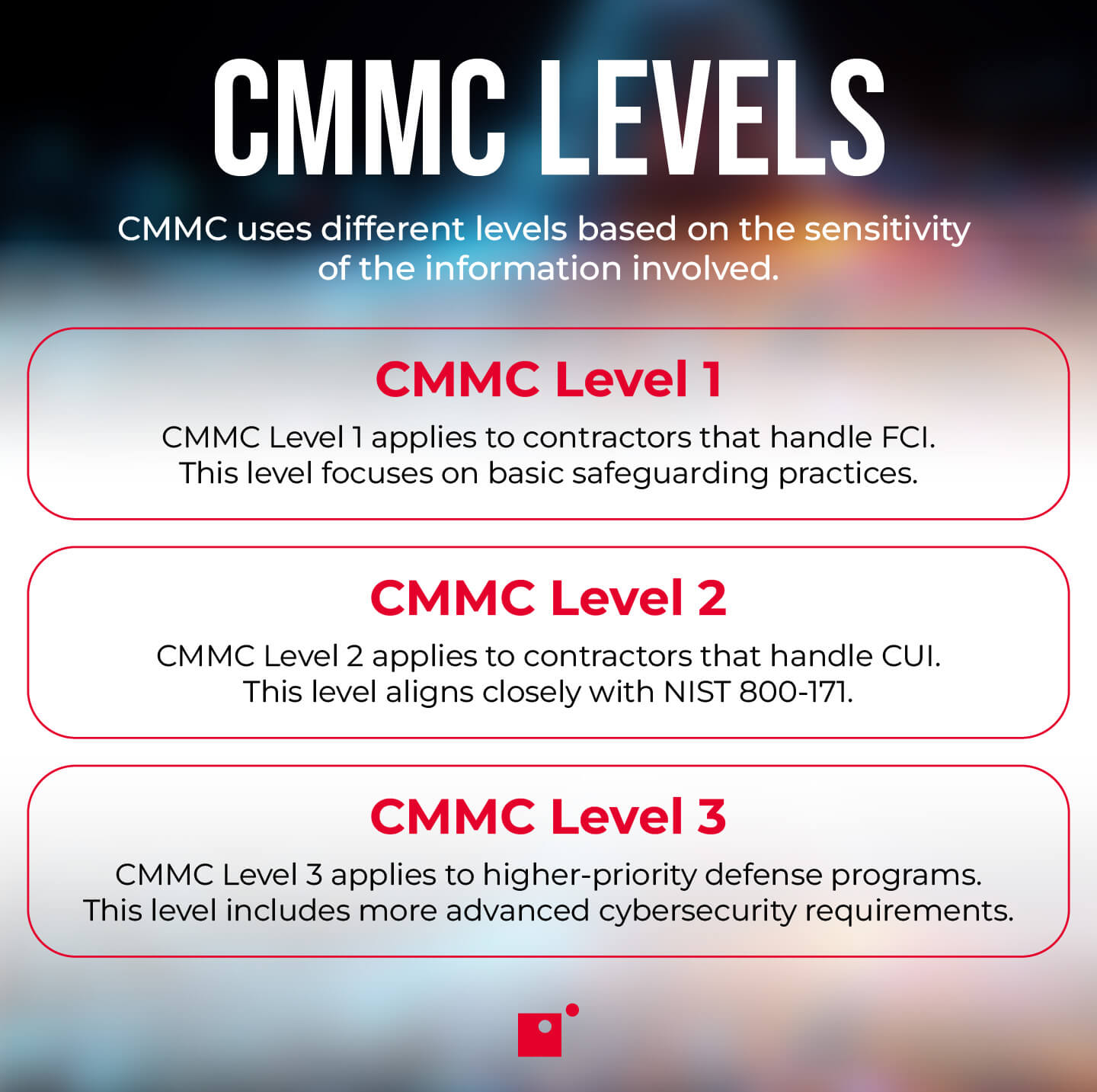
Are preparing for CMMC Level 2
NIST 800-171 includes security requirements across areas such as access control, awareness and training, audit logs, configuration management, user authentication, incident response, risk assessment, physical security, system monitoring, and vulnerability management.
The goal is to make sure CUI is protected from unauthorized access, misuse, or exposure.
How NIST 800-171 Connects to CMMC
NIST 800-171 and CMMC are closely connected, but they are not the same thing.
NIST 800-171 defines many of the cybersecurity requirements contractors need to meet when handling CUI. CMMC is the US Department of War’s program for verifying that contractors have implemented the required protections.
It is one of the most important compliance programs for businesses working with the US Department of War.
CMMC is designed to confirm that companies in the defense supply chain can protect federal contract information and CUI. CMMC moves contractors from saying they are compliant to proving they are compliant.
Depending on the contract, contractors may need to complete a self-assessment, third-party assessment, or government assessment.
That means businesses need more than written policies. They need documentation, evidence, and security practices that are working in real life.
Who needs CMMC certifications? Businesses that:
Bid on US Department of War contracts
Work as a subcontractor to a defense prime
Handle FCI
Handle CUI
Support the defense industrial base
See CMMC requirements in a solicitation or contract
CMMC is especially important because it can affect whether a contractor is eligible for certain US Department of War work. CMMC compliance consulting can help your business identify these needs.
What Is FedRAMP?
FedRAMP (Federal Risk and Authorization Management Program) provides a standardized security authorization process for cloud products and services used by federal agencies.
It is especially important for cloud service providers that want to work with the federal government as it helps federal agencies evaluate whether cloud products meet government security standards.
For contractors, FedRAMP may affect both the cloud products they sell and the cloud tools they use to support government work.
If your organization provides cloud services to federal agencies, FedRAMP can become a major requirement for entering or expanding in the federal market.
Who Needs FedRAMP?
FedRAMP is most relevant for cloud service providers and technology companies that sell cloud-based solutions to federal agencies.
Your business may need FedRAMP if you:
Sell SaaS to federal agencies
Host federal data in the cloud
Provide cloud infrastructure or platforms
Support federal systems through a cloud environment
Are required by an agency to use a FedRAMP-authorized service
What Is Executive Order 14173?
Government contractor compliance is not limited to cybersecurity. Executive orders can also affect federal contractor obligations.
Executive Order 14173, titled Ending Illegal Discrimination and Restoring Merit-Based Opportunity, was issued in January 2025.
It revoked Executive Order 11246, which had long shaped certain affirmative action and nondiscrimination obligations for federal contractors.
Why It Matters for Federal Contractors
Executive Order 14173 is not a cybersecurity framework. However, it is still relevant to federal contractor compliance because it affects the broader compliance environment.
For some contractors, it may impact workforce compliance, HR policies, contract certifications, internal documentation, legal review processes, and employment-related federal contractor obligations.
Because this area is still developing, contractors should monitor agency guidance and work with legal counsel to understand how it affects their specific contracts.
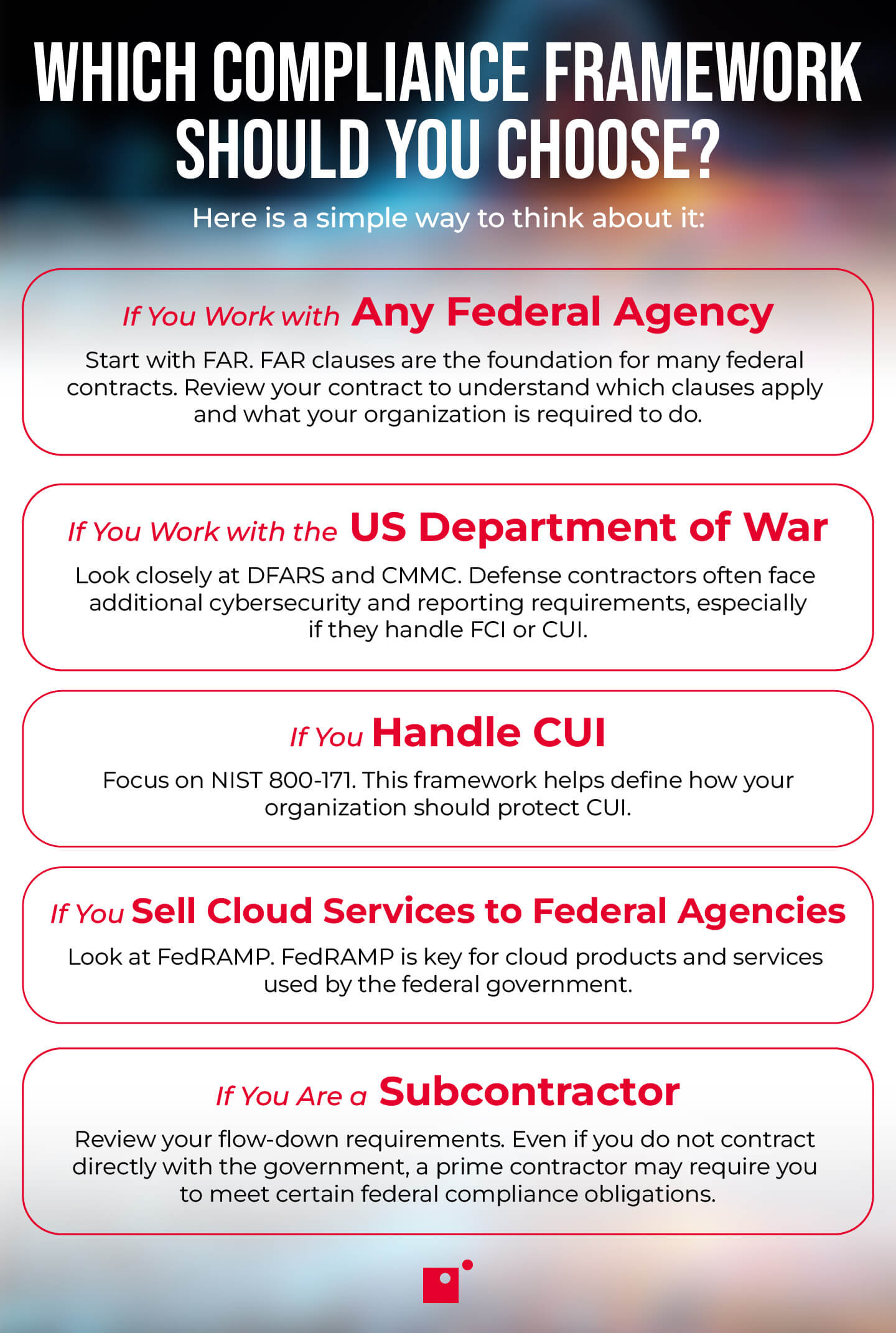
Which Compliance Framework Should You Choose?
Common Challenges of Government Contractor Compliance
Government contractor compliance can be difficult, especially for businesses without large internal security, legal, or compliance teams.
1. Knowing What Applies
There are many different rules, frameworks, clauses, and standards. A contractor may need to sort through FAR, DFARS, CMMC, NIST 800-171, FedRAMP, agency-specific requirements, and subcontractor obligations.
The hardest part is often figuring out which requirements actually apply to your organization.
2. Understanding Contract Language
Federal contracts can be dense and technical.
Important requirements are often buried in clauses, references, and flow-down language. This makes contract review essential.
3. Identifying FCI and CUI
Many contractors are unsure whether they handle FCI, CUI, or both.
This matters because CUI usually triggers more advanced cybersecurity requirements. Before building a compliance roadmap, contractors need to understand what data they have and where it lives.
4. Scoping the Right Systems
For cybersecurity compliance, scoping is critical.
Contractors need to know which systems store, process, or transmit sensitive information. This may include email, file storage, cloud applications, laptops and desktops, servers, networks, backup systems, remote access tools, security tools, and vendor platforms.
Poor scoping can lead to missed requirements, unnecessary spending, or failed assessments.
5. Turning Policies Into Practice
Written policies are important, but they are not enough.
Contractors need to prove that security practices are actually happening. That means maintaining evidence such as access reviews, training records, incident response documentation, system logs, risk assessments, security tickets, vendor reviews, and control testing results.
6. Managing Subcontractors
If subcontractors handle federal information or support contract work, they may also need to meet certain compliance requirements.
Prime contractors need to understand what must be flowed down and how subcontractor compliance will be managed.
7. Keeping Up with Changes
Federal contractor compliance is constantly changing.
CMMC, FedRAMP, NIST guidance, executive orders, and agency requirements can all evolve. Compliance should be treated as an ongoing program, not a one-time project.
Benefits of Government Contractor Compliance
1. More Contract Opportunities
Compliance readiness can help your business qualify for federal opportunities that may otherwise be out of reach. If a solicitation requires CMMC, NIST 800-171, FedRAMP, or specific FAR/DFARS clauses, prepared contractors can move faster and compete more confidently.
2. Stronger Cybersecurity
Many federal contractor compliance requirements are designed to reduce actual security risk. By improving access control, monitoring, incident response, vulnerability management, and employee training, contractors can strengthen their overall cybersecurity posture.
3. Greater Trust with Agencies and Prime Contractors
Federal agencies and prime contractors want partners they can trust. A contractor that can clearly explain its compliance program, provide documentation, and answer security questions is easier to work with.
4. Reduced Contract Risk
Noncompliance can lead to delays, lost opportunities, legal exposure, or performance issues. A proactive compliance program helps reduce those risks before they become expensive problems.
5. Better Internal Processes
Compliance often improves how a business operates. It can lead to stronger documentation, better vendor management, clearer access controls, improved asset tracking, and more consistent IT processes.
6. Competitive Advantage
Many contractors are still catching up. Businesses that invest in compliance early can stand out in federal and defense markets, especially when buyers and prime contractors are looking for reliable, lower-risk partners.
Where to Start with Government Contractor Compliance
Step 1: Review Your Contracts
Start with your current contracts, target opportunities, and subcontractor agreements.
Look for references to FAR, DFARS, NIST 800-171, CMMC, FedRAMP, cyber incident reporting, data protection, and subcontractor flow-downs. Your contracts will help determine which requirements matter most.
Step 2: Identify the Data You Handle
Determine whether your organization stores, processes, or transmits FCI, CUI, covered defense information, personal information, sensitive technical data, and federal agency data.
Once you know what data you handle, you can better understand the security requirements that apply.
Step 3: Map Your Systems
Identify the tools, platforms, and environments that touch federal information. This may include email platforms, file storage, cloud applications, laptops and desktops, servers, networks, backup tools, security tools, project management systems, and vendor platforms.
This step helps define the scope of your compliance program.
Step 4: Run a Gap Assessment
Compare your current environment against the requirements that apply to your business. A gap assessment can help identify missing security controls, weak documentation, unclear policies, vendor risks, technology gaps, process issues, and assessment readiness concerns.
This gives your organization a practical roadmap instead of a guessing game.
Step 5: Prioritize Remediation
Not every issue can be fixed at once. Prioritize remediation based on contract deadlines, security risk, assessment timelines, cost, complexity, and business impact.
Common remediation areas include multi-factor authentication, access control, endpoint protection, logging, vulnerability management, incident response, employee training, and documentation.
Step 6: Build Your Documentation
Documentation is a major part of federal contractor compliance. You may need a system security plan, plan of action and milestones, incident response plan, risk assessment, security policies, asset inventory, vendor list, network diagrams, training records, access control records, and assessment evidence.
Good documentation helps prove that your organization is doing what it says it is doing.
Step 7: Prepare for Assessment
Depending on your requirements, your business may need a self-assessment, third-party assessment, agency review, or authorization process.
For example:
CMMC may require a self-assessment or third-party assessment.
NIST 800-171 may require evidence of control implementation.
FedRAMP requires cloud security authorization.
DFARS may require US Department of War assessment-related submissions.
Assessment preparation should begin early, not right before a contract deadline.
Step 8: Maintain Compliance Over Time
Compliance does not end after one assessment.
Your organization should regularly review policies, update documentation, train employees, monitor systems, review vendor risk, track regulatory changes, test incident response plans, and reassess after major technology changes.
Government contractor compliance works best when it becomes part of everyday operations.
Compliance Is a Business Advantage
Government contractor compliance can seem complicated because it is not one single requirement. It is a layered set of obligations shaped by your contracts, data, systems, agency relationships, subcontractors, and growth goals.
For most businesses, the best place to start is with three questions:
What contracts do we have or want to win?
What federal information do we handle?
Which systems and vendors touch that information?
From there, you can determine whether FAR, DFARS, NIST 800-171, CMMC, FedRAMP, or other requirements apply.
The contractors that approach compliance proactively will be better prepared to protect sensitive information, reduce risk, build trust with federal agencies and prime contractors, and compete for government work with confidence.
Ready to simplify government contractor compliance? Connect with an expert to understand your requirements, close compliance gaps, and build a stronger path forward.
Lauren Hando
Copywriter
Lauren Hando is a Copywriter for Impact's in-house marketing team. She writes, edits, and reviews copy for a variety of mediums—including print, digital, video, social, paid ads, sales collateral, and more—to motivate the target audience and support the sales team.