An AI implementation guide for business leaders that includes strategy, roadmap, governance, ROI, and use cases.
Guide
14 minute read
Jun 01, 2026
AI implementation is the process of bringing artificial intelligence into your business in a practical, useful, and measurable way.
True AI implementation means identifying where AI can create business value, choosing the right technology, preparing your people and data, integrating AI into workflows, and tracking whether it is actually improving the way your organization operates.
For many businesses, the challenge is not a lack of interest in AI. It is knowing where to start.
New platforms, use cases, risks, and opinions appear constantly, making it difficult to separate hype from real opportunity. That is why an AI implementation strategy matters. It gives leaders a structured way to evaluate where AI belongs, where it does not, and how to move from experimentation to measurable impact.
A successful AI implementation should answer a few core questions:
What business problem are we trying to solve?
Where can AI improve speed, quality, decision-making, or customer experience?
What data, systems, and workflows need to be connected?
What risks need to be managed?
How will we measure ROI?
Who will own adoption, governance, and improvement over time?
AI integration services can help businesses that aren’t sure what AI tools actually support business goals and give them the edge they need.
AI Implementation vs. AI Development vs. AI Transformation
AI terms are often used interchangeably, but they do not all mean the same thing. Understanding the differences can help your business choose the right path forward.
AI Implementation
AI implementation is the process of applying AI within your existing business environment. This could mean integrating Microsoft Copilot, adding an AI assistant to a customer service process, using AI to summarize service tickets, or applying AI analytics to business data.
Implementation focuses on adoption, integration, workflow fit, governance, training, and measurable outcomes.
AI Development
AI development involves building custom AI tools, applications, models, or workflows. This may be necessary when your organization has a unique problem that off-the-shelf AI tools cannot solve. For example, a business might need a custom assistant trained on internal documentation, a specialized summarization tool, or an AI-enabled application built around a specific process.
Impact’s AI development services are positioned around using AI and machine learning app development to improve efficiency, while its GitHub Copilot case study shows AI being used to help developers reduce repetitive work and improve productivity.
AI Transformation
AI transformation is broader. It is the long-term shift in how a business operates, competes, and creates value with AI. This may include new operating models, new service delivery methods, enterprise-wide workflow changes, and ongoing AI governance.
AI implementation is often one of the first major steps toward AI transformation, but transformation requires a larger strategy, deeper cultural change, and continuous improvement.
AI Implementation Challenges
AI can create significant value for businesses, but implementation is rarely as simple as turning on a new tool. The most common challenges usually come from unclear strategy, disconnected systems, poor data quality, limited adoption, and lack of governance.
Lack of Clear Business Use Cases
One of the biggest mistakes businesses make is starting with the tool instead of the problem. AI works best when it is tied to a specific business outcome, such as reducing manual work, improving response times, increasing forecast accuracy, or helping employees make better decisions.
Without a clear use case, AI initiatives can quickly become scattered experiments with no measurable result.
Poor Data Quality and Accessibility
AI depends on data. If that data is outdated, incomplete, siloed, or difficult to access, the output will be limited. Many organizations discover during AI implementation that their data environment is not ready to support the results they want.
Before integrating AI into your business, it is important to understand where your data lives, who owns it, how accurate it is, and whether it can be safely used by AI systems.
Employee Adoption and Change Management
AI implementation is not just a technical project. It changes the way people work. Employees may be unsure how to use AI, worried about job disruption, or skeptical that new tools will actually help them.
Training, communication, and leadership support are essential. Employees need to understand what AI is being used for, how it helps them, and where human judgment still matters.
Integration with Existing Systems
Many AI tools create value only when they connect to the systems employees already use. If AI sits outside daily workflows, adoption will suffer. Businesses need to think about how AI connects with CRMs, ERPs, ticketing systems, communication platforms, data warehouses, and other core applications.
This is where AI integration becomes especially important. A tool that looks impressive in a demo may not create value if it cannot work inside the reality of your business.
Governance, Security, and Risk
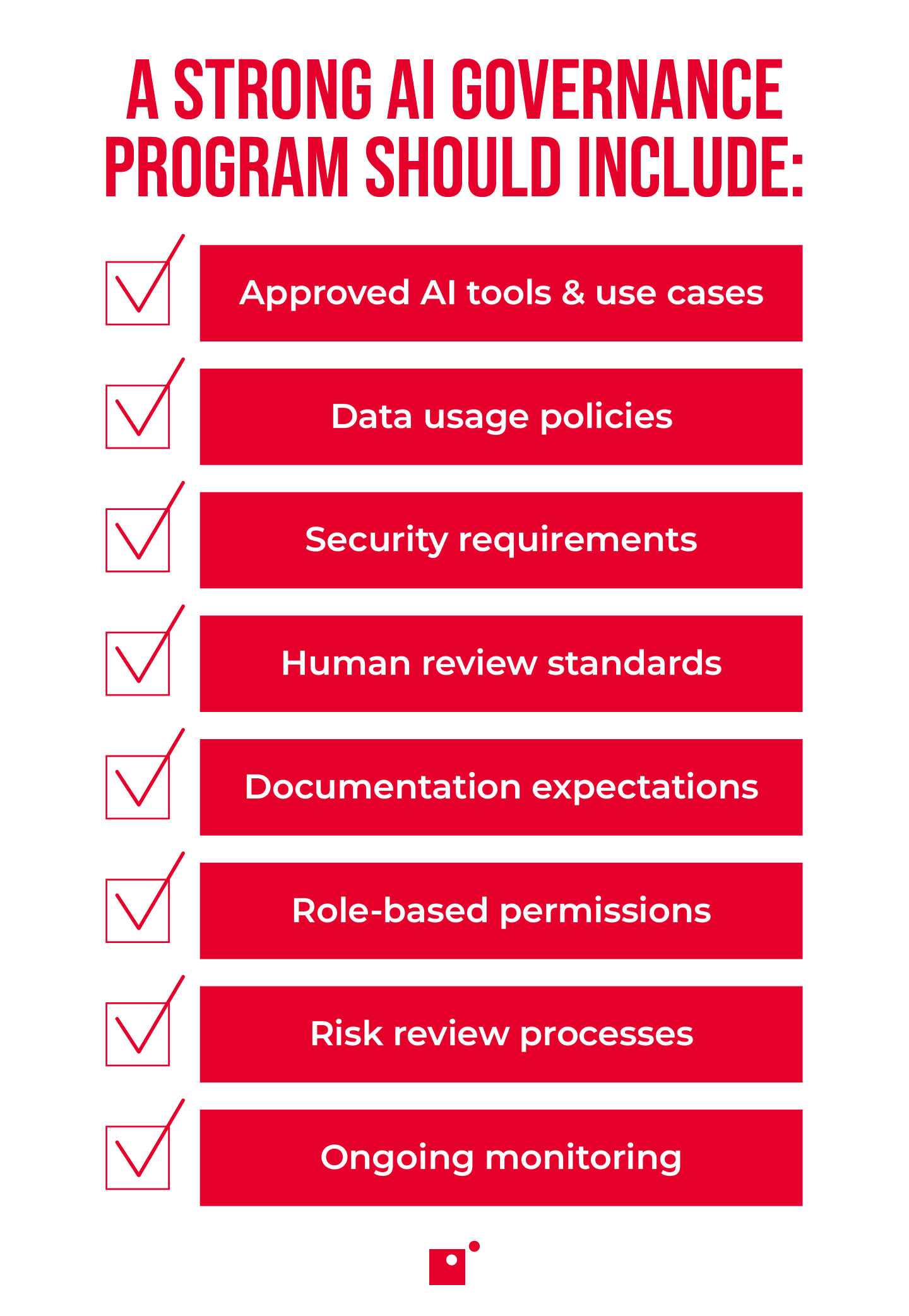
AI introduces new risks around data privacy, accuracy, bias, security, compliance, and intellectual property. Businesses need policies that define how AI can be used, what data can be entered into AI tools, who can approve use cases, and how outputs should be reviewed. For organizations that need support building those policies, ai governance consulting can help create a practical framework for responsible adoption.
AI governance should not slow innovation. It should make responsible adoption easier by giving employees clear rules of the road.
Benefits of AI in Business
AI in business is most valuable when it helps people work faster, make better decisions, reduce friction, and focus on higher-value work. The goal is not to replace every process with automation. The goal is to identify where AI can remove bottlenecks and support better outcomes.
Productivity and Cost Reduction
AI can help reduce the time employees spend on repetitive or administrative work. That might include summarizing information, drafting first versions of documents, analyzing large datasets, routing requests, answering common questions, or automating repetitive workflows.
The value is not only in doing work faster. It is in freeing people to spend more time on strategic, creative, relationship-driven, or revenue-generating work.
For example, Impact’s HR AI case study highlights an AI assistant built to help a small HR team keep up with increasing demands and focus more on strategic responsibilities.
Better Data-Backed Decision-Making
AI can help leaders make sense of large amounts of information more quickly. When connected to the right data, AI can identify patterns, summarize trends, surface insights, and help teams evaluate options.
This is especially useful for organizations that have valuable data spread across multiple systems. AI can help transform that information into something more accessible and actionable.
Competitive Advantage for Early Adopters
Businesses that implement AI strategically can improve speed, service quality, personalization, and operational efficiency before competitors catch up. Early adoption does not mean chasing every new AI trend. It means building the internal capability to test, govern, and scale useful AI solutions.
The organizations that benefit most will likely be the ones that move thoughtfully but decisively. They will identify strong use cases, prepare their people, and build processes that allow AI to improve over time.
How to Ensure ROI from AI Implementation
AI ROI does not happen automatically. A business can spend money on AI tools and still see little return if the technology is not connected to a meaningful business goal. To get real value from AI and increase profit, leaders need to define value before implementation begins.
Start with a Business Problem
The best AI implementation strategies begin with pain points, not products. Look for areas where teams are slowed down by manual work, inconsistent processes, repeated questions, disconnected data, or decision bottlenecks.
Strong AI use cases often appear in areas like customer service, sales operations, marketing workflows, HR administration, IT support, finance and accounting, compliance, software development, knowledge management, and cybersecurity.
Once the problem is clear, it becomes easier to determine whether AI is the right solution and what success should look like.
Define Measurable Outcomes
AI initiatives should have measurable goals. These may include time saved, cost reduced, tickets resolved faster, customer satisfaction improved, employee productivity increased, or decision cycles shortened.
Examples of AI ROI metrics include:
Hours saved per week
Reduction in manual tasks
Faster response times
Improved first-contact resolution
Lower operational costs
Increased employee capacity
Higher quality or consistency of work
Reduced errors
Faster project delivery
The more specific the metric, the easier it is to evaluate whether AI is working.
How Much Does AI Cost?
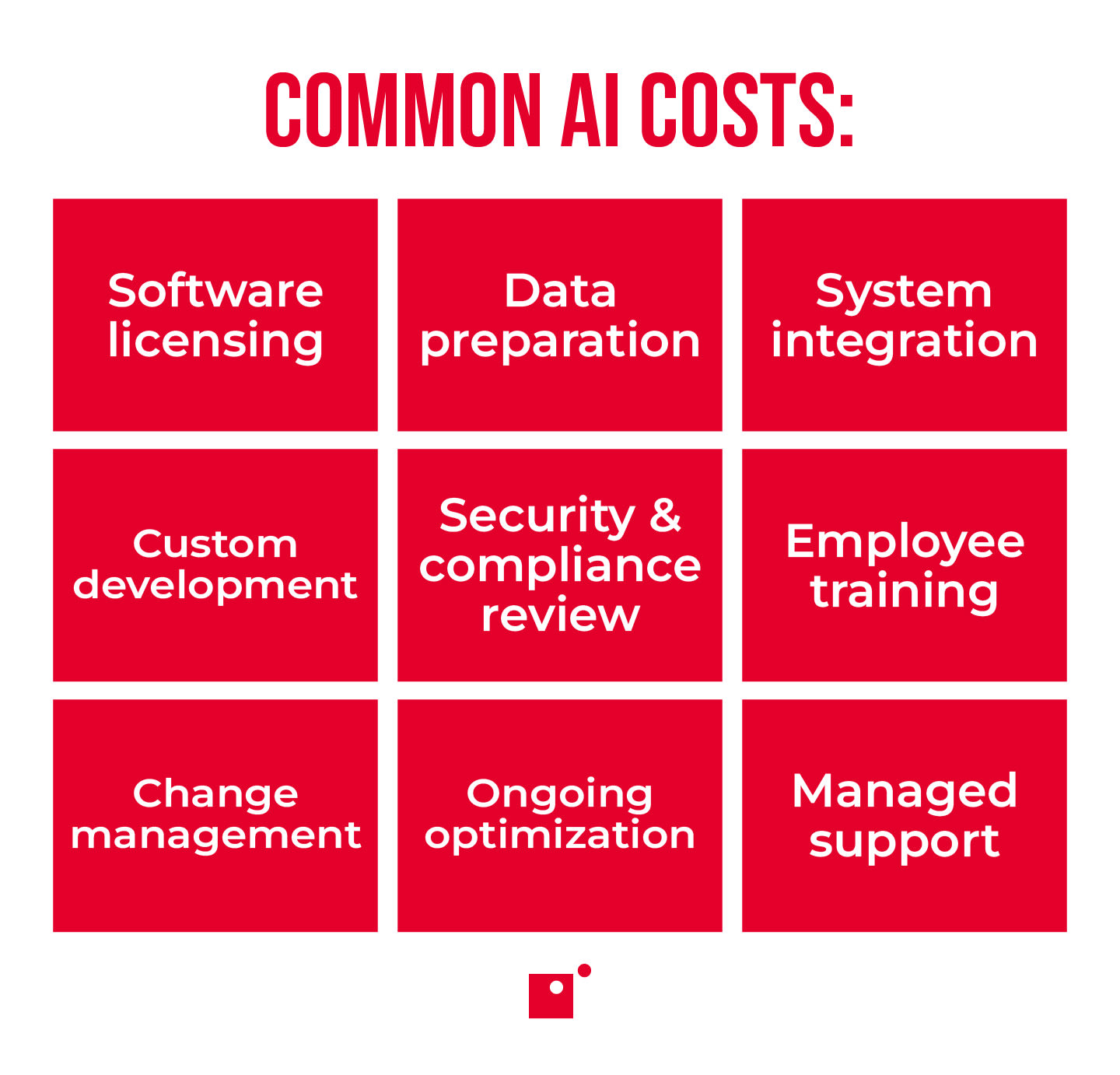
The cost of AI implementation depends on the complexity of the use case, the tools involved, the quality of your data, the level of integration required, and whether your business needs off-the-shelf software, custom development, consulting, or managed services.
A simple AI tool rollout may be relatively low cost. A custom AI application connected to multiple business systems will require more investment. The key is to compare cost against the value of the business problem being solved.
Building the AI Business Case
A strong AI business case should include:
The business problem: What is slowing the team down or limiting growth?
The current cost of the problem: How much time, money, or opportunity is being lost?
The proposed AI solution: What will AI do, and how will it fit into the workflow?
Expected outcomes: What measurable improvements should the business expect?
Risks and requirements: What governance, data, security, and adoption needs must be addressed?
Timeline and ownership: Who will lead implementation, adoption, and optimization?
ROI measurement: How will success be tracked after launch?
The business case does not need to be overly complicated. It just needs to connect AI investment to real business value.
Tools vs. Managed Services
Some businesses can implement AI tools on their own. Others need support evaluating use cases, integrating systems, building custom solutions, training employees, and managing long-term adoption.
AI tools may be enough when the use case is simple, the data is clean, and the workflow is easy to manage. Managed AI services or AI consulting may be better when the business needs strategy, governance, integration, custom development, or ongoing optimization.
Impact’s AI consulting services are positioned around helping organizations bring real value to the business with solutions tailored to their unique needs, while its AI enablement services focus on turning disconnected AI efforts into a cohesive, scalable strategy.
Examples of AI in Business
AI can support nearly every department, but the best use cases depend on your business goals, industry, and operational challenges. Here are several examples of how AI can be used in business.
AI in Healthcare
In healthcare, AI can help improve administrative efficiency, patient engagement, documentation, scheduling, analytics, and operational workflows. It can also support more informed decision-making by helping teams analyze large volumes of information.
The biggest opportunities often come from using AI to reduce administrative burden so healthcare professionals can focus more time on patient care.
AI in Manufacturing
AI in manufacturing can support predictive maintenance, quality control, demand forecasting, production planning, supply chain visibility, and workflow automation. Manufacturers can use AI to identify equipment issues earlier, reduce downtime, improve consistency, and better understand operational performance.
AI in Customer Service
Customer service teams can use AI to summarize conversations, route tickets, draft responses, answer common questions, analyze customer sentiment, and reduce repetitive work for support teams.
AI in HR
HR teams often manage high volumes of repetitive questions, documentation, policy information, and administrative processes. AI can help employees find answers faster, support onboarding, summarize information, and reduce the manual workload placed on lean HR teams.
AI in Cybersecurity
AI can support cybersecurity by helping teams analyze large volumes of alerts, identify suspicious patterns, improve response times, and strengthen governance around AI use. However, AI also introduces new risks, which makes security frameworks and governance especially important.
Businesses need to think about both sides of AI in cybersecurity: how AI can strengthen defenses and how AI tools themselves need to be governed, secured, and monitored.
AI in Development
Development teams can use AI to reduce repetitive coding tasks, support debugging, generate documentation, and speed up development workflows. AI coding assistants can help developers focus more on complex problem-solving and less on redundant work.
The AI Implementation Strategy and Process
An AI implementation strategy should give your business a clear path from exploration to adoption. While every organization’s roadmap will look different, the process should be practical, measurable, and tied to business outcomes.
Impact’s AI consulting process is built to help businesses move from uncertainty to execution by bridging the gap between technology, process, and strategy.
Rather than treating AI as a one-time tool rollout, the process focuses on understanding where AI can create value, building a plan around business goals, implementing solutions with minimal disruption, and continuously improving them over time.
Consulting
The first step in AI implementation is understanding where your business is today and where AI can realistically help. This starts with evaluating current processes, systems, workflows, and data governance frameworks to identify opportunities for AI integration.
At this stage, the goal is not to force AI into every part of the business. It is to uncover the areas where AI can solve real problems, reduce friction, improve decision-making, or help teams work more efficiently.
Ask yourself these questions:
What problems are we trying to solve?
Which processes are most inefficient today?
Where are employees spending too much time on repetitive or manual work?
What systems and data sources would AI need to access?
Is our data organized, secure, and usable?
Do we have the right governance policies in place?
Are employees ready to adopt AI tools?
Who will own AI decisions internally?
This step helps identify what is possible now, what needs preparation, and where AI can create the most value.
Strategy Development
Once the opportunities are clear, the next step is building an AI strategy that aligns with your organization’s goals. This means identifying where AI can have the greatest impact, analyzing your existing infrastructure, and creating a plan that connects AI to measurable business outcomes.
A strong AI strategy should prioritize use cases based on business impact, implementation complexity, data availability, risk level, employee adoption potential, expected ROI, and scalability.
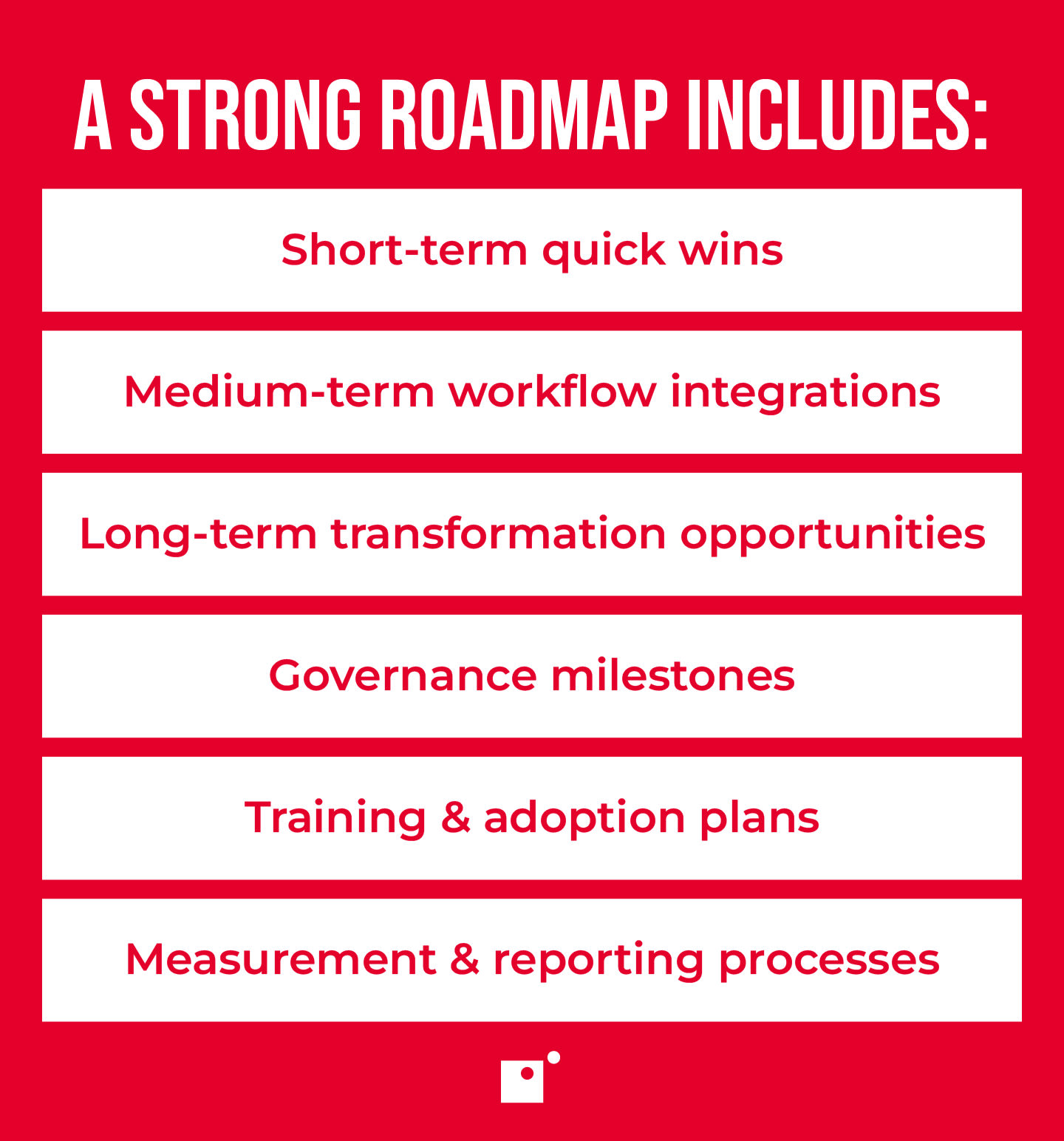
This is also where businesses should build an AI roadmap. The roadmap turns ideas into a clear plan by outlining which use cases should be pursued first, what resources are needed, what systems must be connected, and how success will be measured.
This keeps AI from becoming a collection of disconnected experiments. Instead, every initiative has a clear purpose, owner, and path to value.
Implementation
After the strategy is in place, the next step is applying AI solutions in a way that supports the business without creating unnecessary disruption. Implementation may involve integrating existing AI tools, building custom solutions, connecting systems, preparing data, setting permissions, and educating employees on how to use AI effectively.
This is where planning becomes action. The organization should define what tools can be used, what data can be shared, how AI outputs should be reviewed, and who is responsible for oversight.
A successful implementation should include:
Preparing data and systems
Connecting AI tools to existing workflows
Defining governance and security requirements
Setting permissions and access controls
Piloting the solution with a focused group
Training employees on approved use cases
Establishing feedback channels
Measuring early performance
A pilot can be especially useful during this stage. It gives the business a controlled way to test the solution before scaling it more broadly. During the pilot, track both quantitative and qualitative feedback. Numbers matter, but employee experience matters too. If an AI tool saves time but frustrates users, adoption may still fail.
Training should also go beyond basic tool instructions. Employees need to understand what the tool does, what it does not do, how to use it safely, and where human review is still required. The goal is to make AI feel useful, approachable, and connected to the work people already do.
Optimization
AI implementation does not end once a tool goes live. The final step is continuously monitoring and improving AI applications to make sure they remain effective, secure, and aligned with business goals.
Optimization is where businesses measure whether AI is actually delivering value. This may include tracking time saved, cost reduction, quality improvements, faster response times, increased employee capacity, or better decision-making.
During this stage, businesses should evaluate:
Is the solution achieving the intended business outcome?
Are employees using it consistently?
Are there workflow issues that need to be adjusted?
Are outputs accurate, useful, and reliable?
Are there new risks or governance needs?
Can the solution be expanded to other teams or processes?
What feedback are users providing?
The best AI strategies improve over time. As employees use the tools, new opportunities, refinements, and use cases will emerge. Businesses can then scale what works intentionally, applying the same process of consulting, strategy, implementation, and optimization to new areas of the organization.
This is how companies move from isolated AI experiments to a broader AI implementation strategy that creates measurable value across the business.
AI Governance and Risk
AI governance is the framework your business uses to manage AI responsibly. It helps define how AI is selected, approved, used, monitored, and improved.
Governance is important because AI can introduce risks related to data privacy, security, compliance, bias, accuracy, intellectual property, employee misuse, over-reliance on AI-generated outputs, and a lack of transparency.
AI governance should not exist to stop innovation. It should help employees use AI confidently and responsibly.
How to Get Started on AI Implementation Today
The best way to begin AI implementation is to start with a focused, practical assessment of where AI can create measurable business value.
Start by asking:
Where is our team losing the most time?
Which processes are repetitive or inconsistent?
Where do employees need faster access to information?
What decisions would improve with better data?
What customer or employee experiences could be improved?
What risks need to be addressed before we scale AI?
From there, identify one or two use cases that are valuable, manageable, and measurable. Build a business case, define success metrics, and decide whether your organization can implement the solution internally or needs help from an AI consulting partner.
AI implementation works best when strategy, technology, people, and governance move together. The goal is not to use AI everywhere. The goal is to use AI where it makes work better, decisions smarter, and business outcomes stronger.
Impact’s AI services can help businesses move from scattered AI ideas to a clear implementation strategy, whether that means identifying high-value use cases, integrating AI tools, building custom solutions, creating governance, or supporting long-term adoption.
AI is already changing how businesses operate, but the companies that see the most value will be the ones that implement it with purpose.
Whether you are exploring your first AI use case or trying to scale AI across your organization, Impact can help you build a strategy, connect the right tools, manage risk, and turn AI into real business value.
Lauren Hando is a Copywriter for Impact's in-house marketing team. She writes, edits, and reviews copy for a variety of mediums—including print, digital, video, social, paid ads, sales collateral, and more—to motivate the target audience and support the sales team.