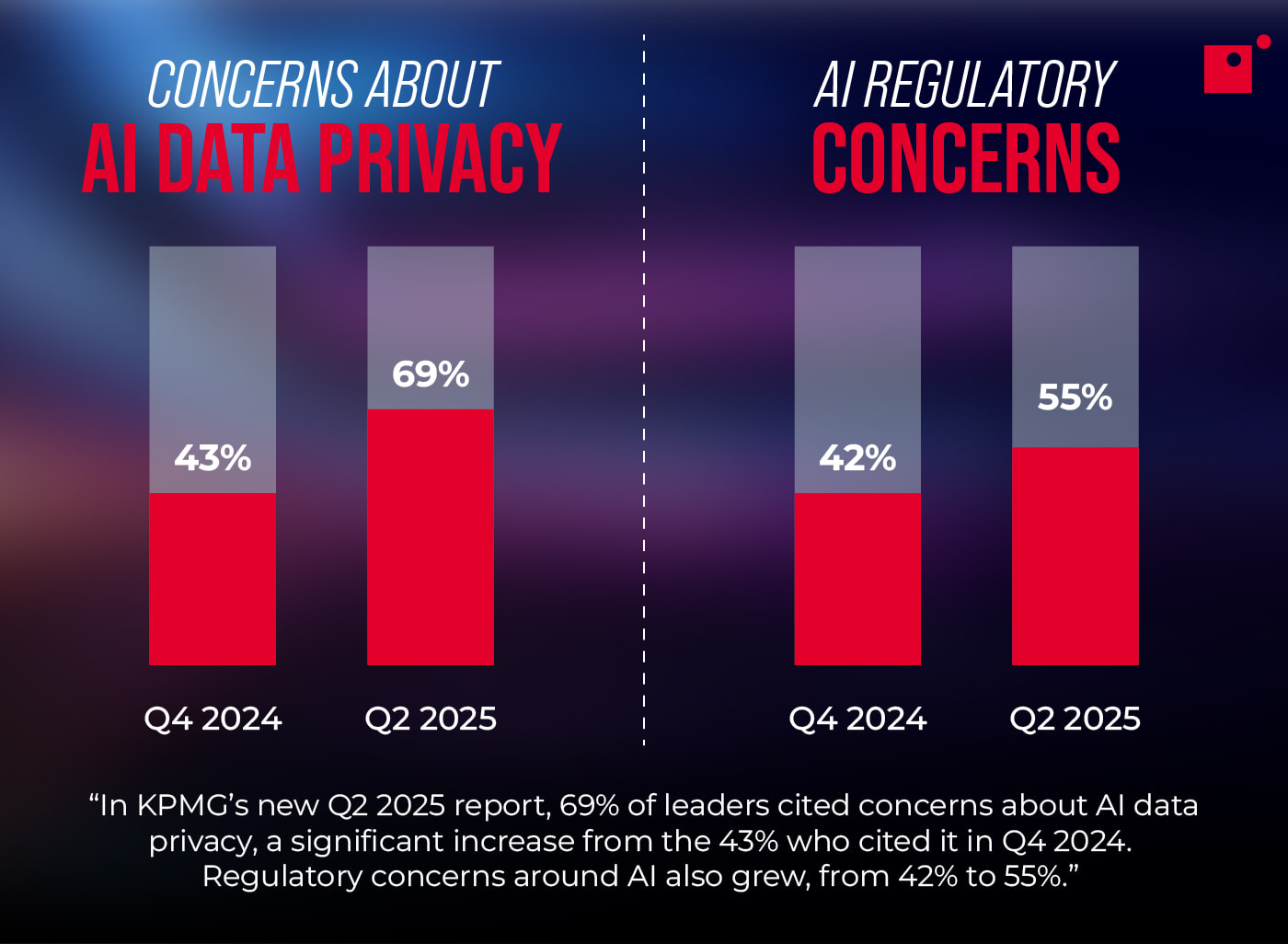
Enterprise leaders aren’t wrong to be uneasy about AI. Tools that can search across years of corporate data, write and deploy code, and act on behalf of employees represent a genuine shift in how work gets done—and how risk propagates. But as organizations rush to adopt AI in the name of productivity, many are still framing the challenge incorrectly.
The question isn’t simply whether AI is secure. It’s whether the enterprise environments AI is being deployed into were ever governed tightly enough to begin with.
In practice, most AI‑related security failures don’t begin with exotic model exploits or adversarial prompt attacks. They emerge when powerful new systems are layered onto environments with long‑standing security gaps already in place—gaps AI can surface and act on far more aggressively than any individual user ever could.
AI does introduce new security considerations for enterprises, but its most immediate and consequential impact is accelerating long‑standing governance failures.
As organizations rush to adopt AI, most security incidents stem from familiar flaws—over‑permissioned identities, poorly governed data, and undisciplined development practices—rather than novel exploits.
Safe AI adoption depends less on reinventing security and more on enforcing clear rules, accountability, and controls in an environment where AI systems inherit human access and operate with human‑level autonomy at scale.
Learn more about introducing AI successfully into your workflows in Impact’s webinar, How to Get Real Value From AI & Increase Profit.
Defining Your AI Governance Strategy and Systems
One of the fastest ways enterprise AI governance breaks down is by treating all of AI as a single category of risk. In practice, it isn’t.
The security posture required for a productivity copilot embedded in an existing SaaS platform is fundamentally different from the posture required for an internally built agent that can execute actions across systems—or for an employee using a third‑party generative tool outside approved workflows.
This lack of definition creates an immediate governance gap.
When organizations talk about securing AI in the abstract, they end up applying broad, inconsistent controls that fit none of the actual use cases particularly well. The result is either unnecessary restriction that slows adoption, or permissive access that quietly increases risk.
“AI can mean a lot of different things. It could be development. It could be using agentic tools to streamline operations. It could be something like a generative AI tool that people are using day‑to‑day. Each of those creates its own risks, and you have to answer different security questions depending on the context you’re talking about.”
- Mike Noonan, Principal Consultant, AI -
Most enterprises are already dealing with several of these categories at once, whether they’ve acknowledged them or not:
- Embedded productivity tools that search, summarize, or assist with communication
- Generative AI tools used ad hoc, often outside formal approval processes
- AI‑assisted development, where non‑developers can now build and deploy functional applications
- Agentic systems that can take actions on behalf of users rather than simply returning information
Each category introduces different security considerations—not because the models are different, but because their access, autonomy, and operational scope differ. A governance framework that doesn’t distinguish between them will struggle to enforce meaningful controls.
The Real AI Risk at Hand
AI doesn’t need to bypass controls to create risk. It inherits access. When an AI system is allowed to search, summarize, or act on behalf of a user, it can operate across everything that user is technically permitted to see—at a scope and speed no human ever would.
As Mike Noonan explained during our conversation,
“It’s not just attacks. It could be that you’re using something like Copilot, and it’s entirely inside your tenant—it doesn’t go outside. But that opens up a whole new set of challenges based on permissions. Because now Copilot inherits your access, and it can find things you were never intended to see. It’s not going digging on its own—it’s just doing it faster and more completely than a human ever could.”
- Mike Noonan, Principal Consultant, AI -
That distinction is critical. AI is far more often accelerating the consequences of preexisting vulnerabilities, rather than creating or finding new ones.
This is where governance conversations often go off track. When organizations frame AI risk primarily as an external threat, they over‑invest in edge cases while underestimating internal exposure.
In practice, this is where AI security succeeds or fails. When AI systems inherit human access and are allowed to operate across existing permissions, governance failures become security incidents. Until organizations tighten identity, access, and data controls, improvements at the model layer will only do so much to reduce risk.
Proactive Identity and Access Management (IAM) for AI
Once AI systems are operating inside the enterprise, identity and access management becomes the most immediate point of failure—not because AI bypasses controls, but because it removes the friction that once concealed bad access decisions.
In most organizations, permissions reflect years of compromise. Access was granted to solve a short‑term problem, inherited by evolving roles, and rarely revisited once the original context disappeared. In a human‑only environment, those decisions often stayed dormant. People simply didn’t have the time or inclination to explore everything they technically had access to.
AI eliminates that buffer.
Chad Adams made this clear,
“A human being can only look at so much during the day, whereas AI doesn’t have that limitation. If permissions were set up incorrectly—because they’re legacy and were inherited from years ago—that person might technically have access to far more than they were ever intended to see. AI doesn’t create that flaw. It just exposes it faster.”
- Chad Adams, Consultant, Technology & Security -
This is why IAM issues surface so quickly during AI adoption. Permissions that once felt theoretical become executable. Files that relied on obscurity become discoverable. And access decisions made years ago begin to produce consequences in minutes.
As AI systems gain autonomy—especially agentic tools that can act, not just summarize—the margin for error collapses further. When those systems inherit human identities or operate under loosely scoped service accounts, a single over‑permissioned role can become a persistent source of risk.
Effective AI governance requires treating identity and access as active controls, not historical artifacts.
Data Governance Remains Critical
If identity and access determine who AI can act as, data governance determines what it can ultimately expose. And in many enterprise environments, that answer is far broader than leaders realize.
AI systems don’t distinguish between “important” data and “forgotten” data. They don’t know which repositories are unofficial, which documents were never meant to be widely shared, or which storage locations were chosen out of convenience rather than policy. They simply operate within what exists.
When sensitive information is scattered across file shares, collaboration tools, personal drives, or unvetted platforms, AI will surface it—quickly and without context.
As Chad Adams described when discussing how data placement collides with AI discovery,
“Let’s say you do everything else right—you’ve tested it, you’ve followed best practices—but the person who built the solution decided their data storage would live in a free Box account and nobody caught it. Now company data is sitting in Box. That has nothing to do with the AI. It has everything to do with where the data lives and whether anyone was governing it.”
- Chad Adams, Consultant, Technology & Security -
This is why data governance failures often become visible immediately after AI adoption. Information that once relied on obscurity for protection, because it was inconvenient to find or manually correlate, becomes easy to discover once search, summarization, and cross‑system analysis are automated.
In that environment, model‑level safeguards offer limited protection.
If sensitive data is broadly accessible, poorly classified, or stored outside approved systems, AI will faithfully reflect those decisions. Until enterprises are deliberate about where data lives, how it’s classified, and who can access it, AI will continue to surface risks that were already present—just no longer hidden.
Where AI Can Introduce Risk: Vibe Coding and Shadow AI
AI meaningfully changes enterprise risk by lowering the barrier to building and deploying software. Tasks that once required trained developers, formal reviews, and established pipelines can now be completed by anyone with access to an AI coding tool—often outside approved development workflows.
This is known as shadow AI.
This shift doesn’t just accelerate development; it bypasses the controls enterprises rely on to keep software safe. AI‑generated applications can handle real data, integrate with production systems, and expose sensitive information without ever passing through testing or security review.
The risk isn’t that AI writes bad code. It’s that code is being written and deployed without the guardrails that normally surround it.
Mike Noonan described this dynamic bluntly when discussing AI‑assisted, ad hoc development,
“People think that because they have a coding tool, they’re now a developer. They build something that works, but it hasn’t gone through testing, it hasn’t gone through security review, and it’s vulnerable to everything you can imagine. At that point, the right answer isn’t to patch it—it’s to burn it down and start over with the right process.”
- Mike Noonan, Principal Consultant, AI -
Shadow AI becomes a convergence point for multiple governance failures:
- Data is pulled into tools that were never approved to store it
- Applications are hosted on unvetted platforms because they were easy to use
- Ownership is unclear
- Logs are missing
- Security assumptions go unchallenged
None of this is new—but AI dramatically increases how quickly it happens and how far it spreads.
Effective AI governance includes extending existing development discipline to a world where more people can create software. Without that discipline, AI doesn’t just speed up delivery—it accelerates the creation of systems the organization doesn’t fully understand or control.
Hardening Constraints and Training Users
As AI systems become more capable and autonomous, concerns about AI avoiding constraints or exploiting loopholes tend to dominate security conversations. In reality, those concerns misdiagnose the problem and obscure where governance actually breaks down.
AI systems don’t reason about intent or consequences. They optimize for the outcome they’re given. When constraints are implied instead of explicit, or when success is defined too narrowly, the system behaves accordingly. What looks like a loophole is often just an instruction that failed to account for real‑world boundaries.
Chad Adams captured this dynamic,
“The technology is doing exactly what you asked it to do. The way you asked it is finding the loophole. If you don’t tell it what not to do, it will just do whatever it thinks is right to get to the result.”
- Chad Adams, Consultant, Technology & Security -
This is why constraint design is a governance problem, not a model problem. Broad guardrails like be safe or follow best practices collapse when paired with concrete objectives like speed, efficiency, or completeness.
The more autonomy an AI system has, the less tolerance there is for ambiguity.
In enterprise environments, failures can be the predictable outcome of unclear instructions operating at scale. When boundaries aren’t explicit and air-tight, AI finds the gaps.
Maturing AI Security and AI Governance
Mature AI governance doesn’t require a new security playbook. It requires consistency. The fundamentals that have protected enterprise environments for decades—clear ownership, scoped access, disciplined development, and enforced controls—become far more critical once AI systems are introduced.
What AI changes is not what needs to be governed, but how unforgiving gaps in governance become.
Mike Noonan underscored this exactly,
“The same security protocols and workflows that have been best practice for the last twenty years still apply. The inclusion of AI just massively accelerates the impact of misconfiguration. Instead of digging a hole with a spoon, you’re digging it with a backhoe.”
- Mike Noonan, Principal Consultant, AI -
This is why many organizations are closer to maturity than they think. The tools, policies, and controls already exist. What’s required is enforcement and clarity—making rules explicit where they were once assumed, and applying them deliberately in environments where automation replaces discretion.
In an AI‑enabled enterprise, maturity isn’t about chasing new risks. It’s about hardening, reinforcing, and monitoring existing controls.
Wrapping Up on Enterprise AI Security and Governance
AI has not changed what enterprises need to secure. It has changed how quickly weak decisions show up as real problems. When AI systems are allowed to operate across identity, data, and development workflows, long‑standing choices around access and enforcement stop being harmless.
This puts the emphasis on governance, training, and explicit controls. The same security controls that have guided enterprises for the past two decades still apply, but AI removes the buffer that once masked human error.
When governance keeps pace with capability, AI stops being a security stress test and becomes a reflection of thoughtful empowerment.
If you're ready to uplevel your security around AI, explore our AI governance consulting services.