Operational efficiency determines how much value your business extracts from every resource it has, like time, people, technology, and capital. Whether you're looking to cut costs, scale faster, or simply run a tighter operation, understanding how to identify and eliminate inefficiency is the first step toward building a stronger business.
- What is Operational Efficiency
- Operational Efficiency vs. Productivity, Profitability, and Cost Cutting
- Why Businesses Struggle with Operational Efficiency
- Signs Your Business Has Inefficiencies
- How to Measure Operational Efficiency
- Identifying Operational Efficiency Opportunities
- Ways to Improve Operational Efficiency
- Operational Efficiency by Business Area
- Real World Examples of Operational Efficiency
- Common Mistakes to Avoid
Streamline Processes
How to Improve Operational Efficiency
Learn what operational efficiency is, how to measure it, and the practical steps businesses can take to improve performance across every department.
Guide
Jun 26, 2026
What is Operational Efficiency?
At a basic level, operational efficiency is how well a business transforms its resources into results.
It's never an exact type of measurement, but you can think of it like a ratio between what you put in (time, money, people, technology) and what you get out. The higher that ratio, the more your business accomplishes without unnecessary cost or effort.
But, know that it's not just about doing things cheaper. True operational efficiency means doing things better. This can mean many things, like:
- Faster processes
- Fewer errors
- Stronger systems
- Teams focused on work that actually moves the needle
For businesses navigating around constant change, rising cyberthreats, and growing pressure to do more with less, operational efficiency becomes a genuine competitive necessity that cannot be ignored.
Operational Efficiency vs. Productivity, Profitability, and Cost Cutting
Operational efficiency is often confused with related business concepts, but the distinctions between them all do matter.
Here's how it differs from three terms it's frequently mixed up with (productivity, profitability, and cost cutting):
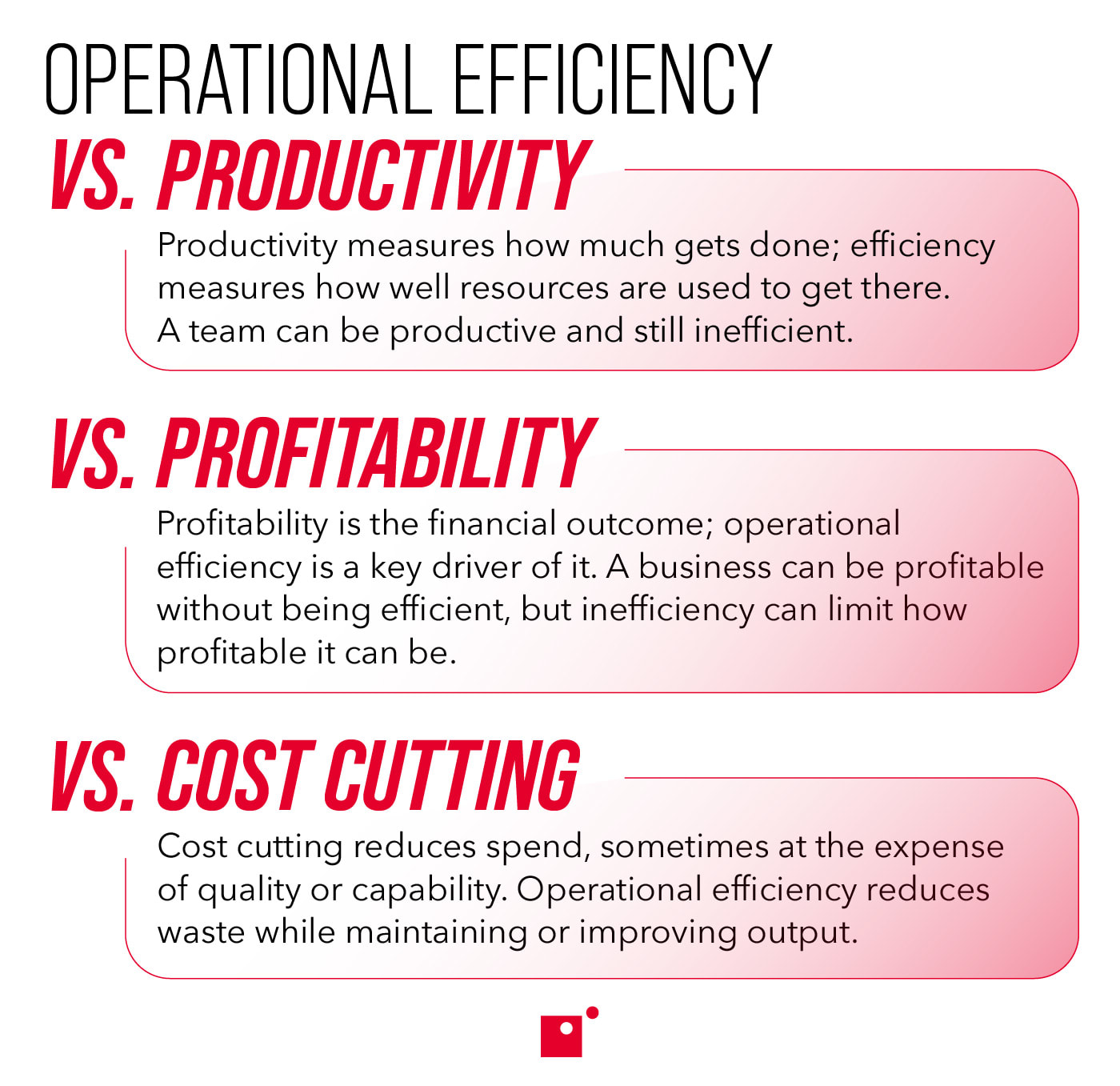
- Operational efficiency vs. productivity: Productivity measures output, i.e. how much gets done. Operational efficiency measures how well resources are used to achieve that output. A team can be highly productive while still being inefficient if they're burning excess time, tools, or budget to get there.
- Operational efficiency vs. profitability: Profitability is the financial outcome; operational efficiency is a key driver of it. A business can be profitable without being efficient, but inefficiency will always cap how profitable it can become. Efficiency creates the margin that turns good revenue into great profit.
- Operational efficiency vs. cost cutting: Cost cutting reduces spend, sometimes at the expense of quality or capability. Operational efficiency reduces waste while maintaining or improving output.
Why Businesses Struggle with Operational Efficiency
Most businesses have no lack of ambition when it comes to improving operational efficiency, but many of them struggle because the obstacles are real and interconnected.
- Legacy systems make modernization costly and complex
- Disconnected tools create data silos that obscure visibility and force manual workarounds
- Cybersecurity risks lurk inside every new process and platform, often going unaddressed until something breaks
- Internal teams are stretched thin, rarely carrying deep expertise across IT, automation, and security simultaneously
- Lack of clear metrics makes it difficult to know which inefficiencies are actually worth fixing first
The result is a cycle where businesses keep patching problems instead of solving them, which, eventually, just leads to more problems. Breaking that cycle requires honest assessment, the right technology investments, and, often, outside expertise that can see the full picture and prioritize what matters most. It’s getting this clarity first that makes improving operational efficiency doable.
Signs Your Business Has Operational Inefficiencies
Operational inefficiencies rarely announce themselves to be obvious. Instead, they accumulate quietly until they're too costly to ignore and spring up in the form of irritated workers, long processes, upset customers, or cyberattacks.
Here are five signs your business may have a problem worth addressing:
- Employees are drowning in manual work: If your team is spending significant time on repetitive, low-value tasks, automation opportunities are being left on the table and talent is being wasted.
- Systems don't communicate with each other: When employees are manually transferring data between platforms or maintaining separate spreadsheets to fill the gaps, you have an integration problem that's bleeding productivity daily.
- Response times are slowing down: Whether it's customer requests, internal approvals, or IT issues, sluggish response times signal process bottlenecks that compound over time.
- Security incidents are increasing: Frequent breaches, vulnerabilities, or compliance gaps often indicate that operational processes and technology infrastructure haven't kept pace with evolving threats.
- Costs are rising without clear cause: When overhead climbs but output stays flat, inefficiency is almost always the culprit hiding in the details.
How to Measure Operational Efficiency
While there is no single measurement that can tell you your operational efficiency, it can be determined using various metrics across your operations.
Measuring operational efficiency requires looking beyond revenue and headcount to the metrics that reveal how well your processes actually perform. Key indicators include overall equipment effectiveness (OEE), process cycle times, cost per unit of output, employee utilization rates, and error or rework rates.
On the technology side, system uptime, ticket resolution times, and security incident frequency tell a revealing story about infrastructure health.
The most important step is establishing baselines.
Without knowing where you started, improvement is impossible to quantify. Regular audits, performance dashboards, and clearly defined KPIs give leadership the visibility needed to make confident, data-driven decisions and track progress over time.
Here are some of the most valuable operational efficiency metrics and what they actually tell you:
Key Metrics for Measuring Operational Efficiency
- Overall Equipment Effectiveness (OEE): Measures how productively your equipment and technology are being used relative to their full potential
- Process cycle time: Tracks how long it takes to complete a specific process from start to finish, shorter cycles generally indicate greater efficiency
- Cost per unit of output: Reveals how much it costs to deliver a product or service, highlighting where resources may be misallocated
- Employee utilization rate: Shows what percentage of employee time is spent on productive, billable, or high-value work versus administrative or redundant tasks
- First-time resolution rate: Measures how often issues are resolved without requiring rework or escalation, a strong indicator of process and team quality
- System uptime and availability: Tracks how reliably your IT infrastructure performs, directly tied to productivity and revenue continuity
- Mean time to resolve (MTTR): Indicates how quickly IT or operational issues are identified and fixed, reflecting the responsiveness of your support systems
- Security incident frequency: Monitors how often vulnerabilities or breaches occur, signaling whether your cybersecurity posture is keeping pace with operational growth
- Customer satisfaction score (CSAT): Ties operational performance directly to customer experience, revealing where inefficiencies are affecting the people you serve
Step-by-Step: How to Identify Operational Efficiency Opportunities
Before you can improve operational efficiency, you need to know exactly where it's breaking down. That starts with a structured, honest assessment of how your business actually operates today.
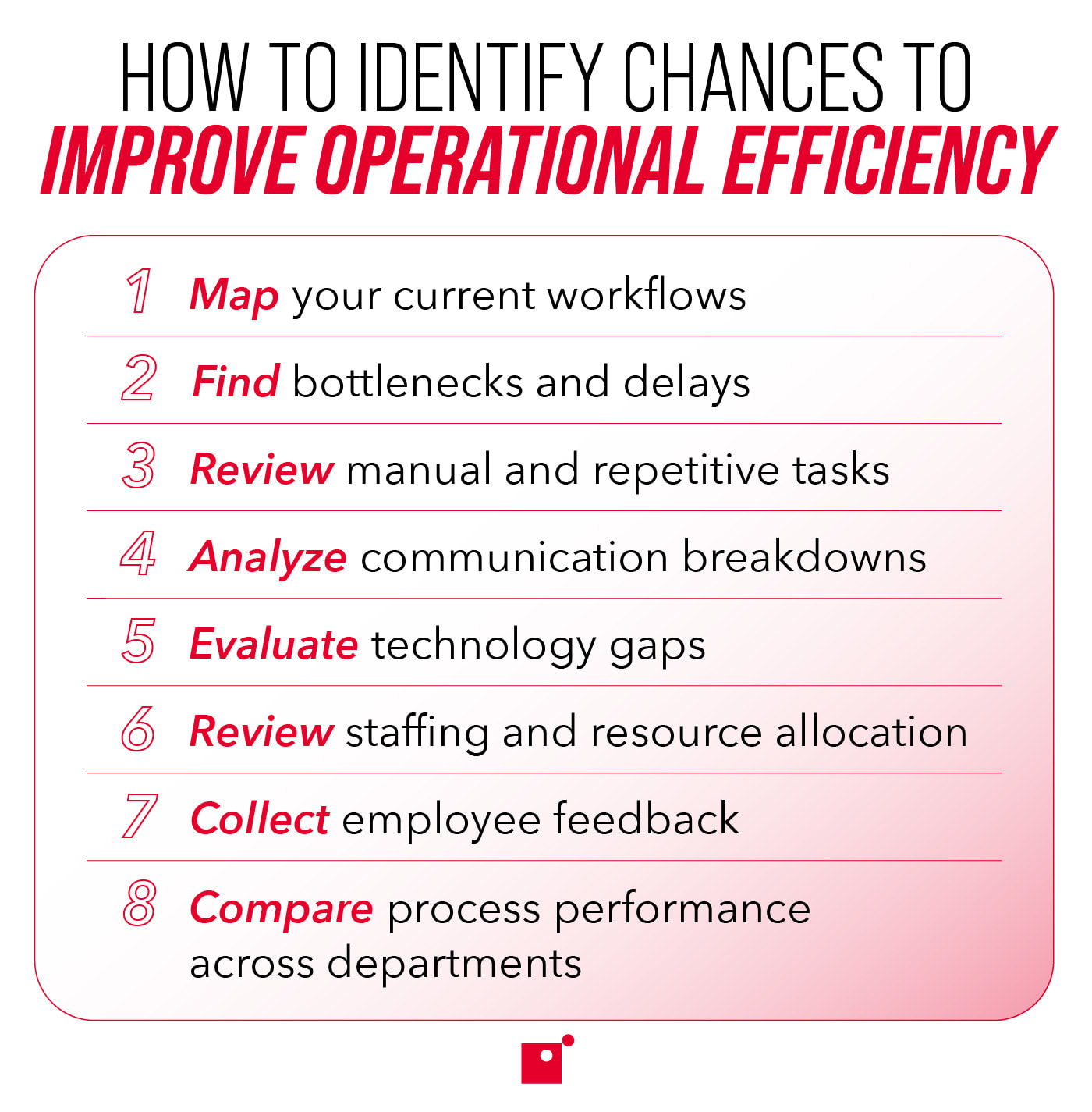
1. Map Your Current Workflows
Start by documenting every core process from end to end.
Who does what, in what order, using which tools, and how long does each step take?
Process mapping creates a visual blueprint of your operations that makes bottlenecks, redundancies, and handoff failures immediately visible.
Many businesses discover during this step that processes evolved organically over time and no longer reflect how work should actually flow. Without this foundation, any efficiency initiative risks addressing symptoms rather than root causes.
A clear map is the starting point for every meaningful improvement that follows.
2. Find Bottlenecks and Delays
Once workflows are mapped, look for where work consistently slows down or stalls.
Bottlenecks often hide in approval chains, handoffs between departments, or overburdened team members who have become single points of failure. Measure cycle times at each stage and compare them against benchmarks or internal targets.
Delays compound, a small slowdown early in a process can create significant downstream disruption. Identifying and addressing these chokepoints often produces immediate efficiency gains without requiring major technology investments or organizational restructuring.
3. Review Manual and Repetitive Tasks
Take inventory of every task your team performs manually on a recurring basis. This can include data entry, report generation, invoice processing, status updates, and similar work. These tasks are prime candidates for automation through AI and modern workflow tools. Beyond the time they consume, manual processes introduce human error and create inconsistency at scale.
Next, quantify how many hours per week are spent on these activities across your organization. The numbers are often surprising, and they make a compelling case for investing in automation tools that free your team to focus on higher-value, strategic work.
4. Analyze Communication Breakdowns
Inefficiencies frequently live inside communication gaps like missed handoffs, unclear ownership, duplicated messages across too many platforms, or decisions that stall because the right people weren't in the loop.
This step involves auditing how information flows across your organization. Ask questions like: Are teams using too many disconnected tools? Are critical updates getting lost in email threads? Is there confusion about who owns what?
Poor communication slows execution, creates rework, and breeds frustration. Streamlining communication channels, clarifying accountability, and integrating your collaboration tools can eliminate significant hidden inefficiency without requiring dramatic operational changes.
5. Evaluate Technology Gaps
Assess whether your current technology stack is actually supporting or hindering your operations.
Are teams working around tools rather than with them? Are platforms failing to integrate, forcing manual data transfers? Is aging infrastructure creating slowdowns, downtime, or security vulnerabilities?
Technology gaps are among the costliest sources of operational inefficiency, yet they go unaddressed because the workarounds become normalized. A thorough technology audit, ideally conducted with outside expertise, reveals where modernization, consolidation, or new investments would deliver the highest return on efficiency and security.
6. Review Staffing and Resource Allocation
Inefficiency isn't always a process or technology problem, sometimes it's a resource allocation problem.
Questions to ask here are: Are the right people assigned to the right tasks? Are high-skill employees spending time on low-skill work because no better system exists? Are some teams consistently overwhelmed while others are underutilized?
Reviewing how people and budget are deployed across the organization often surfaces mismatches that quietly drain productivity. Realigning resources based on actual workload data and strategic priorities can meaningfully improve output without adding headcount or increasing operating costs.
7. Collect Employee Feedback
The people closest to the work almost always know where the inefficiencies are. Frontline employees experience broken processes, frustrating tools, and communication failures every day, but are rarely asked about them in a structured way.
Build feedback loops through regular surveys, one-on-one conversations, or cross-functional working sessions in order to create an environment where identifying problems is encouraged, not penalized.
Employee feedback not only surfaces inefficiencies that leadership can't see from the top down, but it also builds the trust and buy-in needed to successfully implement improvements once they're identified.
8. Compare Process Performance Across Departments
Operational inefficiency becomes visible when you stop looking at departments in isolation and start comparing how similar processes perform across the organization.
Does one team consistently resolve issues faster than another? Are certain departments closing projects under budget while others routinely overrun?
These variances aren't random, they reveal differences in process maturity, tool adoption, leadership, and resource allocation that can be learned from and replicated.
Identify your highest-performing teams, document what they're doing differently, and use those insights to elevate performance across the board. Cross-departmental benchmarking turns internal data into a roadmap for improvement, and it builds a culture of accountability where performance is visible, measurable, and continuously raised.
5 Ways to Improve Operational Efficiency
Improving operational efficiency isn't about one big fix, it's a deliberate, ongoing process. The businesses that succeed follow a clear sequence: assess honestly, set direction, simplify and automate, then measure and adjust. Here's how that process unfolds in practice.
1. Standardize repeatable workflows
Inconsistency is a hidden driver of inefficiency. When the same task is performed differently by different people or teams, errors increase and quality becomes unpredictable.
Standardizing repeatable workflows means documenting the best way to perform common processes and ensuring everyone follows it. This doesn't mean eliminating flexibility or limiting people’s ability to creatively tackle challenges, it means removing unnecessary variation to improve outcomes.
Standardized workflows are also far easier to automate, train new employees on, and measure accurately. Creating clear documentation, templates, and standard operating procedures turns institutional knowledge into a scalable system rather than something that lives only in a few people's heads.
2. Automate manual tasks
Identify repetitive, rules-based tasks, like data entry, scheduling, report generation, or routine customer communications, and apply AI and automation tools to handle them.
This reduces human error, frees employees for higher-value work, and dramatically speeds up processes that used to take hours. Automation should be approached strategically rather than applied everywhere at once. Start with high-volume, low-complexity tasks where the return on investment is clearest, then expand from there.
3. Improve Communication Between Departments
Many operational delays aren't caused by any single team, they happen in the handoffs between teams. Improving cross-departmental communication means clarifying ownership, reducing the number of disconnected tools in use, and creating shared visibility into project status and priorities.
Regular cross-functional check-ins, shared dashboards, and clearly defined escalation paths all help eliminate the confusion that slows execution. Strong communication speeds up individual processes and builds the organizational alignment needed to sustain efficiency improvements over the long term.
4. Integrate Disconnected Systems
Fragmented technology is one of the most common sources of inefficiency. When platforms don't communicate with each other, employees waste time manually transferring data, reconciling discrepancies, and maintaining duplicate records.
Integrating your core systems (CRM, ERP, communication tools, and IT infrastructure) creates a single source of truth and eliminates these manual workarounds entirely.
Integration also improves data accuracy and gives leadership a clearer, real-time picture of operations. This is often one of the more technically complex steps, requiring careful planning to avoid security gaps or disruption during implementation, which is where experienced IT and cybersecurity partners add significant value in ensuring a smooth, secure transition.
5. Reduce Unnecessary Approvals and Handoffs
Excessive layers of approval and handoffs are a seemingly small, but actually significant source of delay in almost every business. It feels like adding layers of safety to have more people’s eyes on things, but the delays it causes (along with extra time required) slows down almost everything, especially when high-level people are involved.
Every additional person or step a task must pass through increases the chance of bottlenecks, miscommunication, and lost time.
To fix, review your approval chains and ask whether each step genuinely adds value or oversight, or whether it exists simply out of habit or outdated risk concerns. Empowering employees with greater decision-making authority within clear guardrails can dramatically speed up execution.
Defining and Improving Operational Improvements by Business Area
Operational efficiency takes a different shape depending on where you look. In different teams and departments, it can look a little different.
While the principles stay consistent, streamlining, automating, and aligning resources with priorities, the specific opportunities vary by function. Here's how efficiency improvements typically show up across key departments:
- IT and Technology Operations: Efficiency means shifting from constant firefighting to proactive infrastructure management, using automation and AI to catch issues before they cause downtime.
- Finance and Accounting: Automating invoice processing, reconciliation, and reporting reduces errors and frees finance teams to focus on strategic analysis instead of manual data entry.
- Human Resources: Streamlining recruitment, onboarding, and administrative tasks through automation gives HR teams more time to focus on culture, retention, and employee development.
- Sales and Customer Service: Integrated CRM systems and AI-assisted support cut response times and manual work, helping reps close more deals and customers get faster resolutions.
- Marketing: Automating repetitive campaign tasks and using data to guide strategy lets marketing teams move faster and invest budget where it actually performs.
- Supply Chain and Inventory: Real-time visibility into inventory and demand forecasting helps teams avoid costly overstocking, shortages, and delays caused by manual tracking errors.
- Project Management: Centralized tools and standardized processes replace scattered spreadsheets, giving managers clear visibility to catch risks before they derail timelines or budgets.
- Compliance and Risk Management: Automated monitoring keeps documentation audit-ready year-round, reducing violations while freeing compliance teams from time-intensive manual tracking.
- Field Service or Service Delivery: Smart scheduling and real-time technician tracking reduce travel time and improve first-visit resolution, creating a faster, more reliable customer experience.
Examples of Real Operational Efficiency Improvements
Sometimes the clearest way to understand operational efficiency is through real examples. These commonly seen transformations show how businesses move from manual, fragmented processes to streamlined, automated systems that save time and reduce errors.
- Automating Manual Invoice Processing: Automated workflows route invoices for approval instantly, cutting processing time from days to hours while reducing costly errors.
- Turning Disconnected Customer Data into Integrated CRM Workflows: A unified CRM eliminates duplicate records and gives sales and service teams one accurate view of every customer.
- Moving From Spreadsheet-Based Reporting to Real-Time Dashboards: Live dashboards replace static spreadsheets, giving leadership instant visibility into performance instead of outdated, manually compiled reports.
- Un-Siloing Departments to Create Shared Workflows: Shared platforms connect departments, eliminating miscommunication and manual handoffs that previously slowed projects down significantly.
- Automating HR Workflows: Automated onboarding streamlines paperwork and training schedules, creating a faster, more consistent experience for every new hire.
- Digitizing Document Management: Digital systems replace physical paperwork, making documents searchable, secure, and instantly accessible from anywhere.
Common Mistakes to Avoid When Improving Operational Efficiency
- One of the most common mistakes businesses make is jumping straight to technology before understanding the underlying process.
Buying new software or automation tools without first mapping workflows often means automating a broken process, making inefficiency faster rather than fixing it.
Another frequent misstep is treating efficiency as a one-time project rather than an ongoing discipline, leading to initial gains that quietly erode as the business grows or conditions change. Many businesses also overlook the many smaller steps found along the way, like gathering employee input or training employees on new tech/processes, which slows adoption and undermines results.
The most successful efforts start with a clear audit, involve the people doing the work, and treat improvement as continuous rather than finished.
When to Get Help with Improving Operational Efficiency
Improving operational efficiency across IT, processes, and security often requires expertise most internal teams don't have in-house.
Managed service providers bring specialized knowledge in technology integration, automation, and cybersecurity, helping businesses identify the right opportunities, avoid costly missteps, and implement changes with the experience to make them stick.
Learn more about improving your operational efficiency with the help of an MSP.

Dylan Grissom
Dylan Grissom is a Senior Copywriter for Impact's in-house marketing team, where he mentors writers, conceptualizes projects through detailed, imaginative creative direction, crafted a new set of brand voice guidelines, and wrote the overall brand messaging guide.
Impact Insights
Sign up for The Edge newsletter to receive our latest insights, articles, and videos delivered straight to your inbox.