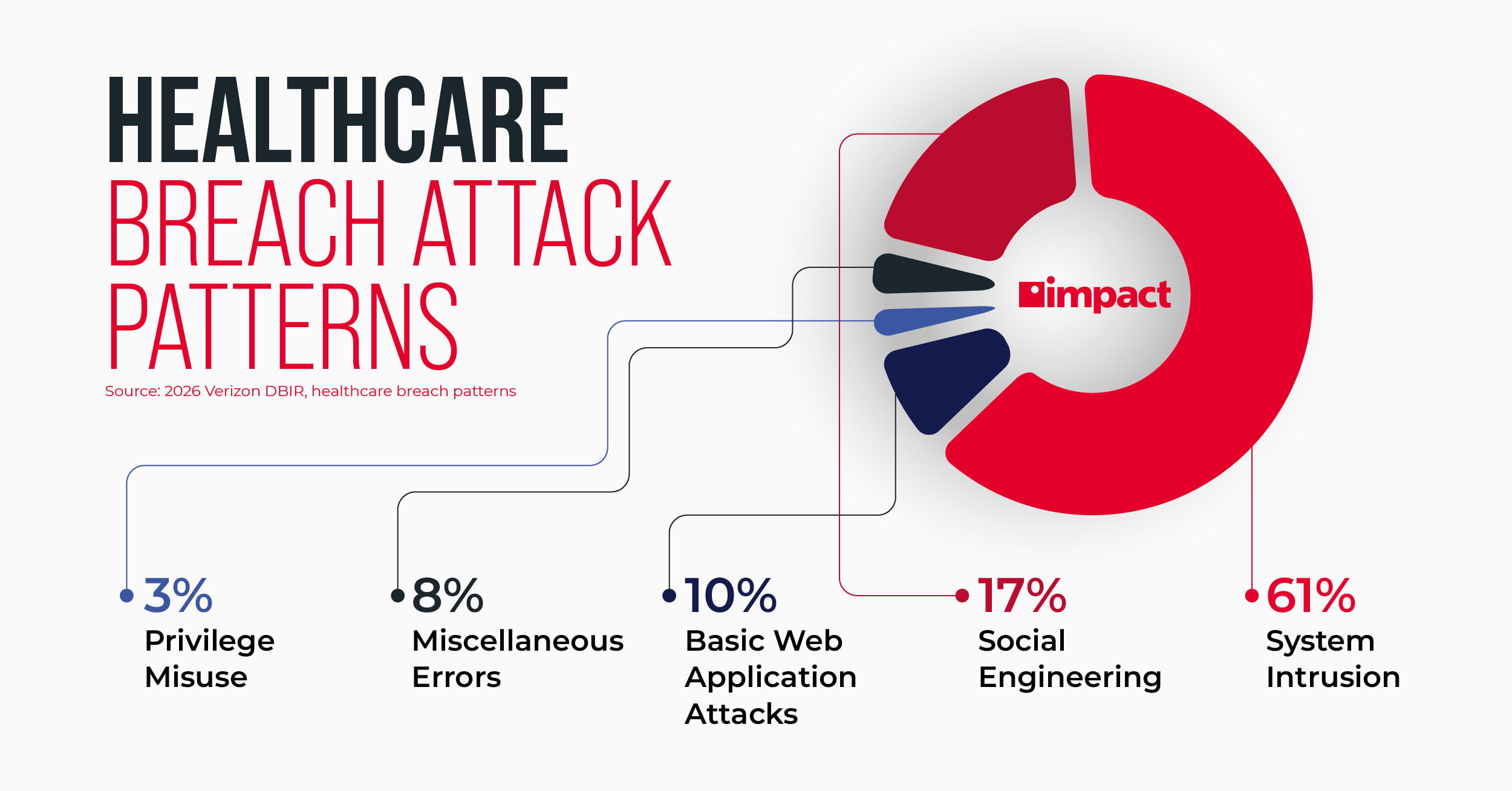
Healthcare has topped the list of the most expensive industries for data breaches for 14 years running, and the numbers behind that streak keep growing. In 2025 alone, 789 large data breaches exposed roughly 138.5 million patient records. An average of more than two major incidents every single day.
Hacking and other IT incidents now account for over 80% of those breaches, a sharp shift from the lost-laptop and misdirected-fax incidents that once dominated the headlines. The reasons healthcare stays such an attractive target are structural.
Electronic health records combine financial data, insurance information, and clinical history in one place, making them worth far more on the black market than a stolen credit card number. Hospitals also run sprawling, hard-to-patch environments layered with legacy systems, outdated devices, and a rotating cast of vendors.
While healthcare institutions remain a top target for data theft, there are ways to actively reduce your threat levels.
Below are a number of controls that healthcare institutions can implement today to strengthen security and protect sensitive data.
Discover how IT touches just about every corner of the healthcare world in Impact’s case-study round-up, Healthcare IT Case Studies Featuring Tapestry 360 Health.
Multi-Factor Authentication (MFA) and Password Managers
Compromised credentials remain one of the most common ways attackers get into healthcare networks, and a stolen password alone is rarely enough to stop them. Multi-factor authentication closes that gap by requiring a second proof of identity before granting access.
In a hospital setting, MFA has to be deployed with clinical workflow in mind. A nurse logging into a shared workstation between patients doesn't have time for a friction-heavy verification process. That's why organizations increasingly turn to proximity badges and single sign-on paired with MFA.
Paired with a password manager that generates and stores unique, complex credentials for every system, MFA eliminates two of the weakest links in healthcare security: reused passwords and unprotected single-factor logins. Under the proposed rule, MFA would become a baseline requirement.
Identity and Access Management (IAM)
MFA confirms who someone is; identity and access management determines what they're allowed to touch once they're in. In healthcare, that distinction matters enormously, because job functions and access needs change constantly across a rotating clinical staff.
Role-based access control, built on the principle of least privilege, ensures each user can reach only the systems and records their job actually requires. Automated provisioning and de-provisioning tied to HR systems closes another common gap: former employees retaining active credentials.
Regular access reviews and audit logging then create the accountability trail that both security teams and HIPAA auditors need, showing not just that a breach occurred, but who could have touched the affected data and when.
Privileged accounts deserve extra scrutiny in this model. IT administrators, EHR vendor support staff, and anyone with broad system access represent an outsized risk if their credentials are compromised.
Privileged access management tools that require additional approval, time-limit elevated access, and log every privileged session give healthcare IT teams visibility into exactly where their highest-risk exposure sits.
Network Segmentation
Even well-defended networks get breached eventually, which is why containment matters as much as prevention. Network segmentation divides a healthcare IT environment into isolated zones, separating the EHR, medical devices, and administrative networks from one another.
This is especially critical in hospitals, where a single flat network can let ransomware enter through a phishing email in the billing department and then spread to imaging systems, infusion pumps, and patient monitors within hours.
Micro-segmentation takes this further, isolating individual devices so that even systems within the same broad zone can't communicate unless explicitly permitted. The HHS' proposed rule changes would make network segmentation a formal requirement.
Data Security and Compliance
Access controls and segmentation reduce the odds of a breach; encryption determines what happens if one occurs anyway. Encrypting protected health information both at rest and in transit means stolen data stays unreadable without the corresponding keys.
The financial case for this is clear. IBM's 2025 Cost of a Data Breach Report found that strong encryption practices save organizations roughly $208,000 per incident on average, while shadow IT adds $200,000 or more to the total cost.
For healthcare organizations, compliance and security are converging on the same point. The proposed HIPAA Security Rule update would require encryption "with limited exceptions," mandatory risk analyses, and annual penetration testing.
Building toward that standard now, rather than waiting for it to become law, is the more defensible position for any covered entity or business associate.
Cloud and IoT Security
Healthcare's attack surface no longer ends at the hospital's walls. Cloud-based EHR platforms, telehealth applications, and remote monitoring tools have moved sensitive data off-premises, while connected devices have turned clinical equipment into network endpoints.
Recent incidents involving more than a million exposed connected medical devices underscore how quickly this expanded footprint can become a liability.
Securing cloud environments requires the same discipline applied everywhere else — MFA and least-privilege access for administrators, encryption for data held by third parties, and clear contractual accountability with any vendor touching PHI.
IoT and medical device security demands its own layer of controls: a full device inventory, isolated network segments, anomaly monitoring, and a patching cadence that keeps pace with new vulnerabilities. Many devices can't run endpoint security software at all.
Telehealth adds another dimension worth planning for deliberately. Video visit platforms and patient-facing apps create new pathways into clinical systems. Many adopted quickly without the same security vetting applied to core infrastructure.
Bringing these platforms under the same encryption, access control, and vendor risk review standards as the rest of the environment closes a gap that grew faster than most security programs could keep pace with.
Wrapping Up on Preventing Data Breaches in Healthcare
No single control prevents healthcare data breaches on its own. MFA and password managers stop stolen credentials from becoming full account takeovers. IAM ensures access matches actual clinical need.
Network segmentation and encryption limit how far an incident can spread and what an attacker can actually use if they get in. Cloud and IoT security close the gaps created by an increasingly connected care environment.
Together, these controls form a layered defense built for how healthcare organizations actually operate: high-pressure, high-turnover, and running on systems that can't simply be taken offline to patch.
With regulators moving toward mandatory MFA, encryption, and segmentation, and breach costs still averaging over $7 million per incident, the strongest organizations are treating these controls as infrastructure now, not compliance checkboxes later.
If your organization is evaluating where the gaps are in your current security posture, a focused risk assessment is often the fastest way to find out and to prioritize the fixes that matter most before an incident forces the issue.
Discover how IT works to make sure healthcare runs smoothly in Impact’s case-study round-up, Healthcare IT Case Studies Featuring Tapestry 360 Health.