AI in healthcare stopped being a pilot program years ago. It's now a daily tool for the majority of physicians, reshaping how providers detect disease, manage records, and spend the hours that used to disappear into paperwork.
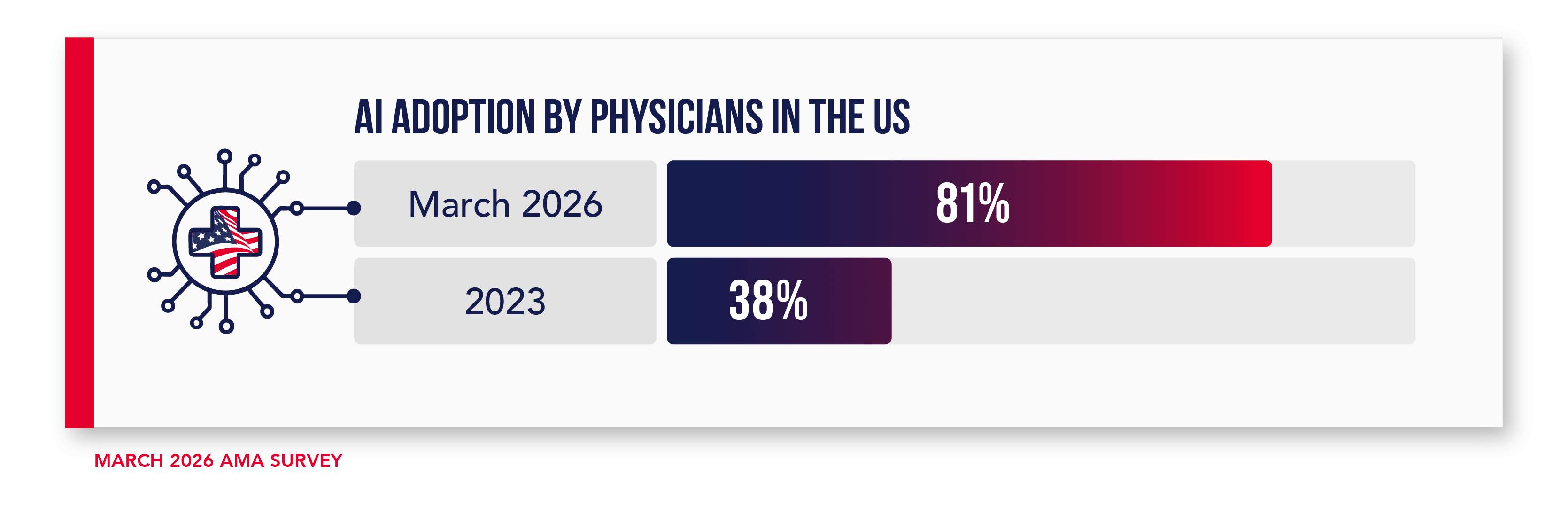
Adoption of AI in clinical practice has more than doubled in three years: a March 2026 AMA survey found 81% of U.S. physicians report using AI in their practice, up from 38% in 2023. That shift has less to do with novelty and more to do with results providers are seeing across diagnosis, documentation, and treatment planning.
Learn more about integrating AI into your systems in Impact’s webinar, How to Get Real Value From AI & Increase Profit.
Applications of AI in the Healthcare Industry
AI has many unique applications in the healthcare industry from organizing the backend to directly helping in patient care plans.
The global market for AI in healthcare is expected to reach $505.6 billion by 2033
Here are a few of the most helpful ways that AI can be beneficial to healthcare providers.
Enhanced Disease Detection and Identification
Diagnostic error remains one of medicine's most persistent problems. Johns Hopkins research estimates that roughly 795,000 Americans die or are permanently disabled by diagnostic error annually, and much of that harm traces back to the same bottleneck: too many images, charts, and data points for any one clinician to review at speed without fatigue setting in.
AI addresses that bottleneck by taking on the first pass, and it's doing so across far more than one specialty. In radiology, AI flags nodules and lesions on imaging before a human ever opens the file. In pathology, it scans tissue slides for malignant cells at a scale no lab tech could match by eye.
In cardiology, algorithms read EKGs and echocardiograms for arrhythmias and structural abnormalities in seconds. And in general hospital care, AI monitoring tools comb through vitals and lab results continuously, flagging early signs of sepsis or deterioration long before symptoms would prompt a nurse to call a physician.
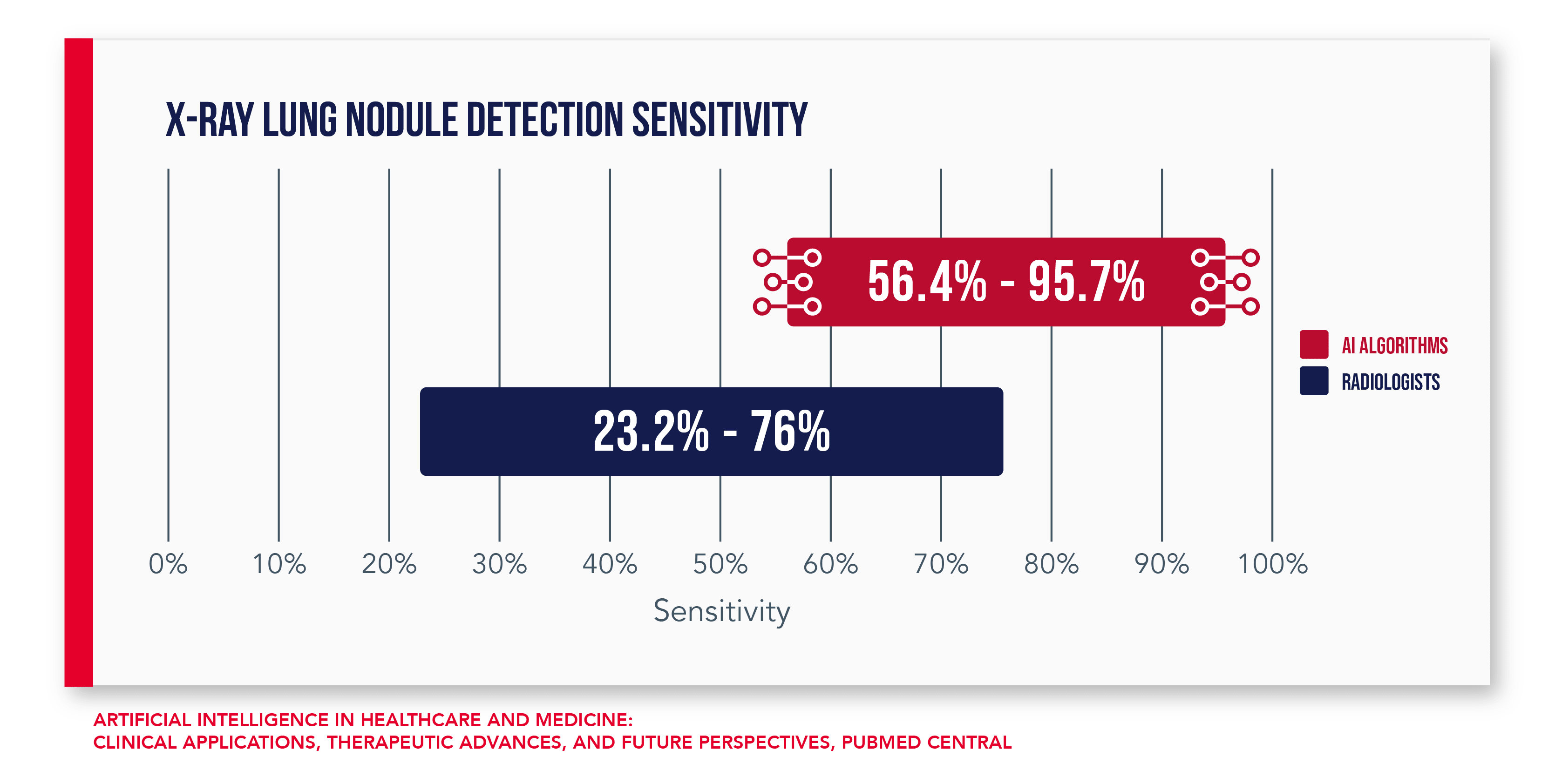
A 2025 review of clinical AI applications found that AI-supported hospitals reported a 42% reduction in diagnostic errors overall, and in trauma radiology specifically, AI cut false negatives per X-ray case by 67%. In lung cancer screening, one of the more heavily studied use cases, AI sensitivity for detecting nodules has reached as high as 95.7%, well above the top end of radiologist performance in the same review.
More Efficient Hospitals
The other place AI is showing up daily is nowhere near the exam room. It's in the documentation that follows every patient visit.
AI-powered ambient scribes, tools that listen to a visit and generate clinical notes automatically, have reduced in-visit documentation time by about 20% and after-hours charting by roughly 30%.
That time back matters: a JAMA Network Open study tracking 263 clinicians across six health systems found burnout rates dropped from 51.9% to 38.8% after 30 days of using an ambient AI scribe.
Separately, the same 2025 clinical AI review found deep learning applied to unstructured EHR data, including free-text clinical notes, reached predictive accuracy exceeding 85% for outcomes like in-hospital mortality, readmissions, and sepsis onset, giving care teams an early warning system that used to require hours of manual chart review.
Predictive and Personalized Treatment
Treatment has traditionally worked from population-level protocols. A standard drug, dose, or radiation schedule gets chosen based on what works for most patients with a given diagnosis. AI is starting to replace that approach with something closer to a plan built around a single patient's genetics, imaging, and real-time response, rather than the average outcome across a clinical trial.
Genomics is where this shows up most concretely. Another thing the 2025 review of clinical AI applications found is that algorithms can identify genetic mutations linked to rare diseases and recommend therapies targeted to those specific mutations. That approach improved patient response rates by up to 30% compared to conventional treatment chosen without a genetic profile.
Now, clinicians can start closer to the right therapy instead of starting with the most common one and adjusting only after it fails.
Radiation oncology follows a similar pattern. For brain tumor patients, the review found that AI can combine MRI imaging with genetic markers to design an individualized radiotherapy schedule rather than apply a standard protocol. That approach increased tumor control rates by 25%. A tumor's specific characteristics, not just its location and stage, now shape how and when radiation gets delivered.
This same shift toward individualized data is reaching patients directly, not just the treatment plans built around them. AI-powered symptom-assessment chatbots have shown alignment with physician recommendations in more than 70% of cases.
They offer a reasonably reliable first triage step before a patient ever books an appointment. Wearables and remote monitoring devices are pushing that same logic further still, generating continuous data on a patient's condition between visits rather than relying on a snapshot taken once every few months.
How Can Providers Start Implementing AI?
Adopting AI into established processes and systems can feel daunting for organizations that have relied on legacy systems or manual review for decades. But the physicians already using it in daily practice, now the clear majority, suggest the harder problem isn't whether to adopt AI. It's choosing where to start.
Bringing in experts who have already helped other healthcare organizations through that process can make the path clearer.
Learn more about integrating AI into your systems in Impact’s webinar, How to Get Real Value From AI & Increase Profit.