Business process automation (BPA) has helped organizations improve efficiency for decades. By automating repetitive tasks and standardizing workflows, businesses can reduce manual effort, improve consistency, and free employees to focus on more strategic work.
Artificial intelligence is expanding what automation can accomplish. Traditional automation excels when processes follow clear rules and predictable paths. AI introduces capabilities such as pattern recognition, prediction, and natural language understanding, allowing organizations to automate tasks that once required human judgment.
Rather than replacing existing workflows, AI often acts as an intelligence layer that enhances them. It helps systems interpret information, generate insights, and adapt to changing conditions.
Understanding how AI fits into business process automation can help organizations identify opportunities to streamline operations while maintaining control over critical business functions.
Learn more about the full power of AI in Impact's webinar, How to Get Real Value From AI & Increase Profit.
What Is Business Process Automation?
Business process automation refers to the use of technology to execute recurring tasks and workflows with minimal human intervention. The goal is to improve efficiency, reduce errors, and create more consistent outcomes across the organization.
Many businesses already use BPA in their day-to-day operations, whether they realize it or not. Routing purchase requests for approval, creating IT tickets from email submissions, and sending onboarding documents to new hires are all examples of business process automation in action.
Business process automation is often confused with robotic process automation (RPA), but the two serve different purposes. BPA focuses on end-to-end workflows that span people, systems, and departments. RPA typically automates individual tasks by mimicking human interactions with software applications.
Consider employee onboarding. The overall workflow may involve HR platforms, payroll systems, identity management tools, and approval chains. That complete workflow represents business process automation. Within it, an RPA bot may enter employee data into multiple systems automatically, eliminating repetitive administrative work.
Traditional automation performs best when workflows follow predefined rules. If a process consistently follows an "if this, then that" structure, automation can execute it quickly and accurately. Challenges arise when processes involve unstructured data, exceptions, or decisions that cannot easily be reduced to fixed rules.
How AI Enhances Business Process Automation
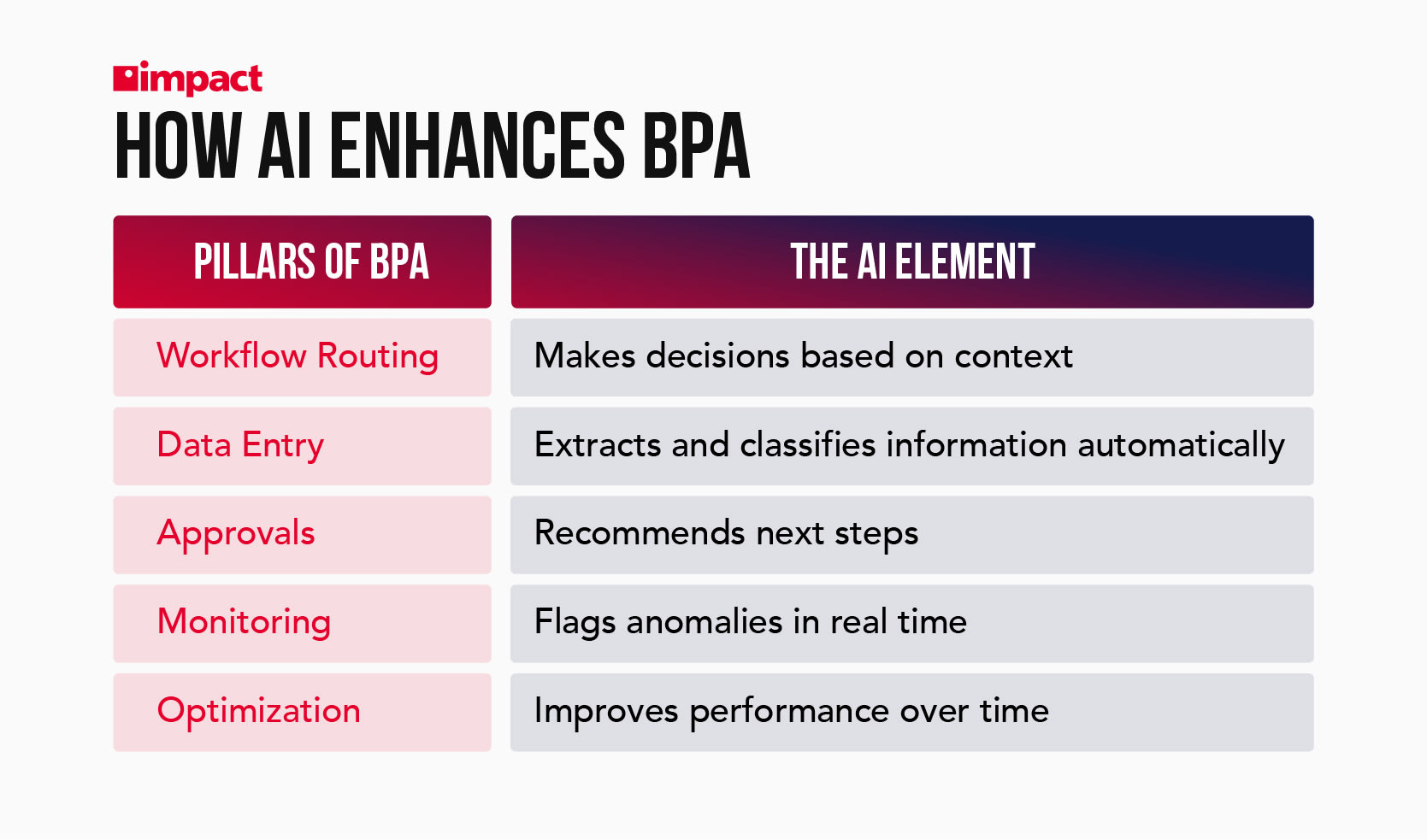
AI extends automation beyond rigid workflows by enabling systems to analyze information, recognize patterns, and support decision-making. Instead of simply executing instructions, AI-powered systems can interpret data and respond to changing circumstances.
AI brings several capabilities to business process automation that traditional workflows often lack:
- Machine learning to identify patterns and improve predictions over time
- Natural language processing (NLP) to interpret emails, contracts, and customer communications
- Generative AI to summarize content and draft responses
- Predictive analytics to forecast outcomes and identify potential risks
One of AI's greatest strengths is its ability to work with unstructured data. Organizations generate vast amounts of information through emails, PDFs, support tickets, chat messages, and documents that do not fit neatly into structured databases. Traditional automation often struggles to process this information because it lacks a consistent format.
AI technologies can bridge that gap. For example, an AI system may analyze an incoming support request, determine the issue being reported, assign a priority level, and route the request to the appropriate team without human intervention.
In finance, AI may identify unusual spending patterns that warrant review. In supply chain operations, predictive models can anticipate inventory shortages before they disrupt production. Generative AI tools can summarize lengthy reports or draft routine communications, reducing administrative burdens and accelerating workflows.
The result is a more adaptive form of automation that can handle complexity while improving operational efficiency.
AI Use Cases in Business Process Automation
AI-powered automation can deliver value across nearly every department, but its impact is easiest to understand through real-world workflows. From processing documents to managing customer interactions, AI allows organizations to automate tasks that previously required significant manual effort.
Invoice Processing and Accounts Payable Automation
Invoice processing has long been a candidate for automation, but traditional workflows often struggle when invoices arrive in different formats or contain missing information. AI helps solve this challenge by extracting data from PDFs, emails, and scanned documents regardless of layout.
Once information is captured, automation workflows can validate purchase orders, route invoices for approval, flag discrepancies, and update ERP systems automatically. This reduces manual data entry, accelerates payment cycles, and improves financial accuracy.
By combining AI with automation, finance teams can spend less time processing transactions and more time focusing on analysis and strategic planning.
Customer Service and IT Ticket Management
Customer support and IT service desks generate large volumes of requests that vary widely in complexity and format. Traditional automation can route tickets based on predefined rules, but AI enables systems to understand the content and context of each request.
For example, AI can analyze incoming emails or support tickets, determine intent, assign priority levels, recommend solutions, and direct requests to the appropriate teams. Some platforms can even summarize previous interactions to provide additional context for support personnel.
These capabilities help organizations improve response times, reduce administrative workloads, and deliver more consistent service experiences.
While these examples represent just two applications of AI-powered automation, similar capabilities can be applied across HR, supply chain, procurement, and countless other business functions.
AI and RPA: Understanding the Difference
AI and RPA are often discussed together, but they solve different problems.
RPA is designed to execute repetitive tasks by following predefined rules. It excels at activities such as moving data between systems, updating records, generating reports, and processing transactions. These tasks are structured and predictable, making them ideal candidates for automation.
AI addresses a different challenge. Rather than executing tasks, AI interprets information, identifies patterns, and generates insights based on context. It enables systems to work with data that would otherwise require human review.
A useful way to think about the relationship is this: RPA performs the work while AI determines how the work should be performed.
Consider an accounts payable workflow. An RPA bot may transfer invoice data into an ERP system and trigger approvals. AI can analyze the invoice itself, extract relevant information, identify discrepancies, and determine whether additional review is required. Together, these technologies create a more intelligent and adaptable process.
This combination is often referred to as intelligent automation because it pairs automation with decision-making capabilities.
Benefits and Challenges of AI-Powered Automation
Organizations that successfully implement AI-powered automation often realize several benefits:
- Faster processing times across business workflows
- Reduced manual effort and administrative overhead
- Improved accuracy and consistency
- Better visibility into operational performance
- Greater scalability as workloads increase
These advantages can help organizations improve efficiency while enabling employees to focus on higher-value activities. AI can also surface insights hidden within large datasets, helping leaders make more informed decisions.
However, implementing AI within business processes is not without challenges.
Data quality remains one of the largest barriers to success. AI systems depend on accurate and well-organized data. Poor data quality can produce unreliable outputs and limit the effectiveness of automation initiatives.
Integration complexity presents another obstacle. Many organizations operate across numerous applications and data sources, making it difficult to connect AI tools with existing systems.
Governance and compliance considerations are equally important. Organizations must establish clear policies regarding data usage, oversight, and accountability, particularly in regulated industries.
Successful AI adoption depends as much on process design and data quality as it does on the technology itself.
Best Practices for Implementing AI in Business Processes
Organizations do not need to automate every process simultaneously to realize value from AI. In many cases, targeted initiatives deliver stronger results than broad transformation efforts.
Businesses typically see the best outcomes when they:
- Identify repetitive, high-volume workflows.
- Map existing processes before introducing automation.
- Start with a limited pilot project.
- Integrate AI into existing systems and workflows.
- Measure performance and refine processes over time.
Automating an inefficient process rarely produces the desired outcome. Taking time to understand how information flows across systems can help organizations identify bottlenecks and opportunities for improvement before implementation begins.
Starting small also reduces risk. Pilot projects allow organizations to evaluate performance, establish governance practices, and build internal expertise before expanding AI initiatives across additional departments.
Most importantly, organizations should view AI as a tool for enhancing existing workflows rather than replacing them entirely. The most successful implementations typically combine automation, human oversight, and continuous optimization.
Wrapping Up on AI in Business Process Automation
Business process automation has long helped organizations improve efficiency by reducing manual work and standardizing workflows. Artificial intelligence expands those capabilities by enabling systems to interpret information, recognize patterns, and support decisions that traditional automation cannot easily handle.
AI does not replace business process automation. Instead, it strengthens it. Organizations that combine AI with well-designed workflows can automate more complex tasks, improve operational efficiency, and make better-informed decisions across the business.
As AI adoption continues to grow, businesses that focus on practical use cases and measurable outcomes will be best positioned to realize its value.
Learn just how powerful AI tools can be in your business by watching Impact's webinar, How to Get Real Value From AI & Increase Profit.