Travel demand has rebounded across the United States, with global markets continuing to regain momentum. At the same time, the operating environment has become more complex.
Customers expect seamless, digital-first experiences at every stage of the journey, from discovery and booking to in-trip support and post-travel engagement. These expectations are shaped not only by other travel brands but by the broader standard set by real-time, personalized platforms across industries.
In this environment, technology plays a central role in how travel organizations compete and grow. It influences how companies understand customer behavior, optimize operations, secure sensitive data, and respond to disruption.
The distinction between customer experience, IT infrastructure, and operational performance is increasingly blurred, requiring tighter alignment across functions.
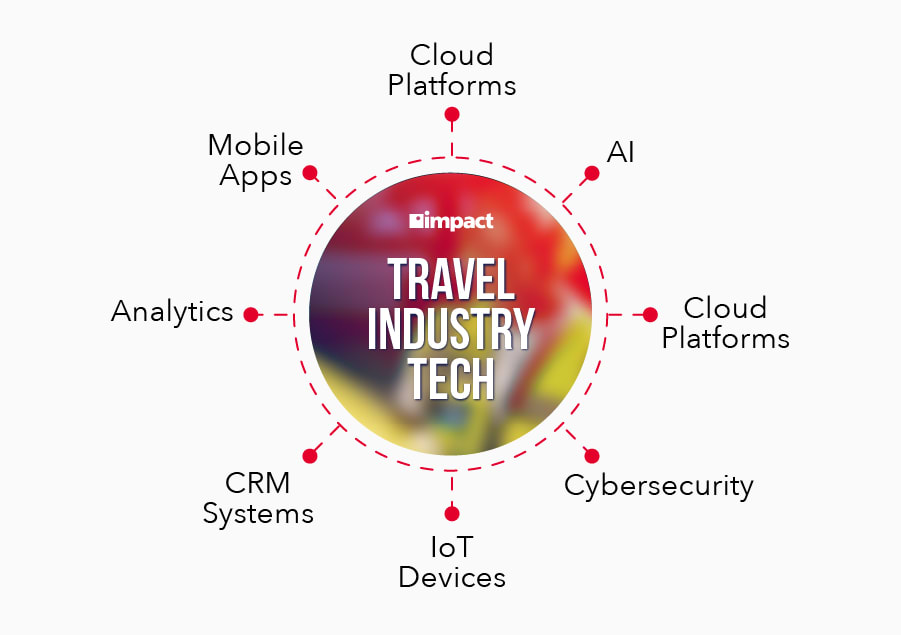
For executive leaders and their teams, the conversation has shifted from incremental digital improvements to coordinated, enterprise-level transformation. The trends outlined below reflect where the industry is investing, how capabilities are evolving, and what it takes to build a more resilient and responsive travel business.
Discover the real capabilities of AI in Impact’s webinar, How to Get Real Value from AI & Increase Profit.
AI Moves to the Core of Travel Operations
Artificial intelligence is no longer a standalone initiative within travel organizations. It is becoming embedded across core systems and workflows, shaping how companies operate, engage customers, and respond to changing conditions in real time. For both executive leaders and operational teams, AI is shifting from experimentation to essential infrastructure.
At a strategic level, AI is helping organizations make sense of increasingly complex data environments. Travel businesses manage a high volume of inputs, including booking behavior, pricing signals, operational constraints, and external factors such as weather and events.
AI models can process these variables continuously, allowing organizations to move from reactive decision-making to more predictive and adaptive approaches.
This shift is particularly visible across three core areas:
- Customer engagement
AI is transforming how travel brands interact with customers before, during, and after a trip. Intelligent assistants, chat interfaces, and automated service tools are now capable of handling a growing share of inquiries, from booking support to itinerary changes. More advanced implementations go beyond automation, using context and historical behavior to deliver more relevant responses and recommendations.
- Operational efficiency
Behind the scenes, AI is improving how travel organizations manage resources and disruptions. Models can predict delays, optimize crew or fleet allocation, and identify potential bottlenecks before they impact customers. This allows teams to intervene earlier and reduce downstream effects on both cost and experience.
- Marketing and demand generation
AI is enabling more precise targeting and segmentation, helping teams identify high-value audiences and tailor campaigns accordingly. Rather than relying on static segments, organizations can continuously refine messaging and offers based on live performance data and evolving customer behavior.
For many organizations, the challenge is no longer whether to adopt AI, but how to integrate it effectively across existing systems. Disconnected implementations can limit impact, while well-integrated AI capabilities can amplify the value of data, personalization, and real-time decisioning efforts across the business.
From an executive perspective, AI maturity is emerging as a clear differentiator. Organizations that invest in scalable models, strong data foundations, and cross-functional alignment are better positioned to improve both customer outcomes and operational performance.
Treating AI as a series of isolated tools fails to recognize its full value.
Personalization at Scale
Personalization in travel is no longer a marketing capability. It shapes the entire journey, from discovery through post-trip engagement. Increasingly, customers assume experiences will reflect their preferences and adjust in real time.
The challenge is not delivering personalization at a single touchpoint. It is maintaining continuity across a journey that spans channels, systems, and providers. That is where most organizations fall short.
Personalization often works best at the top of the funnel, where behavioral data is easiest to capture and activate. As the journey moves into booking, servicing, and in-trip support, that consistency breaks down. Disconnected systems and fragmented data make it difficult to carry insight forward.
The result is uneven execution. Parts of the experience feel relevant; others revert to generic. For customers, that inconsistency is noticeable. For the business, it limits both conversion and long-term value.
Closing the gap is less about adding new tools and more about connecting what already exists. Personalization at scale depends on:
- Shared access to customer and operational data
- Systems that can act on that data in real time
- Alignment across teams that typically operate in silos
As those pieces come together, personalization stops being a layer and starts functioning as part of the core system. Decisions around content, pricing, service, and communication draw from the same inputs and adjust as conditions change.
At that point, personalization is no longer a differentiator. Execution is.
A Modern IT Strategy
For many travel organizations, the limiting factor is not strategy or investment. It’s the environment those initiatives have to run in.
Legacy systems still anchor core operations. They were built for stability and scale, not for speed or interoperability. That gap is now showing up everywhere, as capabilities like AI, real-time pricing, and cross-channel personalization depend on systems that can continuously exchange and act on data.
The friction is immediate:
- Integration takes longer than expected
- Data is fragmented or delayed
- Teams rely on workarounds instead of fixing root issues
Even focused initiatives can stall once they hit dependencies buried in core platforms.
The shift underway is less about full replacement and more about introducing flexibility into the system. Instead of rebuilding everything, organizations are reshaping how pieces connect and evolve over time.
That change tends to follow a pattern. Infrastructure becomes more scalable, data becomes easier to move between systems, and tightly coupled components are gradually pulled apart. The goal is not perfection—it’s reducing the effort required to introduce and scale new capabilities.
As that flexibility improves, the impact compounds. Teams can test and deploy faster. New tools integrate with less friction. Progress is no longer gated by the slowest system in the stack.
For leadership, this turns modernization into a question of operating speed. Rigid environments slow everything down, from innovation to response times during disruption. More adaptable systems create room to move, even if the overall architecture is still evolving.
That difference builds over time. IT modernization does not just support transformation—it determines how quickly it can happen.
Cybersecurity Acts as a Foundation for Growth
As travel becomes more digital, it also becomes more exposed. High transaction volumes, sensitive customer data, and a broad partner ecosystem make the industry an attractive target, and the impact of incidents is more immediate when systems are tightly connected.
Security now directly shapes how confidently organizations can scale digital initiatives. More APIs, deeper personalization, and increased reliance on partners all expand the attack surface. At the same time, any disruption tied to a security issue affects live bookings, active travelers, and customer trust in real time.
The shift in approach is already underway. Static defenses are giving way to continuous, identity-driven models that assume risk is always present. Access is more tightly controlled, activity is monitored in real time, and issues are addressed as they emerge rather than after the fact.
This also changes how security fits into the organization. It is becoming embedded in system design and integration decisions, not applied after deployment. That requires closer coordination between IT, security, and the teams responsible for customer-facing experiences.
For leadership, the implication is straightforward. Cybersecurity is not just about reducing risk exposure. It determines how aggressively an organization can adopt new technologies, how safely it can operate within a connected ecosystem, and how well it can maintain trust under pressure.
Real-Time Decision Making
Travel has always been time-sensitive, but most decision-making hasn’t been. That gap is narrowing as organizations move away from static rules and scheduled updates toward systems that can respond to live conditions.
Demand shifts constantly, disruptions ripple quickly, and customer intent evolves throughout the journey. Static systems struggle to keep up, which is why so many processes have historically been reactive, adjusting only after issues surface.
Real-time decisioning changes that model. Pricing, operations, and customer communications can adjust in motion, based on what is happening now rather than what happened earlier. The value is not just speed, but alignment—when these functions operate from the same signals, responses feel coordinated instead of corrective.
This shift depends on continuous data flow, low-latency systems, and tighter coordination across teams. As those capabilities improve, responsiveness becomes more visible to customers, and slower, disconnected experiences become harder to justify. Over time, acting in real time stops being an advantage and becomes part of the baseline.
The Benefit of Connected Technologies
The travel journey no longer runs through a single provider. It moves across airlines, hotels, mobility services, and platforms, often within a single trip. As a result, the quality of the experience increasingly depends on how well these systems connect behind the scenes.
When those connections work, the benefits are immediate. Booking flows become simpler, with fewer handoffs and less repeated input. Customer data carries across touch points, allowing for more consistent service and fewer gaps in context. It becomes easier to bundle transportation, accommodation, and in-destination experiences into a more cohesive offering.
Stronger connectivity also improves operational efficiency. Data flows more easily between partners, making it possible to coordinate changes, manage disruptions, and adjust plans without relying on manual intervention. That reduces friction internally while creating a more seamless experience externally.
At a strategic level, connected ecosystems give organizations more flexibility in how they grow. Instead of building every capability in-house, they can expand through partnerships, integrate new services faster, and participate in a broader range of customer journeys.
The advantage lies in connecting everything and having it all work together in one seamless flow.
Wrapping Up on Tech Trends in Travel
Travel technology is no longer evolving in isolation. AI, personalization, IT infrastructure, security, and real-time decisioning are converging into a single system that shapes how the entire journey is delivered. Organizations seeing the most impact are aligning these capabilities, rather than treating them as separate initiatives.
This shift changes the focus from individual upgrades to overall execution. Modern infrastructure enables speed, shared data makes real-time decisions possible, and integrated security supports scale. When these elements work together, organizations can deliver more consistent, responsive experiences while adapting more quickly to change.
For leadership teams, the priority is clarity on how well current systems and teams actually connect. The gap between leaders and laggards will increasingly come down to execution—how effectively organizations can act on data, coordinate across functions, and deliver a seamless experience at scale.
Realize the true potential of AI in Impact’s webinar, How to Get Real Value from AI & Increase Profit.