Downtime is one of those business risks that often feels abstract—until it isn’t. A system goes offline, applications slow to a crawl, employees can’t access critical tools, or customers suddenly lose service. In that moment, downtime stops being an IT issue and becomes an operational, financial, and reputational problem.
In today’s always‑connected environment, even brief outages can have outsized consequences. Modern organizations rely on a complex mix of cloud platforms, internal systems, third‑party services, and security controls to keep work moving. When any part of that ecosystem fails, the impact ripples quickly across teams, customers, and revenue.
Understanding what downtime actually is, what causes it, and how it can be reduced is essential for organizations that want to stay resilient. Downtime isn’t always avoidable—but with the right strategies, its frequency, duration, and business impact can be significantly reduced.
What Is Downtime?
Downtime refers to any period when systems, applications, or services are unavailable or not functioning as intended. In practical terms, it’s when employees can’t do their work, customers can’t access services, or critical business operations are disrupted due to technology failures.
Downtime can be planned, such as scheduled maintenance or system upgrades, or unplanned, caused by outages, cyber incidents, human error, or infrastructure failures. While planned downtime is often controlled and communicated in advance, unplanned downtime tends to be far more damaging because it is unexpected and disruptive.
What makes downtime especially challenging for modern organizations is how interconnected systems have become. A failure in one application, network, or third‑party service can quickly cascade into broader operational issues.
As businesses rely more heavily on digital tools to operate, even short periods of downtime can have an immediate and measurable impact.
How Much Does Downtime Cost on Average?
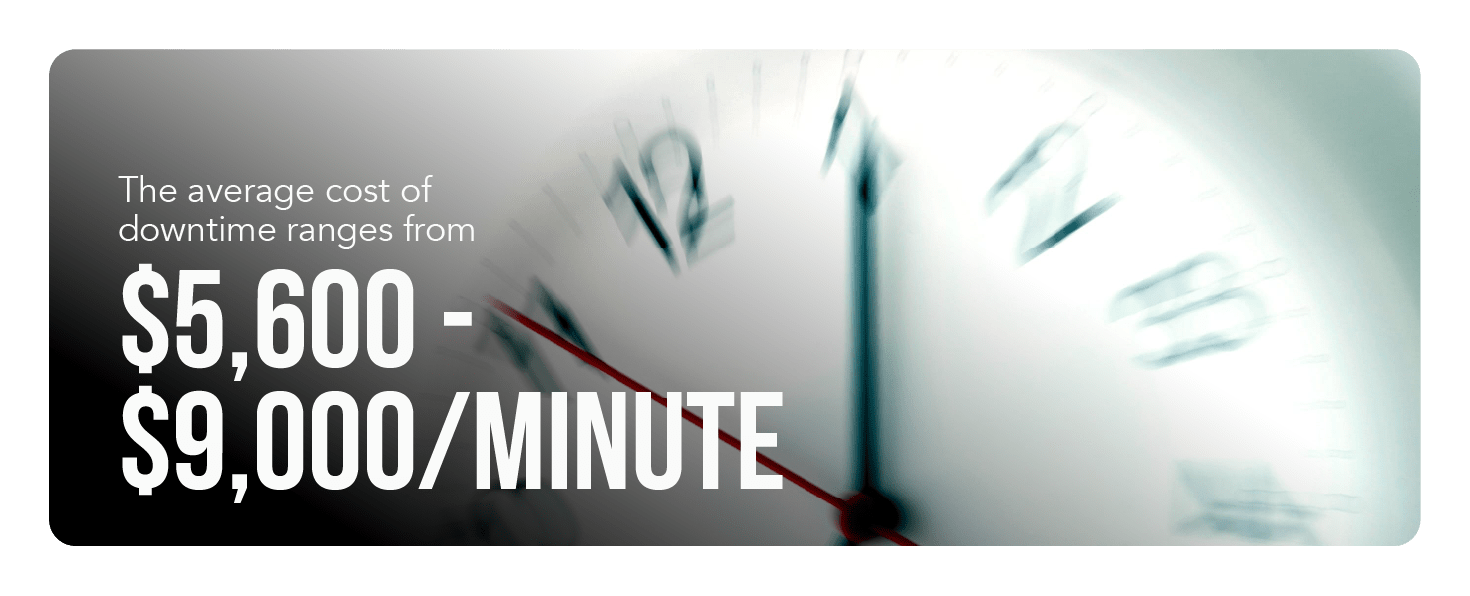
The cost of downtime adds up far faster than many organizations expect. On average, downtime costs businesses between $5,600 and $9,000 per minute, depending on company size, industry, and operational complexity.
Even a short outage can translate into tens or hundreds of thousands of dollars in direct losses. Those costs aren’t limited to lost revenue.
Downtime often triggers a chain reaction that includes stalled employee productivity, missed deadlines, delayed transactions, customer dissatisfaction, and emergency remediation expenses. For larger organizations, the impact is amplified by higher transaction volumes, more users affected, and stricter service‑level commitments.
What makes downtime especially costly is its unpredictability. Unplanned outages tend to occur at the worst possible moments and often require teams to divert time and resources away from strategic work to restore operations.
Over time, repeated downtime incidents can erode customer trust, strain internal teams, and create long‑term financial and reputational damage that far exceeds the initial outage itself.
Common Causes of Downtime
Downtime rarely has a single cause. In most cases, it results from a breakdown in technology, processes, or security that exposes weaknesses in how systems are designed and managed. The most common causes tend to fall into a few core areas.
Technology and Infrastructure Failures
Hardware failures, aging infrastructure, software bugs, and failed updates remain a leading cause of downtime. As organizations rely on more interconnected systems, a relatively small technical issue—such as a misconfigured server or a failed patch—can cascade into a broader outage. Hybrid and cloud environments add additional complexity, increasing the risk that dependencies are overlooked or poorly documented.
Human Error and Operational Mistakes
Human error continues to be one of the most underestimated contributors to downtime. Accidental misconfigurations, incomplete changes, skipped testing steps, or unclear handoff procedures can all take systems offline. Even highly skilled teams are vulnerable when processes are rushed, undocumented, or overly manual, particularly during maintenance windows or incident response situations.
Cybersecurity Incidents
Cyberattacks are an increasingly common cause of downtime. Ransomware, denial‑of‑service attacks, phishing‑based account compromises, and malware infections can disrupt systems directly or force organizations to shut down services as a precaution. In many cases, downtime is not caused by the attack itself but by the time required to investigate, contain, and recover safely.
Third‑Party and Vendor Dependencies
Modern organizations depend heavily on external providers for cloud hosting, SaaS applications, connectivity, and critical business services. When a key vendor experiences an outage, downstream organizations often have little control over the impact. Even well‑managed internal systems can be disrupted if a third‑party service fails.
Environmental and External Factors
Power outages, natural disasters, network disruptions, and physical infrastructure failures can also trigger downtime. While these events may be less frequent, their impact can be severe if redundancy, backup power, or disaster recovery plans are insufficient.
In practice, downtime is often the result of multiple issues occurring at once—a technical failure compounded by limited visibility, slow response, or unclear ownership. That’s why reducing downtime requires more than fixing individual problems; it requires strengthening the systems and processes that support daily operations.
How to Avoid and Minimize Downtime
While downtime can’t always be eliminated, its frequency and impact can be significantly reduced with a proactive, disciplined approach. The most effective strategies focus on prevention, early detection, and fast recovery.
Organizations looking to minimize downtime should prioritize the following:
- Improve system visibility by implementing monitoring and alerting that surfaces performance issues before users are affected. Early detection is often the difference between a minor disruption and a major outage
- Standardize change management so updates, configurations, and deployments follow documented, repeatable processes. Clear procedures reduce the risk of human error and unintended disruptions
- Build in redundancy and resilience through backups, failover systems, and high‑availability configurations. When critical components fail, resilient systems continue operating
- Strengthen incident response readiness with defined escalation paths, response playbooks, and regular testing. Teams that prepare for outages recover faster and with less disruption
- Reduce complexity where possible by consolidating tools, simplifying architectures, and addressing fragile legacy systems that increase failure risk
- Minimizing downtime isn’t about relying on a single tool or fix. It requires aligning technology, processes, and people around reliability so that issues are caught earlier, resolved faster, and less likely to recur
Building a Layered Cybersecurity Strategy
Cybersecurity plays a direct role in downtime prevention. As cyberattacks become more disruptive and operationally damaging, a single security failure can take entire systems offline—sometimes for days. A layered cybersecurity strategy reduces this risk by ensuring that no single control stands alone.
Rather than relying on one defensive tool, layered security focuses on overlapping protections that limit how far an incident can spread and how much damage it can cause. If one layer fails, another helps contain the impact and preserve operations.
A strong layered cybersecurity approach typically includes:
- Perimeter and network protections that reduce exposure to external threats
- Identity and access controls that limit lateral movement and credential misuse
- Endpoint and device security to detect and contain compromised systems
- Monitoring and detection tools that surface suspicious activity early
- Backup and recovery safeguards that allow systems to be restored quickly if an incident occurs
Just as important as the tools themselves is how they’re managed. Clear policies around access, regular patching, employee security awareness, and incident response planning all strengthen these layers and reduce the likelihood that a security event turns into extended downtime.
When cybersecurity is treated as part of operational resilience—not just risk mitigation—it becomes a powerful lever for minimizing outages, accelerating recovery, and maintaining business continuity even under attack.
Wrapping Up on Downtime Causes, Cost, and Reduction Strategies
Downtime is no longer an occasional inconvenience—it’s a persistent business risk with real financial and operational consequences. As organizations become more dependent on interconnected systems, the cost of even brief disruptions continues to rise.
Most downtime can be traced back to a familiar set of issues: technology failures, human error, cybersecurity incidents, third‑party dependencies, and gaps in visibility or process discipline. What separates resilient organizations from vulnerable ones isn’t the absence of problems, but how well they anticipate, contain, and recover from them.
Reducing downtime requires a balanced approach. Proactive monitoring, standardized operations, resilient system design, and a layered cybersecurity strategy all play a role in limiting both the frequency and impact of outages.
When these elements work together, organizations are better equipped to maintain continuity, protect trust, and keep critical operations running—even when disruptions occur.
Downtime may never be fully eliminated, but with the right strategies in place, it can be managed, measured, and minimized.