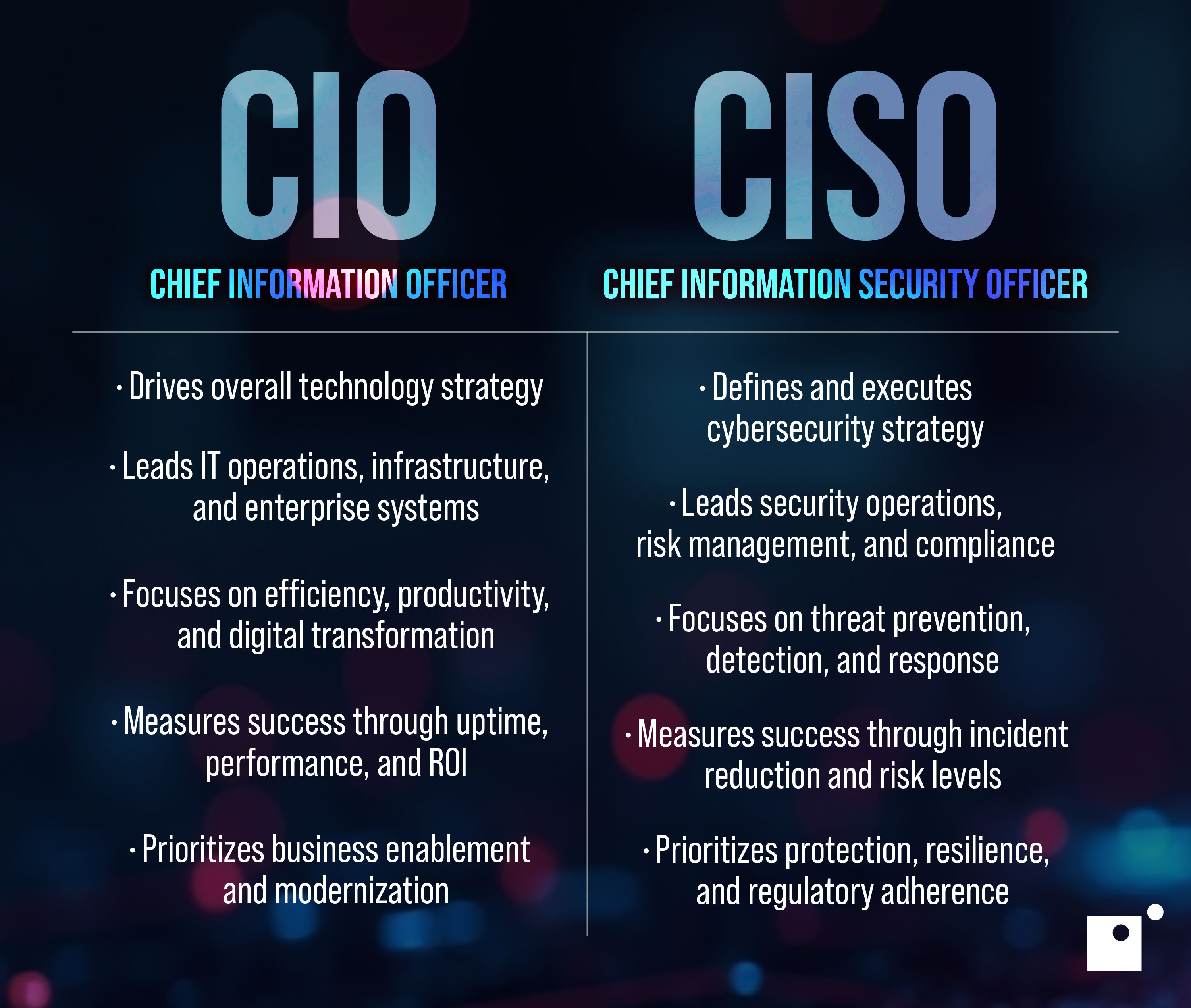
The roles of CIO and CISO are often grouped together because both focus on technology leadership, but they serve very different purposes inside an organization. Each role supports the business in its own way, and each shapes how teams build, protect, and maintain the systems the company depends on.
Understanding what separates the Chief Information Officer (CIO) from the Chief Information Security Officer (CISO) helps clarify how decisions get made, who owns what, and why these positions need to operate in sync.
A CIO oversees the technology strategy that keeps the organization productive, efficient, and aligned with long-term goals.
A CISO focuses on cybersecurity, risk management, and the protection of critical data. Their priorities overlap at times, but the lens they use to make decisions is not the same.
Understand the perspective of the cybercriminal and learn what your CISO is safeguarding you against in Impact’s webinar, How to Hack Your Business.
Chief Information Officer (CIO) vs Chief Information Security Officer (CISO)
Although both roles operate at the executive level, the CIO and CISO guide the organization in different ways. The CIO focuses on how technology supports growth and daily operations, while the CISO ensures that the systems and data behind that growth remain secure.
Their goals often intersect, but the purpose of each role is rooted in a different set of priorities.
The CIO concentrates on building and maintaining the digital environment that helps teams work efficiently. The CISO, on the other hand, evaluates how those same systems introduce risk and how to control that risk without slowing the business down.
These perspectives are complementary, but they are not interchangeable, and they frequently lead to different approaches when new technology or major initiatives, like implementing AI, are on the table.
Understanding these distinctions creates a clearer picture of how the two leaders influence decisions, contribute to strategy, and support the organization as a whole.
The Role of the Chief Information Officer
The CIO is responsible for shaping how technology supports the organization’s goals.
This role covers everything from long‑term planning to day‑to‑day operational performance, and it requires a clear understanding of how tools, systems, and processes help the business move forward. A strong CIO focuses on creating an environment where teams can work efficiently, data flows smoothly, and technology investments make sense.
A key part of the CIO’s job is defining the technology roadmap. That includes evaluating new platforms, modernizing legacy systems, and ensuring that IT spending aligns with the organization’s strategy.
The CIO also manages the teams that keep infrastructure and business applications running, which makes this position central to productivity across the company.
Although security is not the CIO’s sole responsibility, the role does intersect with risk management. Every new initiative has security implications, and the CIO often works closely with the CISO to balance performance, usability, and protection. When this collaboration is consistent, projects move faster and with fewer issues.
The CIO’s work ultimately comes down to one goal: making sure technology strengthens the organization.
The Role of the Chief Information Security Officer
The CISO is responsible for protecting the organization’s information, systems, and overall security posture. This role centers on understanding where the business is exposed to risk and putting the right controls, processes, and technologies in place to manage that risk.
A strong CISO looks at how threats evolve, how the company operates, and how to keep security measures aligned with both factors and industry best practices.
A major part of the CISO’s work involves building and maintaining the organization’s security strategy.
That includes areas like threat detection, incident response, identity and access management, vulnerability management, and security training. The CISO leads the teams that monitor for suspicious activity, investigate issues, and ensure policies are followed across the business.
The CISO also plays a key role in compliance. Many industries have strict requirements for how data must be handled, and the CISO is often the point person for meeting those expectations. This involves regular assessments, coordination with auditors, and ongoing communication with leadership about risks and gaps.
Similar to the CIO, the CISO works across departments, but the lens is different. While the CIO focuses on efficiency and performance, the CISO evaluates how each decision affects the organization’s security. When these roles coordinate effectively, the business can move quickly without creating unnecessary exposure.
The CISO’s role ultimately comes down to helping the organization operate confidently by keeping threats manageable and security practices consistent.
The Relationship Between IT and Cybersecurity
IT and cybersecurity operate in parallel, but they approach the organization’s needs from different angles. IT focuses on availability, performance, and usability. Cybersecurity focuses on protection, control, and limiting exposure. Both functions depend on each other to work effectively, and the quality of their relationship often determines how smoothly technology initiatives move from planning to implementation.
In most organizations, IT teams are responsible for building and maintaining the systems employees rely on. This includes networks, applications, hardware, cloud platforms, and the support structures that keep everything running. Cybersecurity teams work within that environment to monitor threats, enforce policies, and ensure that security is considered at every stage of a project rather than added at the end.
Strong collaboration between IT and cybersecurity helps the business move quickly without increasing risk. This typically shows up in areas like identity management, infrastructure design, patching, and incident response. When the two groups coordinate consistently, projects launch with fewer surprises, users experience fewer disruptions, and security becomes part of the workflow rather than a last‑minute hurdle.
The connection between these functions is not always seamless. IT may push for speed to meet business needs, while cybersecurity may push for controls that slow things down. Clear communication, shared objectives, and involvement early in the planning process help reduce friction and lead to better outcomes on both sides.
Key Responsibilities of CIOs and CISOs
The responsibilities of the CIO and CISO become easier to understand when you look at how each role contributes to the organization’s day‑to‑day operations. The CIO focuses on the systems that keep the business running, and the CISO focuses on the practices that keep those systems secure.
Looking at their responsibilities side by side highlights where their work overlaps, where it diverges, and how the two functions support each other.
Responsibilities of the CIO
- CIO responsibilities generally focus on building and maintaining a strong operational foundation:
- Developing and executing the technology strategy
- Overseeing infrastructure, applications, and IT operations
- Managing budgets for technology initiatives
- Supporting digital transformation and modernization
- Ensuring that tools and systems improve efficiency and reliability
- Coordinating with business leaders to align technology with organizational goals
- CIO success is measured by stability, performance, and how well technology supports the business.
Responsibilities of the CISO
- CISO responsibilities revolve around security, resilience, and risk control:
- Defining the enterprise security strategy
- Leading threat detection, incident response, and vulnerability management
- Managing identity and access controls
- Overseeing security policies and training
- Ensuring compliance with industry and regulatory requirements
- Reporting risks to leadership and recommending mitigation steps
CISO success is measured by risk reduction, resilience, and how effectively the organization prevents or responds to threats.
Responsibilities During a Breach or Cyber Incident
When a security incident occurs, the CIO and CISO take on distinct but closely connected responsibilities.
The CISO leads the response effort. This includes identifying the scope of the incident, coordinating containment, guiding the investigation, and keeping leadership informed as the situation develops. The CISO is also responsible for documenting what happened, managing communication with external parties when required, and ensuring the organization meets any regulatory obligations tied to the event.
The CIO’s role centers on restoring stability. This may involve reallocating IT resources, supporting system recovery, and helping teams bring affected services back online. The CIO works closely with technical staff to minimize disruption and maintain access to essential systems so the business can continue operating.
Clear coordination between the CIO and CISO is essential. Incidents move quickly, and both leaders rely on shared information, aligned priorities, and consistent communication to manage the response effectively and prevent further impact.
Wrapping Up on CIOs vs CISOs
Understanding the differences between the CIO and CISO makes it easier to see how each role contributes to the organization’s overall health. The CIO focuses on how technology supports productivity and long-term growth, while the CISO ensures that the systems behind that growth remain secure.
Their priorities are different, but neither role is effective in isolation.
Organizations that encourage collaboration between these leaders tend to move faster, manage risk more effectively, and respond to incidents with greater confidence. When the CIO and CISO share information early, align on strategy, and maintain open communication, both the business and its security posture benefit.
Although the scope of each role will continue to evolve, the need for a strong partnership between technology and security leadership remains constant. Understanding where the CIO and CISO differ is the first step in helping both succeed.
Learn what your CISO is safeguarding you against in Impact’s webinar, How to Hack Your Business.