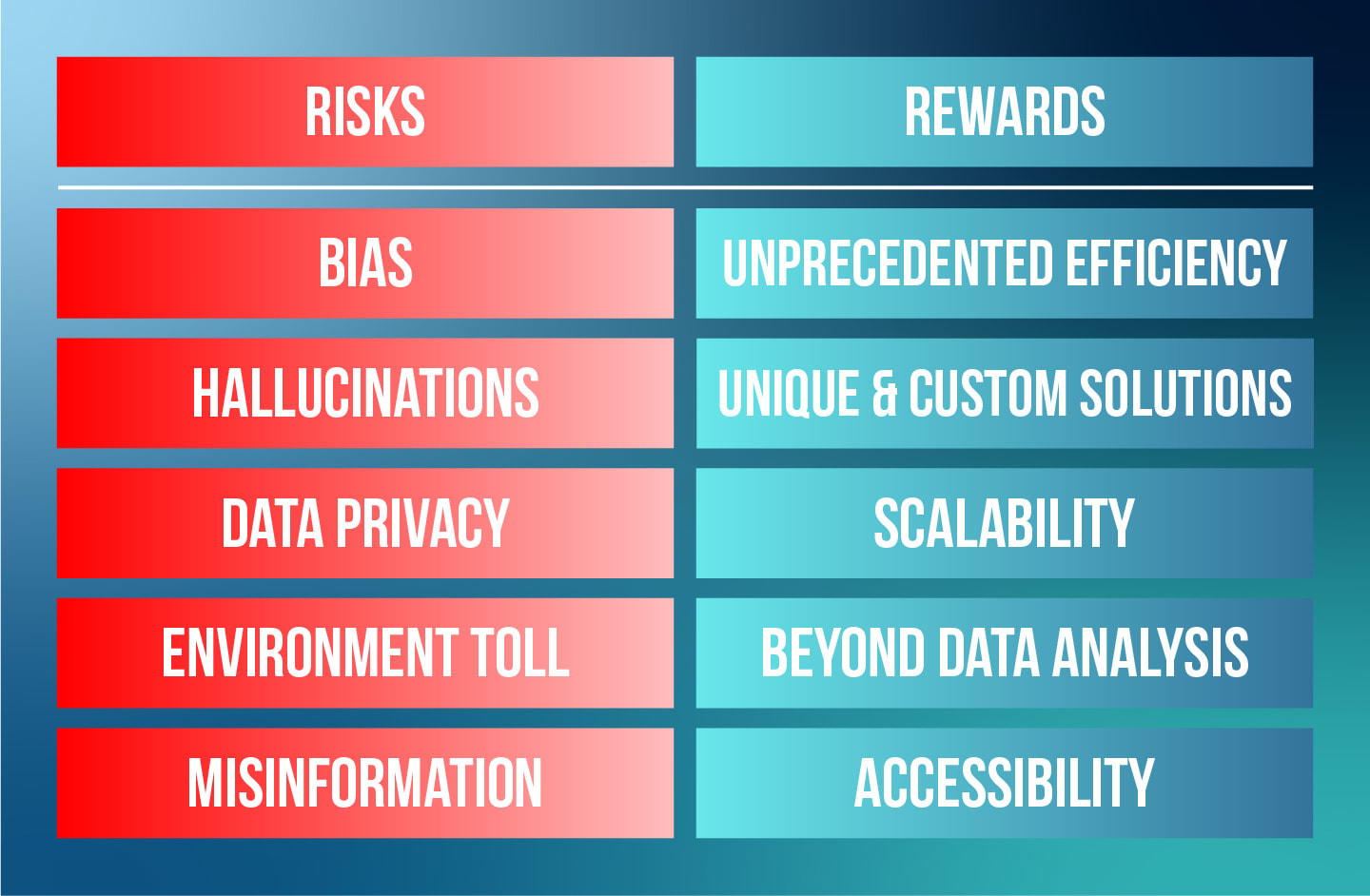
Investing in AI and digital transformation is no longer a question of if, but when. These technologies promise efficiency, scalability, and competitive advantage, yet they come with significant risks that can’t be ignored. From high upfront costs to integration challenges, the path to digital maturity is complex and often unpredictable.
Businesses that succeed in this space understand that risk and reward are inseparable. The potential upside includes streamlined operations, data-driven insights, and new revenue streams. But missteps in timing, strategy, or execution can lead to wasted resources and stalled progress.
This piece explores the realities behind the hype, breaking down the risks, rewards, and practical considerations that shape successful AI and digital transformation initiatives for organizations looking to modernize their workflows through cutting-edge technology.
For more information on introducing new technology into your organization, watch Impact's webinar, Why Your Tech Rollouts Fail (And What to Do About It).
Understanding the Risk of Tech Investment and Digital Transformation
Every technology investment carries uncertainty, but AI and digital transformation amplify that risk because they touch nearly every aspect of a business. The stakes are high—these initiatives often require significant capital, cultural shifts, and operational restructuring. Before committing, organizations need a clear picture of what’s at risk.
Key risk factors include:
- Financial Exposure: Upfront costs for infrastructure, software, and talent can be substantial. Without a clear ROI model, these investments can strain budgets.
- Operational Disruption: Implementing new systems often means rethinking workflows, retraining staff, and managing downtime during integration.
- Strategic Misalignment: Adopting technology without a defined business objective can lead to fragmented efforts and wasted resources.
- Regulatory and Compliance Challenges: AI introduces new layers of complexity around data privacy, security, and ethical use.
- Cultural Resistance: Digital transformation isn’t just technical—it’s behavioral. Resistance from teams can derail even the best-laid plans.
Understanding these risks upfront allows leaders to build mitigation strategies and set realistic expectations. It’s not about avoiding risk entirely—it’s about managing it intelligently.
The Growing Pains of New Technologies
Adopting emerging technologies is rarely a frictionless process. Even when the long-term benefits are clear, the transition period can feel like a balancing act between ambition and reality. What looks like a quick win on paper often becomes a multi-year effort in practice.
Integration is one of the first hurdles. New platforms rarely fit neatly into existing systems, so businesses face complex data migrations, compatibility issues, and custom development work. At the same time, the talent gap looms large. AI and advanced digital tools demand specialized skills, and without the right expertise, organizations risk underutilizing their investments.
Beyond technical challenges, there’s the human factor. Digital transformation changes how work gets done, which means processes need to be reimagined and teams need time to adapt. Cultural resistance can slow adoption, especially when employees are comfortable with legacy systems. Add to that the pressure of unrealistic timelines—often fueled by vendor promises—and it’s easy to see why growing pains are the norm, not the exception.
These obstacles don’t diminish the value of transformation, but they underscore the need for realistic planning. Companies that anticipate friction and invest in training, change management, and phased rollouts position themselves for success rather than frustration.
Timing Your Tech Adoptions and Rollouts
When it comes to AI and digital transformation, timing can make or break the success of an initiative. Move too early, and you risk investing in immature technologies. Wait too long, and competitors may outpace you. The right timing depends on both market conditions and your organization’s readiness.
Key considerations for timing include:
- Market Maturity: Is the technology proven and widely adopted, or still in its experimental phase? Early adoption offers a competitive advantage but comes with higher uncertainty.
- Business Need: Does the solution address an immediate pain point or position you for future growth? Align adoption with strategic priorities rather than hype.
- Internal Readiness: Do you have the infrastructure, talent, and change management processes in place to support implementation? Without these, even the best tech can fail.
- Budget and ROI Expectations: Can you absorb upfront costs and wait for long-term returns? Timing should reflect financial capacity and realistic ROI models.
- Phased Rollouts: Instead of a full-scale launch, consider incremental deployment. This approach allows for testing, learning, and scaling without overwhelming resources.
Timing is about making deliberate choices that fit your business model and long-term objectives. Organizations that approach adoption with a clear roadmap and realistic expectations reduce risk and maximize the chances of achieving meaningful, sustainable transformation.
Navigating the AI Universe
Artificial intelligence isn’t a single technology—it’s an ecosystem of tools, platforms, and methodologies, each designed to solve different problems. For decision-makers, the challenge isn’t just understanding what AI can do, but identifying which solutions align with their business objectives.
The AI landscape includes everything from machine learning models that predict customer behavior to natural language processing systems that automate communication. There are generative AI tools for content creation, predictive analytics for forecasting, and computer vision for image-based insights. Each category offers unique benefits, but none are one-size-fits-all.
Choosing the right path starts with clarity. Define the problem you’re trying to solve before exploring solutions. Are you looking to improve operational efficiency, enhance customer experience, or unlock new revenue streams? Once the goal is clear, evaluate vendors and platforms based on scalability, integration capabilities, and compliance standards. Consider whether you need a fully managed service or a customizable framework that your team can adapt over time.
The AI universe is vast, and it’s easy to get lost in the hype. Focus on practical applications that deliver measurable outcomes, and avoid chasing trends that don’t serve your core strategy. Successful navigation isn’t about adopting the most advanced technology—it’s about selecting the right technology for the right purpose.
Adopting the Right Solution for Your Need
Selecting the right technology isn’t about choosing the most advanced option—it’s about finding the solution that fits your business goals, resources, and long-term strategy. Too often, organizations fall into the trap of chasing trends or buying into vendor promises without a clear plan for implementation. The result? Tools that look impressive but fail to deliver meaningful impact.
A platform that works well in isolation but struggles to connect with your existing systems will create more headaches than value.
Consider the level of customization you require. Off-the-shelf solutions can be cost-effective and quick to deploy, but they may lack flexibility. On the other hand, highly customizable platforms offer control but demand more time, expertise, and budget. Compliance and security should also be part of the conversation—especially if you’re handling sensitive data or operating in regulated industries.
The right solution is the one that aligns with your priorities and can grow with your business. Avoid the temptation to adopt technology for technology’s sake. Instead, focus on practical fit, measurable outcomes, and a roadmap that supports sustainable transformation.
Wrapping Up on the Risk-Reward of Digital Transformation and AI Adoption
AI and digital transformation aren’t optional anymore—they’re defining the competitive landscape. But the promise of efficiency, innovation, and growth comes with real challenges: high costs, integration hurdles, cultural resistance, and regulatory complexity. Success depends on how well organizations balance ambition with pragmatism.
The companies that thrive in this space share a common approach. They start with clear objectives, choose solutions that align with their strategy, and implement with discipline rather than urgency. They understand that timing matters, that growing pains are inevitable, and that risk management is as critical as technical capability.
Key takeaways for decision-makers:
- Start with clarity: Define the business problem before exploring technology solutions.
- Align adoption with strategy: Avoid chasing trends—focus on measurable outcomes.
- Plan for friction: Integration challenges and cultural resistance are part of the process.
- Manage timing deliberately: Balance early adoption benefits with readiness and risk.
- Choose scalable solutions: Ensure technology can grow with your business and integrate seamlessly.
- Measure success continuously: Track ROI and adjust your roadmap as conditions evolve.
Ultimately, the risk-reward equation isn’t about avoiding risk—it’s about managing it intelligently. When businesses invest with purpose, plan for friction, and measure outcomes against long-term goals, digital transformation and AI adoption become more than buzzwords. They become catalysts for sustainable growth.
Learn how you can find success with integrating new technologies into your organization's workflows by watching Impact's webinar, Why Your Tech Rollouts Fail (And What to Do About It).