Manufacturers don’t struggle with a lack of automation. They struggle with the gaps between them. Core systems run production, planning, procurement, and finance, but the work that connects those systems is still largely manual.
Spreadsheets get emailed. Data gets re-entered. Reports get rebuilt the same way every week.
Robotic Process Automation (RPA) targets that in-between work. Not the machines on the floor, and not a wholesale replacement of enterprise systems, but the repetitive, rules-based processes that keep operations moving and quietly consume time and attention.
Below, we look at what RPA actually is in a manufacturing context, where it fits alongside existing automation, and how teams can deploy it without creating new operational risk.
The goal isn’t more technology, it’s more stability, visibility, and consistency across the processes that support production.
Learn more about protecting your manufacturing operations in Impact’s webinar, Keys to Cybersecurity in Manufacturing: Prevent Downtime, Stop Threats.
What Is RPA (Robotic Process Automation)?
Robotic Process Automation, or RPA, is software that performs routine digital tasks the same way a person would. It logs into systems, moves data between applications, runs reports, validates information, and triggers actions based on predefined rules.
In manufacturing, RPA is best understood as process automation, not production automation. It doesn’t control machines or replace shop-floor equipment.
Instead, it handles the repetitive work that happens around core systems, where humans are still acting as the bridge between tools that don’t fully integrate.
RPA works by:
- Following clear, rules-based logic
- Interacting with existing systems through their user interfaces
- Running on schedules or responding to specific triggers
Because it operates at the application level, RPA can be deployed without changing underlying systems. That makes it especially useful in manufacturing environments built on long-lived ERPs, MES platforms, and custom tools.
The value of RPA isn’t sophistication. It’s consistency. When the same steps are executed the same way, every time, teams spend less effort fixing errors and more time managing exceptions that actually require judgment.
AI vs RPA in Manufacturing
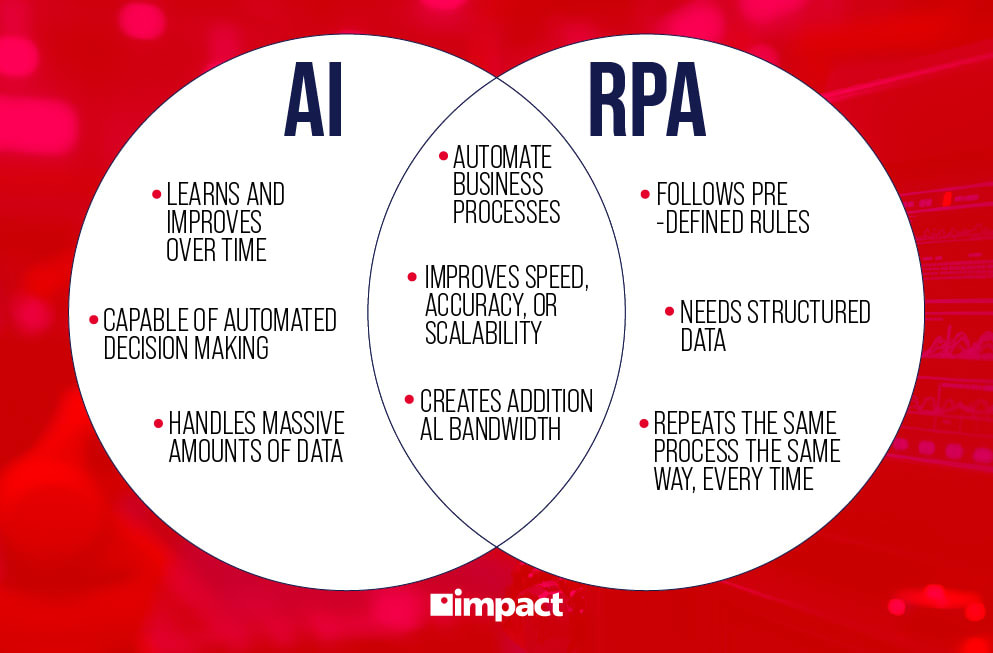
AI and RPA are often lumped together, but in manufacturing, they serve different purposes. Treating them as interchangeable usually creates complexity where none is needed.
RPA is designed for execution. It follows defined rules and runs repeatable tasks the same way every time. When a process is stable and predictable, RPA removes manual effort and reduces variation without changing how the process works.
AI is designed for interpretation. It works best when inputs vary, data is unstructured, or outcomes require judgment. Instead of following fixed logic, AI produces probabilistic insights that support decision‑making.
In practice, RPA handles the mechanics while AI handles the analysis. RPA moves and standardizes data. AI in manufacturing looks at that data to surface patterns, exceptions, or recommendations. Problems arise when AI is applied to processes that simply need consistency, or when RPA is expected to manage ambiguity.
In most manufacturing environments, RPA comes first. It stabilizes processes and improves data quality. AI delivers value once that foundation exists. Used together, they’re complementary. Used interchangeably, they slow things down.
What RPA Looks Like in the Manufacturing Industry
In manufacturing, RPA rarely shows up as a single, high-visibility initiative. It shows up quietly, embedded in day‑to‑day operations, handling the work that keeps systems aligned and information flowing.
Most RPA deployments sit outside the core production environment. They don’t touch machines, control logic, or real‑time operations. Instead, they operate around ERP, MES, planning, quality, and finance systems, where manual steps still exist because integration is incomplete or impractical.
In practice, RPA is often used to move data between systems that were never designed to work together.
A bot might pull production data from an MES, validate it against ERP records, and push it into a reporting or planning tool. Another might reconcile inventory levels across locations, update schedules, or trigger downstream processes when thresholds are met.
What makes RPA effective in manufacturing is its predictability. Bots run on schedules, follow the same logic every time, and produce consistent outputs. That reliability is especially valuable in environments where small data errors can ripple into planning issues, material shortages, or reporting delays.
RPA also tends to be deployed incrementally. Teams automate one process, stabilize it, then move on to the next. Over time, those small automations add up to fewer handoffs, cleaner data, and less reliance on tribal knowledge to keep operations running.
The common thread is that RPA supports manufacturing rather than redefining it. It doesn’t change how products are made. It reduces the friction in the processes that surround production, helping teams spend less time maintaining systems and more time managing the work that actually matters.
Using RPA to Stabilize Production Planning and Scheduling
Production planning usually breaks down because inputs are inconsistent, late, or manually reconciled across systems. By the time planners trust the data, the situation on the floor has already changed.
RPA reduces that instability by standardizing how planning data is collected, validated, and updated. It doesn’t make planning decisions, but it ensures the information feeding those decisions is consistent and current.
In practice, bots pull data from ERP, MES, inventory, and demand systems on a set cadence, resolve basic mismatches, and push clean inputs into planning tools without manual effort. Planning cycles shorten because teams stop rebuilding the same datasets and correcting the same errors.
RPA also helps keep schedules aligned with reality. When inventory levels, order status, or capacity assumptions change, bots can refresh schedules and distribute updates automatically. Adjustments happen predictably instead of relying on someone to notice a change and react.
The result is a planning process that’s less fragile. Planners spend less time maintaining data and more time managing tradeoffs. Schedules don’t become perfect, but they become more reliable, which is usually the bigger win in manufacturing environments.
Ownership and Monitoring
RPA only works in manufacturing when ownership is clear. Bots don’t fail gracefully on their own, and when something breaks, production teams don’t have time to figure out who’s responsible.
Every automated process needs a named owner on the business side, not just IT. That owner is accountable for what the bot does, when it runs, and what happens if the outputs don’t look right. Without that accountability, RPA quickly turns into orphaned automation that no one trusts.
Monitoring is just as critical. Manufacturing environments change constantly: new SKUs, new suppliers, system updates, revised business rules. RPA has to be watched closely enough to catch issues before they ripple into planning, inventory, or reporting.
Effective monitoring usually focuses on a few basics:
- Did the bot run when it was supposed to
- Did it complete successfully
- Did outputs fall within expected ranges
- Were exceptions flagged and routed correctly
When monitoring is in place, failures become manageable. When it isn’t, bots fail silently, and teams only notice after decisions have already been made using bad data.
The goal isn’t heavy oversight. It’s operational trust. When teams know who owns an automation and how it’s monitored, RPA becomes a reliable part of the process instead of another hidden risk.
Scaling RPA
Scaling RPA in manufacturing isn’t about deploying more bots; it’s about repeating success without increasing risk. The jump from a handful of automations to a broader program is where many teams stumble, usually because standards, ownership, and design discipline haven’t kept pace with growth.
The manufacturers that scale successfully tend to reuse patterns. Processes are automated in similar ways, exception handling follows the same logic, and monitoring is consistent across bots. This makes new automations faster to deploy and easier to support, even as they spread across plants, regions, or functions.
Just as important is knowing when not to scale. Not every process should be automated, and not every automation should be replicated everywhere. Scaling works best when RPA is applied deliberately, expanding where it reinforces stability and pulling back where variability or local nuance would create more problems than it solves.
How RPA Fits into an Automation Strategy
RPA works best when it’s treated as infrastructure, not a standalone initiative.
In manufacturing automation strategies, it fills the gap between core systems and more advanced capabilities, handling the execution layer that keeps processes running consistently. It doesn’t replace ERP, MES, or analytics platforms; it makes them easier to operate together.
For most manufacturers, RPA is an early enabler. By standardizing how data is moved, validated, and reported, it reduces noise in day‑to‑day operations and creates more reliable inputs for downstream automation.
That stability is what allows other investments, whether in analytics, optimization tools, or AI, to deliver meaningful results instead of fighting inconsistent processes.
RPA also provides a low‑risk way to improve operations without committing to large‑scale transformation. It can be applied incrementally, adjusted as processes evolve, and retired when no longer needed. That flexibility makes it well-suited to manufacturing environments where systems are long‑lived, and change needs to be controlled.
In a mature automation strategy, RPA isn’t the headline act. It’s the connective layer that keeps processes aligned, reduces manual effort, and supports more advanced automation without increasing operational risk.
Wrapping Up on RPA in Manufacturing
RPA isn’t a cure‑all for manufacturing complexity, and it doesn’t need to be. Its value comes from addressing the unglamorous work that sits between systems, where manual effort, workarounds, and inconsistency quietly undermine operations.
When applied with discipline, RPA brings stability to processes that are already critical but rarely prioritized for improvement.
The most effective RPA programs stay focused on execution, not experimentation. They automate well‑understood processes, assign clear ownership, and monitor outcomes closely. Over time, those decisions compound into cleaner data, more reliable planning, and less operational friction without introducing unnecessary risk.
For manufacturers, the real payoff is subtle but meaningful. RPA doesn’t change how products are made; it changes how confidently teams can run the business around production. And in environments where reliability matters more than novelty, that’s often the most valuable outcome of all.
Learn how to better defend your business from modern threats in Impact’s webinar, Keys to Cybersecurity in Manufacturing: Prevent Downtime, Stop Threats.