Most technologies arrive with fanfare. A few arrive quietly, almost invisibly, and then rewrite the rules of an entire industry. Those are the ones we call disruptive.
At its core, disruptive technology describes innovations that start out serving niche, overlooked, or low-end markets and eventually reshape mainstream industries. They don’t usually begin as the best, fastest, or most profitable option. Instead, they begin as “good enough” alternatives that appeal to customers whom incumbents aren’t paying attention to.
Over time, they improve, move upmarket, and force established players to adapt or fade.
Quick definition | Disruptive technology is an innovation that starts in a small or underserved segment and, as it improves, fundamentally changes or displaces established products, services, or business models.
While many new technologies are labeled or marketed as ‘disruptive,’ few truly are. That distinction matters because if everything is disruptive, nothing is. Companies make poor bets, leaders chase hype, and real strategic risks get ignored.
Understanding what truly qualifies as disruptive technology helps separate passing trends from forces that can reshape markets, business models, and even culture.
Gain a better understanding of the true potential in AI by watching Impact’s webinar, How to Get Real Value From AI & Increase Profit.
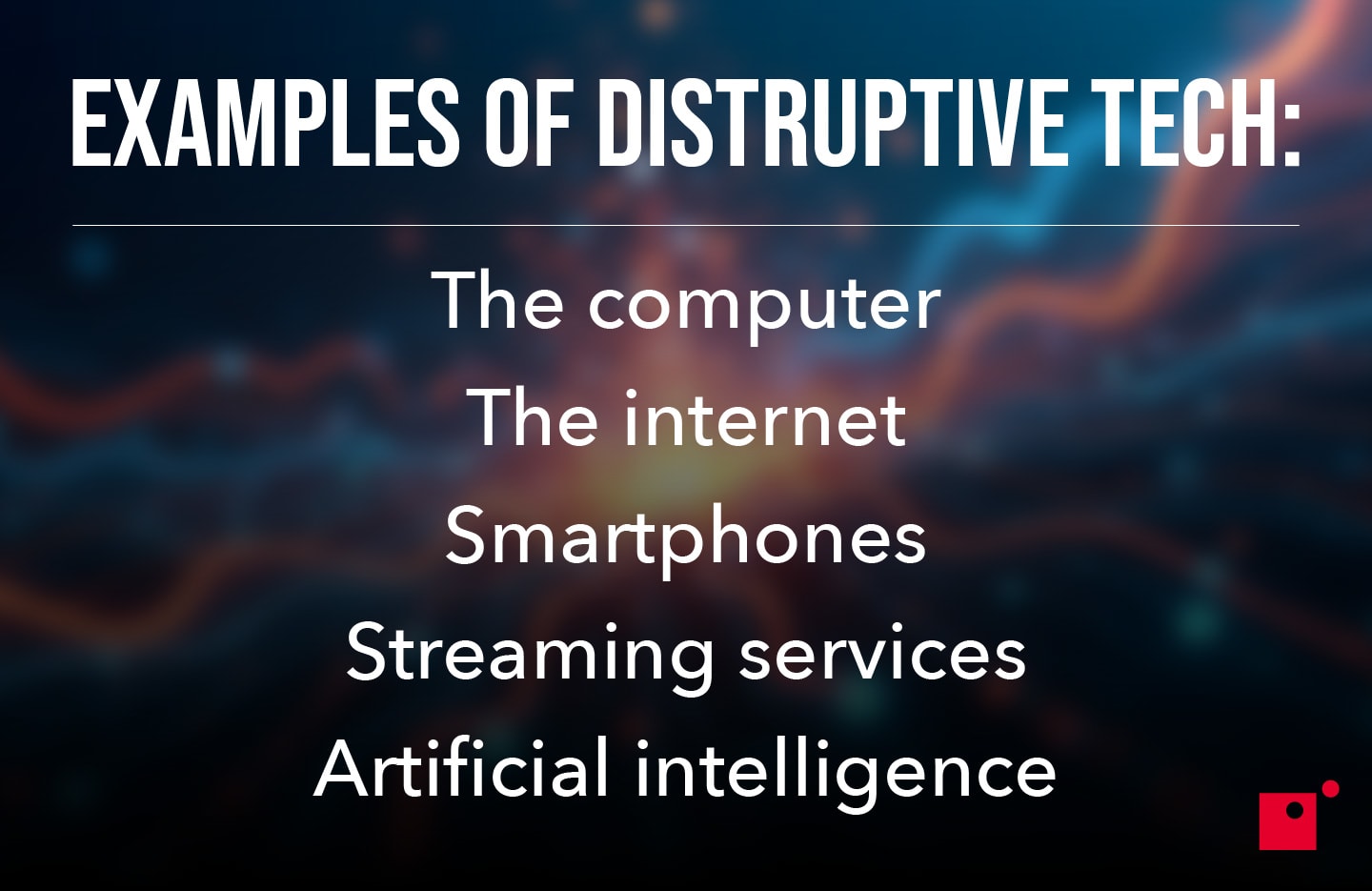
Examples of Disruptive Technology
Disruptive technologies rarely start out glamorous. They enter market segments that incumbents overlook, then improve until they reshape entire industries.
The clearest way to understand disruption is to look at technologies that followed this exact path.
1. Personal Computers
Early PCs were underpowered and dismissed by mainframe and minicomputer makers. They served hobbyists and small businesses—segments established players didn’t value. As performance improved, PCs moved upmarket and overtook incumbents, transforming how organizations and individuals worked.
Why it was disruptive: PCs began at the low end, improved quickly, and redefined an industry once dominated by large, expensive machines.
2. Digital Photography
At first, digital images were low-resolution and inferior to film. They appealed to casual users who valued convenience over quality. As sensors and storage improved, digital overtook film entirely and dismantled Kodak’s core business.
Why it was disruptive: It offered “good enough” quality to a small segment, improved rapidly, and eliminated a long-standing analog market.
3. Streaming Media
Early streaming platforms struggled with buffering, low resolution, and limited libraries. They attracted users willing to trade quality for convenience and cost. As bandwidth and content deals improved, streaming moved into the mainstream and reshaped television, film, and music distribution.
Why it was disruptive: It grew from an underserved digital-first audience and eventually displaced high‑margin, incumbent-friendly distribution models.
4. Smartphones
Before smartphones became dominant, they were viewed as niche devices for tech enthusiasts and business users. Early models didn’t outperform traditional feature phones on battery life or durability. Over time, they absorbed multiple product categories like cameras, GPS units, and audio players, and redefined consumer expectations.
Why it was disruptive: They started with limited performance but evolved into a universal computing platform that eclipsed several established industries.
5. Cloud Computing
Cloud services initially appealed to startups and small teams that couldn’t justify large on‑premises IT investments. Incumbents dismissed the model as lacking control, reliability, or enterprise readiness. As cloud capabilities improved, organizations of all sizes embraced it, and traditional hardware vendors had to reinvent themselves.
Why it was disruptive: It started in an overlooked segment with a low-cost alternative and ultimately reshaped enterprise IT infrastructure.
6. Ridesharing
Early ride‑hailing wasn’t seen as serious competition by taxi companies. It targeted users frustrated by traditional taxi availability or service standards. As mobile adoption surged and platform reliability improved, ride‑hailing scaled globally and fundamentally changed urban transportation.
Why it was disruptive: It capitalized on underserved customers and used mobile technology to reframe how people accessed transportation.
7. E‑Commerce
Online shopping started small and was mostly used by consumers purchasing books, collectibles, or hard-to-find items. Traditional retailers didn’t see it as a threat due to concerns about security, logistics, and consumer trust. Over time, convenience, selection, and price advantages drove e‑commerce into the mainstream.
Why it was disruptive: It entered through narrow product categories, then evolved to challenge and reshape the entire retail sector.
Giving it a Name: The Disruptive Innovation Theory
Clayton Christensen, a Harvard Business School professor, introduced the Disruptive Innovation Theory in the mid‑1990s to explain why established companies often lose ground to upstarts with seemingly inferior products. His insight was simple but counterintuitive: major industries usually aren’t overturned by better technology.
They’re overturned by technology that begins as worse, but also in the right place.
Christensen observed that disruptive innovations enter at the low end of a market or in niches incumbent players don’t value.
These early products are cheaper, simpler, and easy to dismiss. They appeal to customers who are overlooked because they don’t generate big margins or require advanced features. Over time, the technology improves faster than the incumbent solutions and moves into the mainstream, forcing established players to react from behind.
The theory reframed why industry leaders fail. It isn’t laziness or ignorance. It’s that they focus on their most profitable customers, and that focus blinds them to early threats that don’t fit their business models.
The idea took off because it helped explain familiar patterns explored in the examples above.
Christensen also warned that “disruption” shouldn’t be used as shorthand for anything new or fast‑growing. Mislabeling technologies leads to bad strategy, whereas when used correctly, the theory remains one of the most useful tools for identifying which innovations are likely to reshape an industry and which are simply getting attention.
Indications Technology Is Disruptive
Now, there are indicators that we can look for to tell whether or not an emerging technology truly is disruptive or not.
The hardest part of disruption isn't identifying it — it's convincing a profitable business to take an unprofitable threat seriously before it's too late. In my experience working with SMBs across manufacturing, construction, and professional services, the companies that wait for disruption to become obvious are usually the ones scrambling to catch up.
-Mike Noonan, Principal AI Consultant-
- It enters at the low end or in an overlooked niche.
Disruptive technologies usually start in markets incumbents ignore—segments with thin margins, low performance needs, or customers who aren’t considered “core.” - Early versions are inferior but appeal to an unserved or new segment
Initial products often lack features or quality. Their value is that they solve a problem for users incumbents aren’t serving well. - It improves faster than the incumbent technology.
Once it establishes a foothold, its performance and cost-effectiveness climb quickly, often outpacing established solutions. - Incumbents have little incentive to react early.
Because the early market is unprofitable or strategically irrelevant, leading companies rationally dismiss the new technology. - It moves upmarket over time.
As performance improves, mainstream customers begin adopting it. This is the point at which the incumbent finally notices—often too late. - It ultimately reshapes or replaces an existing model.
A disruptive innovation doesn’t just compete; it changes how an industry delivers value, forcing incumbents to adapt or fade.
The Digital Shift
The rise of internet‑connected technologies changed the conditions under which disruption happens. Before the 1990s, disruptive innovations often took years, sometimes decades, to move upmarket. Once digital technologies became mainstream, that timeline compressed.
Markets began to shift faster, and technologies that started small could reach scale with far fewer barriers.
Digital tools reshaped the landscape in a few key ways:
- Lower distribution costs: Software, apps, and online services could reach users without physical production or shipping. That made it easier for newcomers to enter markets incumbents once controlled through scale and infrastructure.
- Continuous improvement: Cloud platforms and connected devices allowed updates to roll out instantly. Technologies no longer improved in slow, predictable cycles tied to manufacturing or hardware releases.
- Network effects: As more people adopted internet‑based services, their value increased. That dynamic helped small players grow rapidly once they found traction in a niche.
- Data as an advantage: Usage data became a feedback loop that accelerated refinement and personalization—often faster than incumbents could match.
These changes amplified the theory behind Disruptive Innovation. Digital technologies gave smaller companies the ability to test, iterate, and scale without the capital investment incumbents relied on.
As a result, disruptions that once evolved slowly now play out in far shorter cycles.
The shift also blurred the boundaries between industries. Cloud computing, smartphones, and the Internet of Things created ecosystems where hardware, software, and services overlap. That interconnection means a small innovation in one domain can trigger changes across several others—a situation Christensen’s early examples only hinted at.
Digital transformation didn’t invent disruption, but it accelerated it, widened its reach, and made it a defining feature of modern markets.
The Internet as a Facilitator of Continuous Disruption
The internet didn’t just speed up disruption, it created a system where new innovations can emerge, scale, and reshape markets with far fewer obstacles. It acts as a constant foundation for experimentation, letting small ideas find early users and mature quickly.
A few dynamics make this possible.
- Global reach from day one: Even the smallest product can find its niche users online without traditional distribution or retail channels.
- Rapid iteration: Software updates, feature tests, and fixes can be delivered instantly, allowing early versions to improve while they're already in use.
- Compounding network effects: As more people adopt a platform or service, its value grows. That momentum helps niche products move into the mainstream faster than was possible before the internet.
Together, these forces create a market environment where disruption isn’t occasional; it’s ongoing. Small entrants can scale quickly, incumbents face pressure sooner, and technologies that start at the fringes can spread across industries with surprising speed.
The Influence of Disruptive Technology
When a disruptive technology gains ground, it reshapes the environment around it. Industries open up, competition shifts, and long‑standing assumptions about how value is created begin to change.
The biggest lesson I've learned across 25 years of disruptive technology, saying 'change is hard' is never enough. Especially when the person saying it isn't the one being changed. AI is moving faster than anything I've seen, and the noise is deafening. But the organizations that win won't just adopt the technology. They'll stop long enough to understand what the shift looks like from the other side of the table. That's strategy.
-Jon Evans, Chief AI Officer-
For businesses, the effects are immediate. New entrants challenge established players in places incumbents once considered secure. Business models evolve as companies adopt more flexible, digital‑first ways of delivering products and services. Inside organizations, priorities move toward speed, adaptability, and continuous improvement, traits early disruptors often rely on by necessity.
Consumers experience the shift as well. Technologies that start at the edges often reset expectations around convenience, cost, and access. What begins as an alternative for a small group eventually becomes standard. Streaming, smartphones, and online marketplaces all followed this pattern.
Disruptive technologies also influence how people work. Some roles change or fade, new ones emerge, and organizations adjust the skills they depend on. The shifts vary across industries, but the pattern is consistent: as disruptive technologies move upmarket, they shape the tools people use and the pace at which organizations operate.
Taken together, the influence is broad. Disruptive technologies do more than replace older ones, they push markets, companies, and culture toward new norms that eventually feel inevitable.
Wrapping Up on Disruptive Tech
Disruptive technologies rarely announce themselves. They start small, serve overlooked users, and gradually work their way into the center of industries that once seemed stable. Understanding how they emerge, how they evolve, and how they reshape expectations makes it easier to separate long‑term shifts from short‑term noise.
As digital tools continue lowering barriers to entry and speeding up improvement cycles, disruption has become a regular feature of the modern economy rather than an occasional event. Businesses are adapting, consumers are adopting, and entire markets keep adjusting to new norms created by technologies that initially looked unremarkable.
The pattern is clear: disruption begins quietly, grows steadily, and eventually changes the rules. Knowing what it looks like in its early stages can help companies plan better, individuals prepare earlier, and everyone navigate an environment where change happens faster than ever.
AI might just be the next disruptive technology. Learn where the real potential lies in Impact’s webinar, How to Get Real Value From AI & Increase Profit.