Technology facilitates productivity, but not every organization has the internal resources to manage IT on its own. As a result, many teams weigh the value of keeping IT in-house against the advantages of partnering with an outside provider.
Both approaches can support long-term growth, but they require different levels of staffing, investment, and oversight. This article breaks down what businesses typically consider when deciding whether to insource or outsource, and how the right partnership can strengthen day-to-day operations.
Discover the value of working with an IT service provider in Impact’s webinar, What a Real MSP Partnership Looks Like.
Why Do Businesses Outsource IT Services?
Businesses often outsource IT to reduce the strain on internal teams and ensure their systems are supported by specialists who can keep pace with evolving technology.
Managing infrastructure, software updates, security monitoring, and user support requires time and focus, and many organizations don’t have the staffing or budget for a fully built-out internal department. Outsourcing gives them access to a broader range of skills without taking on additional headcount or training.
Cost stability is another motivating factor.
Outsourcing turns a variety of IT expenses into a predictable monthly investment, which helps organizations plan more effectively and avoid surprises tied to emergency fixes or system replacements. This model also frees teams from maintaining hardware or managing complex projects.
This can be especially useful for companies that are growing quickly or experiencing steady change.
Scalability plays a major role as well. When needs increase, businesses can adjust their level of support without reorganizing internal responsibilities. And when operations slow or shift, they don’t have to restructure a team or absorb unused labor. This flexibility keeps technology aligned with business goals rather than overextending internal resources.
Many organizations also value the consistency outsourcing brings. Providers typically offer monitoring, patching, and routine maintenance as part of their core services, which helps businesses reduce downtime and stay ahead of issues. With these tasks covered, internal staff can concentrate on work that contributes directly to overall business performance.
The Benefits of Outsourcing
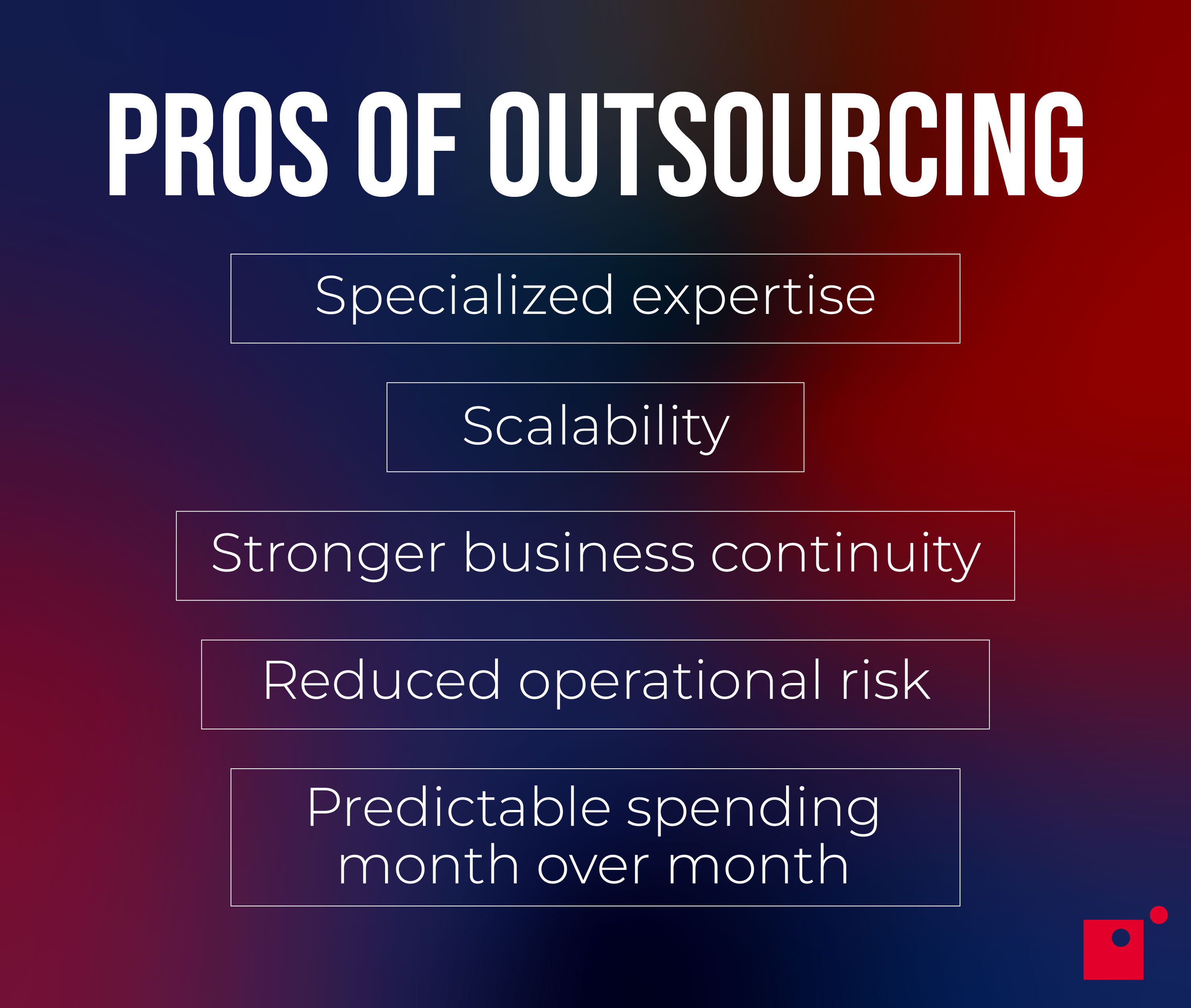
Outsourcing supports businesses by strengthening their technical foundation and reducing the strain on internal resources. The most meaningful benefits include:
- Access to broader expertise: Outsourced teams bring experience across multiple systems, platforms, and environments. This helps organizations handle both routine needs and more specialized challenges without expanding internal staffing or taking on new training requirements.
- Predictable, consolidated costs: Many IT expenses such as maintenance, monitoring tools, patching, and advanced security capabilities, are built into a single service agreement. This gives businesses a clearer sense of what they’re spending each month and reduces the likelihood of surprise costs.
- Reliable coverage and continuity: Outsourcing ensures that essential tasks happen on a consistent schedule. Providers manage updates, monitoring, and incident response as part of their core work, which helps reduce downtime and keeps systems running smoothly.
- Scalable support during periods of change: As a business grows or shifts direction, its technology needs often change with it. Outsourced teams can adjust support levels quickly, allowing organizations to maintain stability without reorganizing internal roles or taking on additional hires.
- Strengthened security posture: Reputable providers track emerging threats, manage patch cycles, and maintain established security protocols. This reduces the risk of overlooked vulnerabilities and supports a more resilient environment without placing additional pressure on internal staff.
Overall, outsourcing gives companies a practical way to keep their technology aligned with their goals while limiting operational strain.
Knowing if Your Business Is Ready to Work with an IT Partner
Companies usually reach a point where internal resources can’t keep up with the operational and security demands of their technology environment. Some of this shows up gradually, such as support requests taking longer to resolve or maintenance tasks slipping in priority. Other times, it becomes clear during periods of growth.
Several indicators tend to signal readiness for an external IT partner. Consistent delays in routine work are often the first sign, especially when staff are balancing technology responsibilities with other operational duties.
Rising downtime or recurring technical issues may also point to gaps that internal teams can’t resolve quickly enough. Security needs add another layer because, as threats evolve, many businesses find it difficult to manage patching, monitoring, and compliance without dedicated support.
Upcoming organizational changes can also influence the timing. Expanding operations, shifting to new systems, or preparing for regulatory requirements often creates a need for more structured planning than a small team can manage.
When long-term strategy becomes difficult to map out, an IT partner can help clarify priorities and align technology with broader business goals.
Recognizing these patterns allows a business to approach outsourcing thoughtfully rather than reactively. Bringing in a partner at the right time helps protect productivity, reduces risk, and creates a more sustainable foundation for future growth.
What to Look for in an IT Partner
Choosing an IT partner works best when you focus on how well a provider can support daily operations, long-term planning, and the security needs of your organization. Key qualities to look for include:
- Clear, documented processes: Providers should have defined workflows for monitoring, maintenance, escalations, and communication. This creates consistency and helps avoid surprises as needs change.
- Breadth of technical expertise: A capable partner can support existing systems while guiding you toward tools or practices that improve stability and security. This includes familiarity with cloud platforms, endpoint management, and modern security standards.
- Transparent communication: Strong partners offer regular updates, maintain thorough documentation, and make it easy for internal staff to stay informed about ongoing work. This clarity reduces confusion and supports better decision-making.
- Strategic guidance, not just reactive support: A good provider helps evaluate risks, plan for lifecycle management, and identify technology decisions that align with business goals. This includes support for budgeting and long-term planning.
- Ability to integrate smoothly with internal teams: Reliable partners adapt to your workflows, respect existing processes, and provide support without creating friction or unnecessary complexity.
These qualities help ensure the partnership delivers stability, reduces operational strain, and keeps technology aligned with broader organizational goals.
Keeping Security Top of Mind
Security is one of the most important factors to evaluate when bringing in an IT partner. Modern environments involve a mix of cloud services, remote access, and constant threat activity, which makes it difficult for internal teams to manage every layer effectively.
Outsourcing adds structure and consistency in ways that help reduce risk without increasing internal workload.
A reliable partner should handle the fundamentals like routine patching, system updates, continuous monitoring, and a clear incident response process. These practices limit exposure to vulnerabilities and make it easier to maintain stability over time.
Experience with compliance or industry‑specific requirements is also valuable. Providers who understand how to manage access controls, documentation, and data handling can help organizations meet obligations without slowing down operations.
Keeping security top of mind means treating it as an ongoing effort supported by consistent processes, not irregular one-off fixes. The right IT partner helps maintain that discipline while allowing the business to stay focused on its core work.
Why Outsourcing with the Right Partner Can Work
Outsourcing works best when the provider can operate as an extension of the business rather than a separate, disconnected service. The right partner brings structure, predictable support, and a level of expertise that complements internal capabilities instead of replacing them.
This creates a balanced model where day‑to‑day needs are covered while longer‑term planning remains steady and informed.
A strong partner helps maintain consistency across the environment by following defined processes for maintenance, monitoring, and issue resolution. This reduces the chance of interruptions and keeps systems running smoothly without adding pressure to internal teams.
And when problems do surface, a well‑aligned provider can respond quickly and address issues with minimal disruption.
Another reason outsourcing can work is the flexibility it provides. The right partner can scale support up or down as operations shift, giving the business room to grow or reorganize without rebuilding internal roles. This helps align IT resources with actual needs rather than fixed staffing constraints.
Strategic input also plays an important role. A capable provider can guide decisions around upgrades, risk management, budgeting, and overall technology direction. This advice helps leaders plan ahead and avoid decisions that create unnecessary expense or technical debt.
When communication is consistent and expectations are clear, outsourcing becomes a dependable way to maintain stability without losing control over the environment.
The relationship works because the provider supports the organization’s goals, not just its technical requirements.
Final Thoughts on Insourcing vs. Outsourcing IT
Both insourcing and outsourcing can support a stable, secure technology environment, but they offer different levels of flexibility, investment, and long-term commitment.
Insourcing gives businesses full control over their systems and processes, which can be valuable for organizations with the resources to staff and maintain an internal team. Outsourcing offers a practical alternative for companies that need broader expertise, predictable costs, and support that can scale as needs change.
The decision often comes down to the structure of the business and the capacity of its internal staff. When workloads grow, security requirements increase, or long-term planning becomes difficult to manage alone, an outsourced partner can provide the consistency and guidance needed to keep operations moving.
With the right provider, businesses gain access to specialized support without losing visibility or control.
Choosing between the two approaches is ultimately about finding the model that aligns with the organization’s goals. When the partnership is intentional and well-structured, outsourcing can serve as a dependable extension of the business and help create a more resilient foundation for future growth.
Learn more about the benefits of working with a full-service provider in Impact’s webinar, What a Real MSP Partnership Looks Like.